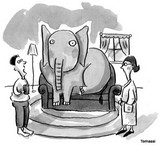
 eBay v. MercExchange is such a short decision, but we are having an exciting time unwrapping the tidy package. Look at the following quote from the decision involving the question of “working” the invention.
[S]ome patent holders, such as university researchers or self-made inventors, might reasonably prefer to license their patents, rather than undertake efforts to secure the financing necessary to bring their works to market themselves. Such patent holders may be able to satisfy the traditional four-factor test, and we see no basis for categorically denying them the opportunity to do so.
This quote invokes division of labor ideals. Certain entities simply don’t have the ways, means, or inclination to manufacture, market, and/or sell their inventions. For those entities, the Supreme Court says that there is no requirement to work the invention. But what about other entities — those with they ways, means, and inclination to work similar inventions? Doesn’t the Supreme Court’s unanimous opinion imply that there is a basis for denying injunctions to large manufacturers who do not actually practice the inventions in the patents that they assert?
More notes on the eBay case:
let me bookmark it
so cool
air jordan retro 1
air jordan retro 2
air jordan retro 3
air jordan retro 4
air jordan retro 5
air jordan retro 6
air jordan retro 7
[http://www.towholesalejewelry.com Wholesale jewelry] [link to towholesalejewelry.com Jewelry wholesale] [link to towholesalejewelry.com Fashion jewelry] [link to towholesalejewelry.com Pandora jewelry] [link to towholesalejewelry.com Titanium jewelry] [link to towholesalejewelry.com Trendy jewelry] [link to towholesalejewelry.com Pearl jewelry]
http://www.cnmeirong.net整形美容
http://www.zgc168.com网站制作
http://www.bjyxns.com模特经纪,模特演出
http://www.guilitec.cn远程抄表
http://www.hxhd.com项目申报,投资融资
http://www.cnmeirong.net整形美容
http://www.zgc168.com网站制作
http://www.bjyxns.com模特经纪,模特演出
http://www.guilitec.cn远程抄表
http://www.hxhd.com项目申报,投资融资
http://www.aypearl.com – Wholesaler of fashion handmade jewellery, beaded jewelry.thousands of fine-quality jewelry with exacting wholesale prices,all the world can enjoy best service from us.
饰品批发 http://www.ayjewelry.com
The quoted statement is SCOTUS’s response to the district court’s idea that irreparable harm can’t be shown in the face of “plaintiffs willingness to license its patents” and ”its lack of commercial activity in practicing the patents”. Further, the statement was given as only one example of a general statement: the broad categorizations made by the district court aren’t in line with traditional notions of equity.
Because of this preamble, I don’t think the justices mean to invoke division of labor ideals as strongly as you suggest. They simply put forth an economic justification for why one class of patent holders might choose licensing. Since large organizations have equally compelling justifications for licensing (opportunity cost for capital investment) or not practicing (selling a similar invention in the same market) there’s no reason why they shouldn’t have similar protection from categorical denial of injunctive relief, so long as they too can satisfy the endorsed four-factor test.
Now, I don’t mean to suggest that your idea of division of labor won’t come into play in a judgement of the ‘irreparability’ of some harm suffered by a large plaintiff, I just don’t think the justices’ example meant to suggest that such plaintiffs could never satisfy the test.
Dennis – The eBay decision certainly puts “working” in the spotlight, and at least opens the door for courts to inject a requirement to work the patent (or practice the invention) into an injunctive relief analysis. In a recent hearing in the House (June 15th, 2006, Patent Trolls: Fact or Fiction), Representative Berman was quick to mention his belief that the Supreme Court got it right in eBay, returning the injunctive relief analysis back “to the standard originally intended.” He recognized this issue regarding a “working” requirement, and explained that the eBay decision, as well as the reform efforts in Congress, are not attempts to impose a working or use requirement on the patentee or to prevent general licensing. According to Representative Berman, that’s “not what we are trying to do here.”
You can read more about that particular hearing, which was conducted a month to the day after the Supreme Court announced its decision in eBay, at the following URL:
link to promotetheprogress.com