McDonnell Boehnen Hulbert & Berghoff LLP

« June 2007 | Main | August 2007 »

Jul 30, 2007

MercExchange v. eBay: Injunction Denied

TomWoolstonMercExchange v. EBay (E.D.Va 2007)

For the second time, Judge Friedman (E.D. Va.) has denied MercExchange’s request for permanent injunctive relief.  Judge Friedman notes that injunctive relief is only available when a plaintiff is suffering current irreparable harm that threatens future irreparable harm. In other words, past injury is not a variable in the injunction calculus — willful or not, what’s done is done and cannot be fixed by an injunction.

No Presumption: As a starting point, the Court found that willful infringement of a patent creates no presumption of irreparable harm.

Irreparable Harm: Although the Court agreed that MercExchange has suffered harm do to the infringement — the harm is not irreparable.  This finding is based on MercExchange’s “consistent course of seeking to maximize the money it can obtain from licensing its patents to market participants.” In particular, after the trial, MercExchange licensed its patents to UBid. (Note: post-trial activity alters decision — focusing on eBay’s media reports).

Suspect Patents = No Injunction?: As a secondary factor, the Court continued its assertion that the potential suspect nature of the MercExchange patents also leads to a denial of injunctive relief:

Furthermore, KSR reveals the Supreme Court’s reservations regarding patents similar to the ’265 patent, the PTO twice issued interim actions rejecting all claims in the ’265 patent as obvious prior to the issuance of KSR.

Monopolist <> Injunction: Finally, the court rejected MercExchange’s argument that eBay’s de facto monopoly position necessarily leads to entry of a permanent injunction.

Injunction Denied

Notes:

  • EBay’s motion for stay pending reexamination was also denied.
  • There is more to this opinion. Including a further discussion of public interest…

Patently-O TidBits

  • Patently-O in the Wall Street Journal [Link Subscription Req’d]
  • Patently-O in the Wall Street Journal Again: “This widely respected patent blog offers thoughtful, sometimes provocative commentary by University of Missouri associate law professor Dennis Crouch and others. Always current. It groups posts according to patent topic and includes reviews of patent cases by year, as well as a patent-related jobs board. Bookmark this one!” [Link Subscription Req’d]
  • Jobs: One of the most innovative patent related companies – Ocean Tomo – recently posted a job offering for General Counsel on our Patent Law Job board. Other recent needs include Vista IP Law Group; Genentech; Black Lowe; Sheridan Ross; Intrexon; and Townsend and Townsend and Crew. Two employers e-mailed this week to note that their jobs had been filled.  In some ways, Job postings are a form of advertising — telling the world that you are successful and growing.
  • Another big job: The USPTO is looking to hire another attorney in the Solicitor’s Office – Help defend the BPAI.
  • A big job fair: Applicants should also consider the AIPLA Job Fair — resumes are due by August 31.
  • Patently-O on Facebook: Virtually meet other Patently-O readers.

New Rules for Patent Appeal Board (BPAI)

The oncoming changes to PTO continuation practice is predicted to significantly increase the number of cases appealed to the PTO’s Board of Patent Appeals and Interferences (BPAI). In an effort to avoid a new bottleneck, the patent office has proposed a new set of rules designed to help the Board “continue to resolve ex parte appeals in a timely manner.”  The rules appear to place more of a burden on applicants to submit appeals that are both clear and precise.

Notes:

  • No public hearing will be held.
  • Comments are due September 28, 2007 to BPAI.Rules@uspto.gov.
  • For further information, contact Fred E. McKelvey or Allen R. MacDonald at 571-272-9797.
  • Read the new rules.

Integra v. Merck: Research Tools Exemption Still Undecided

Integra Lifesciences v. Merck KGaA (Fed. Cir. 2007).

In 2005, this case reached the Supreme Court – who held that the safe harbor created by 35 USC 271(e)(1) “exempted from infringement all uses of patented compounds ‘reasonably related’ to the process of developing information for submission” to the FDA. ‘Reasonably related’ research is determined in a two-part test:

    1. Was the research conducted after the biological mechanism and physiological effect of a candidate drug is reasonably recognized; and
    2. If the research is successful would it “appropriately be included in a submission to the FDA.”

On remand, the CAFC applied the Supreme Court’s legal ruling to find that Merck’s uses of Integra’s patented RGD peptides was not infringement under the 271(e)(1) safe harbor.  In part one of the test for ‘reasonably related the CAFC found that the accused experiments had all been “conducted after it had been discovered that a RGD peptide shrank tumors in an animal model. ” Part two, is satisfied because of the fact that the experiments “yielded data relating to efficacy, mechanism of action, pharmacology, or pharmacokinetics.”

Applying these criteria, there was no evidence at trial in conflict with the evidence that all of the experiments here at issue were conducted after it had been discovered that a RGD peptide shrank tumors in an animal model; indeed, Integra so conceded to the Court. The primary Integra argument on this remand is that the FDA is interested only in safety data at the IND application stage; although that argument was unambiguously disposed of by the Court. At the jury trial, before the Court, and on this remand, Integra does not dispute that the accused experiments yielded data relating to efficacy, mechanism of action, pharmacology, or pharmacokinetics. At the trial the admissibility of the scientific evidence and its premises were not challenged.

In the process of reversing the lower-court’s infringement decision, the CAFC dismissed a number of argument by Integra. For instance, Integra argued only experiments that are “entirely routine” should be subject to the exemption. The CAFC rejected those arguments in turn.

[T]he [Supreme] Court's explanation of the criteria of '271(e)(1), the safe harbor does not depend on a distinction between "discovery" and "routine," but on whether the threshold biological property and physiological effect had already been recognized as to the candidate drug. The Court recognized that experiments are run in order to learn information, whatever the stage of the research.

Research Tools: The court did not discuss the issue of “research tools” because “the parties emphatically confirmed that research tools were not at issue.” (post-hearing letter).

Judge Rader in dissent to Judge Newman’s opinion:

This decision casts a large shadow over patent protection by its overly expansive interpretation of the 35 U.S.C. § 271(e)(1) exemption. In particular, this court today expands the exemption beyond the Supreme Court’s limits on the provision to eliminate protection for research tool inventions.

Rader would have decided the research-tool issue.

Sadly this court does not even examine the patents at issue in this case. This court, noted for its emphasis on claims as definers of patent scope, ironically does not recite or analyze the claims of these patents in the slightest. Moreover this court speaks in broad terms about the experiments and results without specifying which patented compound or method was in use in the experiments. A careful examination of the patents shows that two of them have no application at all outside of a laboratory. If the patents in this case are not research tools, then of course this court could quickly construe the claims and show that they claim drugs or other products likely to undergo FDA clearance, not simply laboratory methods. Unfortunately even a cursory analysis of the patents (undertaken in this dissent) shows that two of them have no application outside the laboratory.

Jul 26, 2007

No Revival For "Unintentional" Missed National Stage Filing Date (Delay Must Be Unavoidable)

Aristocrat Technologies Australia (ATA) v. International Gaming Technologies (IGT) (N.D.Cal. 2007).

ATA originally filed an Australian provisional patent application on July 8, 1997.  Exactly one year later (on July 8, 1998) ATA filed its international PCT Application. In the US, a PCT applicant can wait 30 months to file its national stage application. ATA was actually given an extra two-days because the 30–month deadline of January 8, 2000 fell on a weekend. 

Unfortunately, the January 10, 2000 deadline came and went — The PTO did not receive the national stage conversion until the next day January 11, 2000. By that time, however, the application had been abandoned.

Unable to Correct Filing Date without Proof of Mailing or PTO Receipt: ATA first asked the PTO to “correct” the filing date. This failed when ATA was unable to submit an express mail receipt or other direct proof of submission. The applicant did submit a certificate of mailing, a fee payment check, and a letter from the patent attorney that all indicated a January 10 filing date — these, however, did not pass muster with the PTO.

Revival for Missed National Stage: ATA was then able to revive the application by showing that the “entire delay” in filing the appropriate papers “was unintentional.” 

During litigation, IGT challenged the PTO’s unintentional revival standard. In particular, 35 USC 371, which defines abandonment for failure to comply with national stage requirements, only allows for revival when a failure was “unavoidable.”

Failure to comply with these requirements shall be regarded as abandonment of the application by the parties thereof, unless it be shown to the satisfaction of the Director that such failure to comply was unavoidable. 35 USC 371.

The “unavoidable” standard is much higher than that for “unintentional” abandonment. And clearly, the applicant did not show that the delay was unavoidable.

Summary Judgment of Invalidity

For the foregoing reasons, the Court GRANTS Defendant's Motion for Summary Judgment and finds that Defendants have shown, by clear and convincing evidence, that both patents in suit are invalid because the '215 Application was abandoned, and not lawfully revived.

Notes:

  • This case has implications for Sections 371, 133 and 151.
  • Statutory provisions for revival due to unintentional abandonment:
    • 35 USC 111: Failure to submit fee and oath of a patent application;
    • 35 USC 41: Fee schedule for revival of unintentionally abandoned applications. This section provides a specific fee for revival of unintentionally abandoned applications as an explicit alternative to revival of unavoidably abandoned applications; and
    • 35 USC 122: Abandonment due to failure to rescind nonpublication request.
  • Statutory provisions that only refer to revival due to unavoidable abandonment:
    • 35 USC 133: Abandonment due to failure to respond to PTO notice (Normally a 6–month deadline, but may be less);
    • 35 USC 151: Revival for failure to pay issue fee; and
    • 35 USC 371: Failure to comply with national stage filing requirements.
  • PTO Rules:
    • 37 C.F.R. 1.137(b) provide for revival of applications based on an applicant’s unintentional delay in replying. Under the rule, abandoned applications, reexamination prosecution terminated under §§ 1.550(d) or 1.957(b) or limited under § 1.957(c), or lapsed patents may all be revived under this standard.  The PTO rules are, however, subordinate to statutes.
  • Caselaw:
    • Lumenyte v. Cable Lite (Fed. Cir. 1996): Patentee had revived case as unintentionally abandoned. The CAFC affirmed the ruling without questioning whether such revival is ever permissible.
    • Morganroth v. Quigg (Fed. Cir. 1989): Affirming that the Director does not have authority to revive an unintentionally abandoned patent application “that resulted from the applicant's failure to appeal from a final district court judgment that upheld the Commissioner's prior refusal to issue a patent.”
    • New York Univ. v. Autodesk, Inc., 2007 U.S. Dist. LEXIS 50832 (SDNY 2007): The court found that the delay in reviving was not even unintentional. The court explicitly did not reach the question of whether revival for unintentional abandonment due to failure to respond to an office action is even permitted. (Remember, 35 USC 133 only allows for revival of unavoidably abandoned applications.)
    • Field Hybrids v. Toyota (D.Minn 2005).
  • Admin Law: There are a number additional admin-law issues in the case for those interested.
  • Tech-Law-Forum discussess the case [LINK]
  • Read the case [LINK]

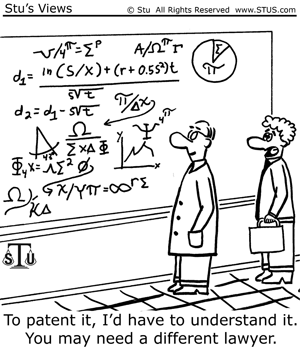
Hiring a Patent Attorney?

PatentCartoon

(Published with permission from Stu’s Views).

Jul 25, 2007

Patent Continuation Changes: "No earlier than October 1, 2007"

The PTO provides the following notice: [LINK]

On July 9, 2007, OMB concluded its review of the Continuations and Claims rule changes. The final rules will be made public when they are published in the Federal Register, which is expected to be later this summer. The rules will become effective at least 60 days after publication in the Federal Register, and no earlier than October 1, 2007.
The IPO provides the following report:
PatentLawPic006PATENT CONTINUATION AND CLAIMS RULES EXPECTED TO BE IN EFFECT IN OCTOBER -- At a conference in New York yesterday, a speaker from the USPTO said the new patent rules on continuation applications and numbers of claims are expected to be published in August and in effect in October. IPO believes the rules are likely to be less severe than those that were published for comment in 2006.
According to an internal e-mail published on the Patent Hawk site: [LINK]


An internal USPTO team is currently working on details of implementing the rule changes. Examiners and managers will be given information and training on the new rules once they are published in the Federal Register. Additionally, management is currently discussing with POPA the appropriate process for negotiating any impacts the rules package may have.An internal USPTO team is currently working on details of implementing the rule changes. Examiners and managers will be given information and training on the new rules once they are published in the Federal Register. Additionally, management is currently discussing with POPA the appropriate process for negotiating any impacts the rules package may have.


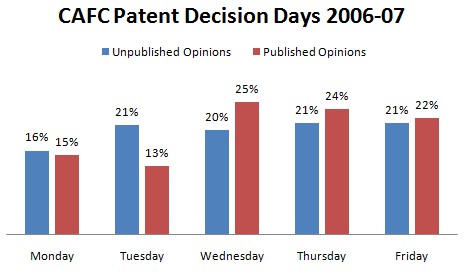
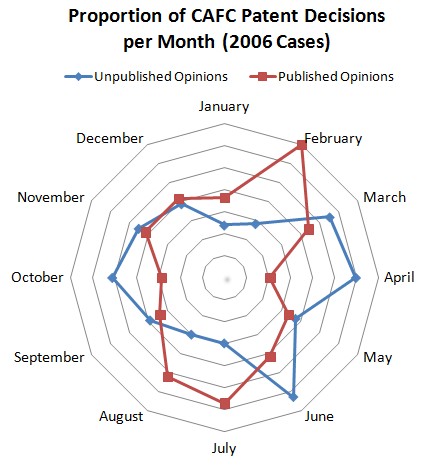
When are CAFC Opinions Released?

Patent.Law014

Patent.Law017

This data is incedental to other research that I’m working-ona and may be important for investors.  Each topo-level in the graph represents 2%. “Published Opinions” are precedential opinions. “Unpublished Opinions” include both non-precedential written opinions and decisions released without opinion.

Jul 24, 2007

Patently-O TidBits

  • Please send me your write-ups and client-alerts regarding McKesson. I’m looking for your approach to the issues. dcrouch@gmail.com.
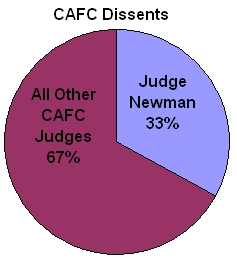
  • PatentLawPic003Over the past 25 years approximately 350 CAFC case decisions include dissenting opinions.  Judge Newman is clearly the most prolific dissenter both in terms of absolute numbers and relative rate. Judge Newman has penned 115 of the dissents — 33% of the total, and her dissent rate per year on the court (4+) is almost double the nearest other judge.  Judge Moore may be the rising alternative voice. In less than a year of service, she has already filed two dissents. (Source – Lexis search).
  • Aharonian v. Gutierrez continues rolling along. Patent commentator and activist Greg Aharonian along with David Pressman, David Lentini, and Steve Morsa filed suit against the Government earlier this month. The charge: Margaret Peterlin’s apointment as PTO deputy director was “illegal and an abuse of discretionary power.”  In particular 35 U.S.C. 3(b) requires that the deputy directory have “a professional background and experience in patent or trademark law,” and there has been no showing that Peterlin had any such qualifications prior to taking the job.  Of course, after serving for two months as deputy director, she now does have experience. Like Director Dudas and your Patently-O author, Ms Peterlin graduated from the University of Chicago Law School.
  • The anonymous Patent Troll Tracker has an interesting post on the shift in patent filings from the Northern District of California to the Eastern District of Texas. 2006 was the first year that more patent cases were filed in the EDTX than in the NDCA. Projected 2007 numbers have EDTX with more than twice the number of patent cases as NDCA. [LINK].
  • Patent Law Jobs — One way to track potential law jobs is through an RSS link. http://feeds.feedburner.com/PatentLawJobs.
  • Patently-O on Facebook: Connect with Patently-O readers.

Patented Method of Arbitration :

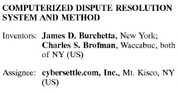
PatentLawPic005Cybersettle v. National Arbitration Forum (NAF) (Fed. Cir. 2007) (non-precedential)

Cybersettle owns the patent on a computerized dispute resolution method. Disputing parties make settlement bids into a computer. If there is a close-enough match between the parties, the case is settled. A party may pre-submit multiple bids to be used in consecutive bidding rounds.

The National Arbitrators Forum (NAF) is a private corporation that handles arbitration and was sued for infringement — apparently after conducting 100,000+ such resolutions. NAF lost its infringement suit, but appealed on claim construction.

Cybersettle’s claimed method includes the steps of “receiving a plurality of demands [and] a plurality of settlement offers.” The lower court, however, did not require the receipt of multiple offers and demands. Rather, the claim was construed to be satisfied if the system “has the capacity to receive multiple offers and demands, even if ony one demand and one offer are received.”

On appeal, the CAFC reversed, finding that a claimed method requires actual practice of the method — not simply the capability.

A patented method is a series of steps, each of which must be performed for infringement to occur. It is not enough that a claimed step be “capable” of being performed.

On remand, the district court will need to determine what portion of NAF’s infringing actions included multiple offers and demands.

In the course of their operation, the accused … systems would infringe (assuming all the other claim limitations were satisfied) only when they received multiple demands and multiple offers; proof that those systems were capable of receiving multiple demands and multiple offers is not proof that they ever performed the claimed methods.

Vacated and remanded.

Notes:

  • National Journal (Andrew Noyes) previewed the case on July 9, 2007. [LINK]
  • Interestingly, the opinion offered no discussion of patentable subject matter issues.
  • The patent [LINK]

Jul 23, 2007

Are Administrative Patent Judges Unconstitutional?

DuffyIn his recent essay [LINK], Professor John Duffy raises the shocking point that since 2000, the appointment process of BPAI Judges has been unconstitutional. Generally, administrative officers must be appointed by a cabinet level official. Under 35 U.S.C. 6, however, the PTO director appoints the board. This disconnect, created by the 1999 patent reform measures, creates a serious constitutional problem.

If Professor Duffy is right (1) the law must be changed; (2) recently appointed BPAI judges will need to be re-appointed in a proper manner; and (3) any pending BPAI appellant could raise the issue as a challenge to BPAI authority so long as the panel includes recently appointed judges.

In re Metoprolol Succinate Patent Litigation (Fed. Cir. 2007).

Astra holds the patent on Toprol-XL (Metoprolol succinate) and sued several generic ANDA filers. On summary judgment, a Missouri Federal court held Astra’s patent invalid for improper obvious-type double patenting and unenforceable. Astra appealed for inequitable conduct during prosecution.

Double-Patenting: A later patent claim will be invalid for obviousness-type double patenting if it is not patentably distinct from an earlier claim from a commonly-owned patent. This analysis involves construction of both sets of patent claims.

[T]he critical inquiry remains whether the claims in the [prior] application define an obvious variation of the invention claimed in the … patent [at issue].

Normally, obviousness-type double patenting is avoided by filing a terminal disclaimer. Here, however, a secret inventorship and ownership dispute prevented such action.

Invalidity affirmed.

Inequitable Conduct: On summary judgment, the district court also found the patent unenforceable based on Astra’s failure to notify the PTO of the inventorship dispute during prosecution.  Inequitable conduct, however, is rarely found on summary judgment. Here, the CAFC saw potential holes in proof of intent — finding that the “district court erred in equating the presence of an incentive with an intent to deceive on summary judgment.”

Dissent: Judge Schall dissented

Declaratory Judgment Jurisdiction Denied in Biotech Research Patent Case

Benitec Australia v. Nucleonics (Fed. Cir. 2007)

Benitec’s infringement suit against Nucleonics was derailed by several factors. Perhaps most critically, the Supreme Court’s Merck v. Integra decision expanding the research exemption of 271(e)(1) left Benitec with no viable infringement claim. Benitec voluntarily dismissed its claims against the defendant Nucleonics and also issued a covenant not to sue for Nucleonics current activities. (Covenant submitted within its appeal opposition brief).

In the meantime, Nucleonics had filed declaratory judgment counterclaims — asserting invalidity and unenforceability.  Nucleonics wants the patent invalidated to remove any investor concerns regarding future products.  On appeal, the CAFC determined whether DJ jurisdiction still exists in this case.

The Supreme Court’s jurisdiction requires “a substantial controversy, between parties having adverse legal interests, of sufficient immediacy and reality to warrant the issuance of a declaratory judgment.” MedImmune.

DJ jurisdiction clearly existed at the time of filing. However, when the controversy disappears, so does jurisdiction. Here, the CAFC found that the controversy was gone and that Nucleonics “future work” was too speculative and might not be infringing anyway.

We also recognize that Nucleonics wishes to receive the benefit of a ruling on the validity and scope of Benitec’s patent now, while Nucleonics undertakes any nascent animal work. There is currently, however, no “substantial controversy, between [Benitec and Nucleonics], of sufficient immediacy and reality to warrant the issuance of a declaratory judgment.” MedImmune, 127 S. Ct. at 771. And there may never be. Although Nucleonics lost the appeal, it certainly won a major victory by forcing Benitec to issue a covenant not to sue.

Dismissal affirmed.

In Dissent, Judge Dyk would have allowed the DJ case to continue:

Supreme Court precedent requires that, if a patentee files an infringement lawsuit and the particular claim of infringement is mooted, a counterclaim for invalidity should not be dismissed unless the patentee demonstrates that there is no possibility of a future controversy with respect to invalidity. See Cardinal Chem. Co. v. Morton Int’l, Inc., 508 U.S. 83, 98 (1993). In my view, Benitec made no such showing.

Notes:  

  • Sitting by designation, Judge Whyte penned the opinion. This is only the second CAFC opinion where a judge sitting by designation cast the deciding vote, and is the only CAFC case where a judge sitting by designation penned an opinion and another judge dissented.  The N.D. California IP Bar has often called for Judge Whyte’s appointment to the CAFC. This opinion my provide some guidance as to his potential jurisprudential conduct.
  • Although formally a loser, Nucleonics’ appeal forced Benitec into issuing a covenant not to sue — a major litigation victory.

Jul 19, 2007

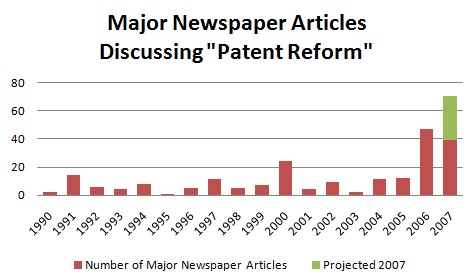
Patent Reform 2007

Patent.Law013

The LexisNexis Major Newspaper database includes most large market newspapers.  The database was searched for articles discussing “patent reform.” 

In today’s news, are the reports that the House Bill is out of committee. However, without major coalition building amendments, the legislation is unlikely to become law.

BPAI Pecedential: Obviousness of a Combination

Pay_by_touchEx parte Catan (BPAI 2007).

Catan’s invention involves using a bioauthentication device (e.g., fingerprint scanner) to authorize credit-account orders. On appeal, the Board of Patent Appeals & Interferences (BPAI) affirmed the Examiner’s finding of obviousness based on a combination of references. 

As we know, a combination of familiar elements used according to known methods is probably obvious unless it yields unpredictable results. Obviousness determinations at the PTO are, at least theoretically, made easier by giving claim terms “their broadest reasonable construction.” In Catan’s case, for instance, the claimed ‘consumer electronic device’ could reasonably include a combination of base and remote stations communicating over a wireless network. (no “local” requirement).

Two pieces of prior art were presented: Nakano disclosed everything except that a password was used instead of the bioauthentication device, and Harada disclosed a fingerprint scanner. A third reference, Dethloff, taught that bioauthentication can substitute for a password.

This really is an easy example of obviousness:

“The claim is to a structure already known in the prior art that is altered by the mere substitution of one known element for another element known in the field for the same function. The facts themselves show that there is no difference between the claimed subject matter and the prior art but for the combination itself.”

The Board goes-on to say that the linking-reference (Dethloff) was not necessary, but it makes the case against the applicant even tighter. Motivation for the combination is also found in Harada, which also discusses various types of authorization techniques.

Notes:

  1. This case would probably have been affirmed before KSR.
  2. Reasons for combining prior art must still be explained.
  3. Winners provide at least some “unpredictable results.”  (What could this applicant have argued? – some potential credit users are fearful of losing their password and others are especially prone to forgetting their password. . . the invention opens protected credit transactions to a whole new segment of the population. A $20k study could probably support this theory…)

Jul 18, 2007

Patent Reform: Required Pre-Filing Search and Patentability Analysis

The PTO’s accelerated examination program (formerly petition to make special) requires that the applicant conduct a prior art search and provide an extensive discussion of how the submitted prior art relates to each claim. As mentioned in earlier Patently-O posts, I expected that the program somewhat of a prototype — if all goes well, the PTO may require a preliminary search and discussion of prior art findings for all cases.

The future is here: The recently amended Senate Bill includes orders for the PTO Director to require search reports and patentability analyses for all filed applications (except for those filed by “micro-entities”).  Failure to submit a report would result in abandonment.  A new 35 U.S.C. Section 123 would read as follows:

“The Director shall, by regulation, require that applicants submit a search report and other information and analysis relevant to patentability.  An application shall be regarded as abandoned if the applicant fails to submit the required search report, information, and analysis in the manner and within the time period prescribed by the Director.  Applicants from micro-entities, as defined in section 124 of this title, shall not be subject to the requirements of any regulations promulgated pursuant to this section.”

In the past, IPO President Marc Adler has suggested on his blog that patentees should conduct pre-filing searches. [LINK]. Of course. Mr. Adler’s comments suggest only a voluntary system.

Notes:

Exam Question: Prior User Rights?

The currently pending patent reform bill would create an expanded prior user defense to patent infringement.  Under the proposal, an accused infringer would not be liable for infringement if it had been commercially using the invention at least one year before the patent application filing date. The defense would extend to affiliates and assigns.

However, an invention that in commercial use more than one year before the filing date would usually be found unpatentable as anticipated. Can you provide example situations where prior user rights might be important?

Jul 17, 2007

Ex Parte Kubin: Overcoming the Deuel

Ex Parte Kubin (BPAI 2007) (Precedential)

Kubin’s patent claims are directed to a cDNA molecule (NAIL) that serves as an NK cell surface marker. During examination, the examiner found them obvious. On appeal to the Board of Patent Appeals and Interferences (BPAI or Board), the applicant constructed an argument based on In re Deuel (Fed. Cir. 1995), that its cDNA claims cannot be “made obvious by mere knowledge of a desired protein sequence and methods for generating the DNA that encodes that protein.” (Quoting Deuel). 

The Board, however, affirmed the rejection, finding the claims invalid because the cDNA structure would have been “obvious to try.”  This case likely eviscerates any strength still remaining in Deuel.

[T]he Supreme Court recently cast doubt on the viability of Deuel to the extent the Federal Circuit rejected an “obvious to try” test. Under KSR, it’s now apparent “obvious to try” may be an appropriate test in more situations than we previously contemplated. . . .

Thus, isolating NAIL cDNA was “the product not of innovation but of ordinary skill and common sense,” leading us to conclude NAIL cDNA is not patentable as it would have been obvious to isolate it.

Kubin’s claims were also challenged on enablement and written description because they claimed only 80% identity with the described DNA sequence.

On enablement, the Board noted a parallel from its obvious to try analysis. Although there are certainly caveats, the Board appears to have held that a compound that is obvious to try is necessarily enabled because it would not require undue experimentation to make and use the invention.

The amount of experimentation to practice the full scope of the claimed invention might have been extensive, but it would have been routine. The techniques necessary to do so were well known to those skilled in the art.

Written Description: On the other hand, the Board found that “appellants did not describe the invention [] sufficiently to show they had possession of the claimed genus of nucleic acids.”

Rejections affirmed on obviousness and written description.

Notes:  

  • This is one of two precedential BPAI opinions for 2007.
  • The application appears to be owned by Immunex, a company now owned by Amgen after a $17B purchase.

35 U.S.C. 101: Patentable Subject Matter

In his most recent “top-ten” paper — Hal Wegner identifies four pending appeals that challenge the court’s current broad patentable subject jurisprudence:

  • In re Nuijten (SN 09/211,928);
  • In re Comiskey (SN 09/461,742);
  • In re Bilski (SN 08/833,892);
  • In re Ferguson (SN 09/387,823)

It is quite possible that something from this set of cases will eventually produce a Supreme Court decision. In 2006, the Supreme Court initially granted certiorari on the issue of subject matter patentability in Metabolite v. LabCorp. That case was later dismissed without decision (as improvidently granted).  However, a block of justices appear ready to apply new subject matter limits once the right case comes along.

In Nuijten, the PTO refused to issue a patent on a novel type of signal unless the patentee included a limitation directed to a specific mode of transmission (e.g., smoke signal, electromagnetic, etc.). Nuijten argues that bares signals should be patentable subject matter under Section 101. That case was argued in February 2007, and a decision is expected soon. IPO’s brief supports Nuijten and broad application of patentable subject matter.

In Comiskey, the CAFC requested supplemental briefing on patentable subject matter issues. The claims involve a method of handling arbitration (that does not require any machine assistance).  Section 101 was not raised by the Examiner, Board, or PTO Solicitor, but was raised sua sponte by the CAFC. During the appeal, the PTO representative indicated that Comiskey was successful in the current appeal (on obviousness) that the PTO would likely raise 101 issues on remand.

Bilski similarly involves claims to a method of managing risk, but is not tied to any particular form of technology – such as an electronic computer. AIPLA’s amicus brief supports Bilski and a broad interpretation of patentable subject matter. Briefing is now complete, but arguments have not been scheduled.

Ferguson is still in the briefing stage. (Ferguson’s opening brief, filed last week, was rejected as non-compliant). Although not yet public, Ferguson’s claims apparently claims a method “of marketing a product.”  Fish & Richardson is handling the appeal.

Notes:

Jul 15, 2007

Do Patents Discourage Innovation?

Meurer_white_65wTwo former Boston University Law School Colleagues occupied New York Times headlines on Sunday in a discussion of the economics of patent law.   Michael Meurer and Jim Bessen are both economists and both law professors. Over the past few years, the pair has compiled a tremendous amount of economic data regarding patents and companies who patent.

Meurer & Bessen’s bottom line: On average, the patent system is bad for innovation.  They agree innovator firms often profit from their own patents. However, the pair’s data shows that the innovator firms are also the ones most likely to be targeted by other patent holders. (litigation, licensing, etc.) In today’s system, they find, the disincentives created by other people’s patents outweighs the incentives to build your own portfolio.  I.e., on average, the patent system discourages innovation. (Patents do a much better job in pharmaceuticals and much worse job in IT.)

Bessen_jamesMeurer & Bessen do not suggest dismantling the patent system — rather, they believe that a number serious reform measures are needed to shift the balance back to a positive state where patents incentivize innovation.

Their reform proposals call for clear predictable patent boundaries — something that every patent practitioner knows is a serious problem. Unfortunately, the current reform proposals hardly even touch this major issue.

Their book, Do Patents Work?, will be out in 2008 (Princeton). For now, you can find snippits of the research at the following links:

Jul 12, 2007

Reasons for Allowance Do Matter

Pharmastem_licensed2PharmaStem Therapeutics, Inc. v. Viacell, Inc. (Fed. Cir. 2007)(Read Part I of our analysis)

In addition to regular examination, the asserted patents had also been reexamined by examiners at the PTO.  Later, during litigation, several already cited references were used by courts as invalidation tools.

Patents are given a presumption of validity.  When previously considered references are asserted in an invalidity defense, the presumption of validity is even stronger.  Courts reason that such a challenge “bears the added burden of overcoming the deference that is due to a qualified government agency presumed to have done its job.” 

Here, however, the CAFC gave little weight to the Examiner’s review of references after finding a misstatement in the Examiner’s reasons for allowance.

The examiner … summarized her analysis of the prior art by stating that none of the cited references “addresses the presence of hematopoietic stem cells in umbilical cord or placental blood, that these cells may successfully be cryopreserved, or that, as a collection from a single human at birth, these cells may comprise an amount that is sufficient to effect hematopoietic reconstitution of a human adult.” That explanation is flawed for three reasons. First, as we have explained, the prior art references and the admissions in the specification address the presence of hematopoietic stem cells in cord blood, even though the references may not conclusively prove their presence. Second, Koike established that cord blood could be cryopreserved without substantial losses in the population of progenitor cells; the inventors contributed nothing more with respect to cryopreservation, as their mouse experiments were not performed with cryopreserved blood. Third, while the joint specification states that the amount of cord blood obtained at the time of birth would often be sufficient to transplant an adult, the inventors reached that conclusion simply by comparing the known properties of bone marrow against the results of routine testing of their own cord blood samples.

Although left ambiguous, it appears that the flaws in the Examiner’s final analysis gave the courts reason to take an entirely fresh look at the references in question.

Patently-O TidBits

Three blogs I (re)started reading today:

Patently-O Jobs continues to grow rapidly. 100,000 views in less than two weeks. Most popular categories:


Jul 11, 2007

Continuation Changes: Where we stand and What to Do

600px-Seal_Of_The_President_Of_The_Unites_States_Of_America_svgCurrent status of the USPTO’s changes to continuation and claiming practice:

  1. Rules Approved: Two sets of final rules have been approved by the Bush administration (OMB).
  2. Preliminary Rules Softened?: The preliminary rules published by the PTO limited the number of continuations that could be filed based on any given invention (continuation limitations) and also limited the number of claims per application that would be examined (claim limitations).  Unsourced leaks from within the PTO indicate that the final approved rules are somewhat softened from those originally released. The exact content of the final rules will not likely be available until the PTO publishes them in the Federal Register.
  3. Potential Rules: Hal Wegner and others have indicated that the new rules will potentially limit continuations for new applications to one RCE and two continuations. Further continuations would likely be available after showing cause. For applications already filed, the PTO may allow three continuations. Claim may be limited to twenty-five total claims, five of them independent.
  4. Timing: The PTO apparently has the green-light to move forward. The rules can become effective within 30–days of publication in the Federal Register.  My expectation is that the publication will occur in the range of Aug-Oct and the effective date will be in the range of Sept-Nov.
  5. Currently Pending Applications: It is almost certain that currently pending applications will fall within the continuation rules.  The currently pending applications will likely be allowed a third continuation. However, there are some indications (rumors) that recently filed applications (that have not yet received an office action) will be limited to two continuations. Any continuations filed after the rule change will fall within the claim-number limitations.
  6. What to do now?: Many companies have reportedly already filed continuation applications in the hope of avoiding some of rule-change sting.  That approach appears prudent – especially for valuable cases where multiple continuations have already been filed. You may want to talk with David Boundy (DBoundy@Cantor.com) about fighting the rules and Kevin Noonan (noonan@mbhb.com) about how your company should handle the rule changes. It appears that neither the IPO or AIPLA are actively opposing the rule changes.


Best Book for Learning Patent Law Practice?

A skilled and motivated paralegal or assistant can more than double the effectiveness of a patent prosecution office. A Patently-O reader and new prosecution paralegal recently submitted the following question:

Hi, I'm currently working as a Paralegal in an Intellectual Property in-house legal department. Can you please tell me what will be the best book to learn patent prosecution from start to finish? I want to know dates, categories, subject matter (i.e., issued, published, granted and so forth).

Suggestions for our reader? Are there particular conferences or workshops best suited for paralegals and assistants?

Jul 10, 2007

OMB approves proposed changes to continuation practice.

The ORIA has concluded its review of the PTO proposed rules with approval . . .finding them “consistent with change.”

Links:

=====

AGENCY: DOC-PTO RIN: 0651-AB93
TITLE: Changes to Practice for Continuing Applications, Requests for Continued Examination Practice, and Applications Containing Patentably Indistinct Claims
STAGE: Final Rule ECONOMICALLY SIGNIFICANT: No
RECEIVED DATE: 04/10/2007 LEGAL DEADLINE: None  
** COMPLETED: 07/09/2007 COMPLETED ACTION: Consistent with Change
AGENCY: DOC-PTO RIN: 0651-AB94
TITLE: Changes to Practice for the Examination of Claims in Patent Applications
STAGE: Final Rule ECONOMICALLY SIGNIFICANT: No
RECEIVED DATE: 04/10/2007 LEGAL DEADLINE: None  
** COMPLETED: 07/09/2007 COMPLETED ACTION: Consistent with Change

Notes: Thanks to Brad Pedersen for the tip.

CAFC: Proving Utility Is Not Inventive

PharmaStem Therapeutics, Inc. v. Viacell, Inc. (Fed. Cir. 2007)

PharmaStem sued six defendants for infringement of its broadly written patents covering cryopreserved umbilical cord stem cells useful for hematopoietic reconstitution. The defendants offer cryopreservation of umbilical cord blood to serve the donor later in life. A jury found infringement and validity, but the district court set aside the verdict — holding that the patents were not infringed.

Defendant’s Ads Not Specific Enough: The defendants advertised that their product would aid in hematopoietic reconstitution. However, the district court found (and the CAFC agreed) that the ads were insufficient to serve as an admission that the stem cells were "in an amount sufficient to effect hematopoietic reconstitution of a human adult" as required by the claims. This decision stands to reinforce the principle that a patentee must prove infringement of every limitation of every element of any asserted claim.

Infringe the Whole Claim: PharmaStem’s method claims include collecting, preserving, and using the stem cells .  The defendants, however, are only responsible for collecting and preserving the cells. Transplant physicians do the rest.

PharmaStem argued contributory infringement under 271(c) — alleging that the defendants sold or offered to sell a component of a patented method especially adapted for infringement. Of course, the defendants do not sell stem cell blood — rather they are “merely bailees”. Because 271(c) requires sale of a product, there is no infringement here.

Invention is Obvious: When asserting obviousness based on a combination of prior art references, the patent challenger must show that a PHOSITA “[1] would have had reason to attempt to … carry out the claimed process, and [2] would have had a reasonable expectation of success in doing so.”

Reason to attempt:

In view of the prior art references, the first part of that test is plainly satisfied here. The idea of using cryopreserved cord blood to effect hematopoietic reconstitution was not new at the time [of filing]. Two of the prior art references…suggest using cord blood for that purpose. Two others…suggest cryopreservation and storage of the cord blood until needed. Accordingly, this is not a case in which there is any serious question whether there was a suggestion or motivation to devise the patented composition or process.

Expectation of Success: The inventors appear to have conclusively proven that umbilical cord blood is capable of hematopoietic reconstitution.  Unfortunately for them, completing a proof is not necessarily inventive. Rather, prior scientists strong suspicion of the capability creates an expectation of success so strong that “no reasonable jury” could find the patent valid.

While the inventors may have proved conclusively what was strongly suspected before—that umbilical cord blood is capable of hematopoietic reconstitution—and while their work may have significantly advanced the state of the science of hematopoietic transplantations by eliminating any doubt as to the presence of stem cells in cord blood, the mouse experiments and the conclusions drawn from them were not inventive in nature. Instead, the inventors merely used routine research methods to prove what was already believed to be the case. Scientific confirmation of what was already believed to be true may be a valuable contribution, but it does not give rise to a patentable invention.

Holding: Patent is invalid and not infringed.

[More to come on this case]

Jul 08, 2007

CAFC Patent Appeal Statistics

The Court of Appeals for the Federal Circuit (CAFC) has created a new page of statistics.

  • Approximately 34% of CAFC decisions were patent cases. [LINK]
  • Patent appeals are less likely to settle pre-decision than other cases. [LINK]
  • Statistics for patent cases (9/05 – 9/06):
    • Total terminated: 496
    • Total terminated on merits: 278 (56%)
    • Of those terminated on on merits:
      • Percent affirmed: 60%
      • Percent affirmed-in-part: 20%
      • Percent dismissed: 3%
      • Percent reversed: 13%
      • Percent other: 4%
      • [LINK]
  • Check-out the CAFC Stats: [LINK]
  • See also PatStats.org

Jul 06, 2007

Further Limitations on Doctrine of Equivalents: Equivalent Foreseeable if Disclosed in Relevant Art

Patent.Law012Festo Corp. v. SMC Corp. (Fed. Cir. 2007).

In 1988, Festo sued SMC for infringement of its magnetized pistons.  Since then, the CAFC has issued numerous Festo opinions including two en banc. The Supreme Court has also ruled twice. This appeal, like many of the others involve the scope and limits of the doctrine of equivalents (DOE).

Doctrine of Equivalents: While patent claim language traditionally defines the patent right, the doctrine of equivalents occasionally allows for a finding of infringement even when an accused product falls outside the literal limits of claim language.  More particularly, DOE applies when a claim limitation differs insubstantially from the accused product or if the accused element performs the substantially same function in substantially the same way with substantially the same result (function/way/result test).

Prosecution History Estoppel: A narrowing claim amendment made during prosecution creates a presumption that the element should be narrowly interpreted — legally precluding application of the DOE.  In its 2002 Festo decision, the Supreme Court noted three exceptions that would allow for DOE infringement even after a narrowing amendment: (1) the equivalent was unforeseeable; (2) the reason for the narrowing amendment was only tangentially related to the equivalent; or (3) “some other reason…”.

Foreseeable Equivalent: In this case, Festo’s amendment was narrowing, but the patentee argued that SMC’s equivalent was unforeseeable to one of ordinary skill at the time of the amendment. The question was whether the accused product’s aluminum sleeve was a foreseeable alternative of the claimed magnetizable sleeve.  Aluminum sleeves were already well known in the art, but Festo argued unforeseeability because no PHOSITA knew that the aluminum sleeve would serve as a magnetic shield (the function of the sleeve). This unknown function — according to Festo — made the use of aluminum unforeseeable. In its briefs, Festo attempted to find a requirement for functional foreseeability in the function/way/result test of DOE.

The CAFC rejected Festo’s argument and instead found that foreseeability should be broadly interpreted — finding “that an alternative is foreseeable if it is disclosed in the pertinent prior art in the field of the invention.  In other words, an alternative is foreseeable if it is known in the field of the invention as reflected in the claim scope before amendment.” This result follows the court’s 2003 en banc decision that later developed and nonanalogous technology are “usually not foreseeable” — but that equivalents already known in the relevant field are generally foreseeable.

Here, the CAFC went a step further — implying that the question of whether a PHOSITA could have known the suitability of a particular a alternative is not relevant to the question of foreseeability.

“An equivalent is foreseeable if one skilled in the art would have known that the alternative existed in the field of art as defined by the original claim scope, even if the suitability of the alternative for the particular purposes defined by the amended claim scope were unknown.”

Consequently, the aluminum sleeve was seen as foreseeable – and thus prosecution history estoppel applies to block the doctrine of equivalents.

Dissent: Judge Newman dissents – noting that the opinion is “confound[ing]”, “incorrect”, and “futher erodes the residue of the doctrine of equivalents.”

Jul 04, 2007

4th of July Predictions

Here are my predictions:

  1. Although committee meetings will continue, substantive legislative patent reform is dead for 2007. There is simply too much opposition and too many varied viewpoints.
  2. Despite strong opposition, the proposed continuation rule changes will be implemented.

Happy Independence Day!

CAFC: General Purpose Computer Does Not Include RISC Processor

Patent.Law001Hutchins v. Zoll Medical (Fed. Cir. 2007)

[Updated] Hutchins is an individual inventor and represented himself pro [se] before the district court and on appeal. Hutchins’ patent relates to computer aided CPR. (U.S. patent no. 5,913,685). The district court granted summary judgment of noninfringement in favor of Zoll.

Hutchins lost on claim construction — with the courts holding that a “general purpose computer” does not include the RISC processors. The prosecution history made this finding easy as the “general purpose computer” limitation was added during prosecution to avoid “similar devices with dedicated microprocessor units.”

Patent Law Jobs by Patently-O

On July 1, Patently-O released its new job site: Patent Law Jobs by Patently-O. The site already has thirteen new job postings that have been viewed by several thousand patent law prospects. 

As usual with Patently-O, function predates style. We have job opportunities and patent professionals who need jobs. In the coming days, we’ll be working on a prettier design.

Hopefully, we can serve as a match-maker for each of these potential employers.

If you need patent help, please forward this info to your recruiting coordinator!

Notes:

  • Patent Law Jobs: www.patentlyo.com/jobs
  • Job Submissions: Post a patent law job
  • E-mail me comments (dcrouch@gmail.com)
  • Job postings are also going-out on the news wires via Google news. (not guaranteed…)
  • New job offers can always be found in the right sidebar on Patently-O. New jobs will also be included in the Patently-O e-mail service.

Jul 03, 2007

Honeywell as Lexicographer: Heading Defined as Bearing

Honeywell v. Universal Avionics (Fed. Cir. 2007).

GulfstreamHoneywell holds a patent covering a final-approach flight warning system. The novel system was able to determine whether the flight was in its final-approach without relying upon wing flap position. Universal’s TAWS system is allegedly infringing. After claim construction, a jury found infringement.

Honeywell’s claim discussed the “heading” of the aircraft in one element of the claim. The drafter should have used “bearing” instead because the focus was on the aircraft’s relative direction.  On appeal, the CAFC determined that the specification did its job of redefining heading and thus, allowed the court to define heading as the bearing.

The specification of the ’436 patent clearly communicates the meaning the patentees have assigned to the term “heading.” It does so by describing the claimed system’s alignment determination as depending on the direction of the aircraft from the runway (i.e., what is conventionally known as the aircraft’s bearing), not the direction in which the aircraft is pointing (i.e., what is conventionally known as the aircraft’s heading).

Lessen to consider: The patentee Honeywell won here because its patent claim was narrowly defined.

Notes:

  • In June 2007, another case between Honeywell and Universal was decided by the CAFC. [LINK]

Chemical Cases: Prima Facie Obviousness Requires "some Reason" for Modification

Takeda Chemical v. Alphapharm (Fed. Cir. 2007).

Alphapharm filed an ANDA with the FDA — hoping to begin making generic version of Takeda’s patented diabetes treatment ACTOS. ($1.7 b annual sales). The district court found the invention nonobvious, but Alphapharm asked the CAFC to review the case under the new standards of KSR v. Teleflex. On appeal, the CAFC affirmed.

Graham Primary Law: In the 1966 case of Graham v. John Deere, the Supreme Court set forth the primary methodology for determining obviousness. That methodology requires an examination of 1) the scope and content of the prior art; 2) differences between the prior art and the claims; 3) level of ordinary skill in the pertinent art; and 4) objective evidence of nonobviousness.  According the CAFC, KSR left the Graham formula intact, but added the provision that the test must be flexibly applied.

Although flexibility is required, one inflexible rule is that a prima facie obviousness rejection requires at least “some reason” that would have led a chemist to modify the prior art in a particular manner. Here, the court could find no reason for such a modification or that the modification would have been ‘obvious to try.’ – validity affirmed.

Genus-Species Unexpected Results: Judge Dyk in Concurrence indicated that two of the broader claims were likely invalid based on a rule of unexpected results for species:

In my view a species should be patentable over a genus claimed in the prior art only if unexpected results have been established.

 Dyk concurred with the validity finding because the “overbreadth” argument had been waived.


Jul 01, 2007

Written Description: CAFC Finds Prima Facie Rejection

Hyatt v. Dudas (Fed. Cir. 2007)

Under MPEP guidelines, the addition of new claims limitations lightens the examiner’s burden of proving inadequate written description.  In particular, Section 2163.04(I)(B) provides for a Section 112 rejection of a newly amended claim where “Applicant has not pointed out where the new (or amended) claim limitation ‘____’ is supported, nor does there appear to be a written description of the claim limitation in the application as filed."

In this case, Gilbert Hyatt had filed a new set of claims in a continuation (claiming priority back to 1970’s) and the examiner rejected those claims for lack of written description. Without arguing the merits, Hyatt focused his appeal on the examiner’s failure to provide a prima facie case — and the legal founding of the MPEP provision.

During prosecution, the PTO is given the initial burden of providing a prima facie case for any rejection. The rejection must include at least some specifics regarding problems with the claims.  However, that requirement can be met through an explanation of “what, in the examiner’s view, is missing from the written description.”

MPEP is OK: The CAFC found that MPEP 2163.04(I)(B) is properly written because it requires specific recitation of the problematic claim language (as opposed to a vague general rejection)

[S]ection 2163.04(I) expressly instructs the examiner to specify which claim limitation is lacking adequate support in the written description.

Specifics?: The examiner’s written description rejection asserted that the claimed combination was not adequately described (although each particular element was described).  After reviewing the rejection, the CAFC found that the examiner’s focus on “support for linkage” was sufficient to “clearly notif[y Hyatt] of what exactly the examiner felt was missing by way of written description.”  This shifted the burden going forward, and consequently, Hyatt is now under a duty to bring-forth the requested descriptive evidence.

Notes:

  • Gilbert Hyatt is known for receiving a broad patent on the microcontroller.  (That patent was later invalidated in an interference with TI).
  • Before the patent was invalidated, Hyatt received $70 million+ in royalties.
  • California wanted Hyatt’s taxes and took the case to the Supreme Court. (California v. Hyatt)


Search Patently-O


  • The Web Patent Blog

Patently-O Jobs

Subscribe


  • Patently-O is the most popular patent law blog and a daily read for over fifteen thousand patent law professionals from every major innovative corporation, IP Law Firm and world patent office. Click the link above to receive an automatic Patently-O e-mail each morning with the freshest posts.