 American Seating v. USSC (Fed. Cir. 2008)
Under 35 U.S.C. Section 271(a), offering to sell a patented invention is a form of patent infringement. This case examines, inter alia, what damages might ensue from such “on sale” activities even when an infringing product is not actually manufactured or sold.
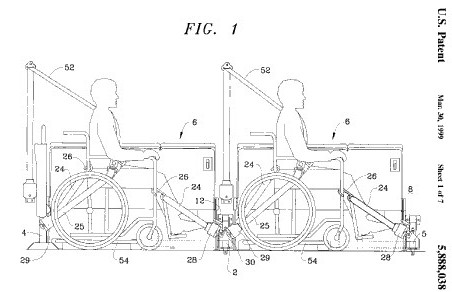
In a separate part of the case, USSC’s VPRo-I wheelchair tiedowns for mass transit were found to infringe a patent held by American Seating. At some point, USSC stopped selling the VPRo-I and switched to a non-infringing design (presumably to avoid infringement). For pending VPRo-I orders, USSC simply notified customers that the new design would serve as a substitute.
After finding the patent valid and infringed by the offer to sell, the Michigan jury awarded American Seating lost profit damages based on the USSC’s non-infringing sales “because in those cases USSC first made infringing offers to sell the VPRo I, but ultimately delivered the [non-infringing] VPRo II.”
On appeal, the CAFC affirmed that a damage award for the non-infringing sales was appropriate because USSC had essentially pulled a bait-and-switch on its customers. Although courts have “significant latitude” in types of harms that can lead to an award of lost profits. However, plaintiffs must at least prove that the infringement was a “but for” cause of the lost profits.
The Federal Circuit’s 1999 Grain Processing decision also dealt with cases where the an infringing product was not actually sold. In that case, the court held that lost profit damages should only be available when the the product sold is not a substitute for the infringing product. Thus, lost profits would not be available if the replacement was “acceptable to all purchasers of the infringing product.” American Seating provided evidence that some customers had complained about the new model — thus proving that it was not an adequate.
Thus, the CAFC affirmed the lost profit award — finding that “absent USSC’s offer to sell the [infringing] VPRO-I, the sales would have gone to American Seating.”
Notes:
- Look for a follow-up post on this case in the coming days discussing other lost profit issues, including damages for “collateral sales” and a discussion of public use under 102(b).
Sounds like to me that one of these 2 newer examiners pretty much knows what they are talking about and & how to examine properly and one just wants to do it his/her way no matter what the rules and laws are. Leave it to the reader to figure our which is which. 😉
examiner#6k,
We all have things about the system that we do not agree with & think are wrong. But we still have to go by what the rules are until they are changed. Personally, I don’t think that business methods should be allowable. And I don’t like the current interpretation of 101. Nor do I agree that a claim that simply lists a bunch of elements without any connections there-between is definite. However, they are my opinions. When I am reviewing a case, if someone doesn’t follow the rules & doesn’t make a 101 when the current rules say they should, or makes a 112, 2, rejection because a claim is broad (not vague), I will definitely bounce it back to the examiner for corrections & possible error. Those are the rules we have to live by until they get changed.
Now, please try to present your “opinions” in a clear, and non-embarrassing, manner. And try to remember the old saying: “It is better to be silent & let people think that you are dumb than to speak up & confirm it”.
MVS
“Oh, and don’t lecture me on how to behave on these boards when you were public enemy #1 before I stepped into the arena and purposefully acted worse than you. In no small part just to see the reaction, one part irritated examiner/citizen, one part troll, one part concern for the system but at the same time knowing that these boards don’t make a hill of beans either way.
My “professional life” got off to a great start dealing with you clowns in law. I may as well still be playing Counterstrike (and I hated that game) with dorm mates as a freshman for all the maturity displayed here, so I may as well leave the leet on. Besides, this is Mr. Crouches blog, he can remove any and all of my posts anytime, as well as yours.”
Might want to read the whole signature of the person you’re responding to… I’m NOT Malcolm Mooney, as you clearly seem to have thought I was by these statements, and these two posts are the FIRST I’ve ever put on PatentlyO. I was inspired to do so by your ridiculously unprofessional behavior and apparent complete lack of understanding of the legal system (such as your attitude expressed elsewhere that case law isn’t relevant).
“I submit yes on all accounts, and I also submit you’ll be seeing a lot more 112’s here soon. And we all know, 112’s = ease of finality, why? Because it doesn’t matter if our art fails the first time around if the 112 sticks, so you fix that, then we use good “sticking” art the second time around in response to your arguments.”
Ok, sure, you didn’t say YOU’D do it, but you sure sounded like you saw this as legitimate practice and almost gleeful to see it happen… 112 rejections have their place; I’d say I make them in 50% of the first actions I make. I’ve only made one of them final after amendment, however; every time other than that one the amendment has been made exactly according to what I suggested in my OA to overcome the rejection. I DON’T use them as a way of just having some sort of rejection on the record or to force an amendment solely for an excuse to use the “new grounds of rejection were necessitated by amendment” form paragraph (even when they weren’t necessitated by it) and go final.
Yeah, applicants overclaim. So reject on the art. Seriously, if you can’t find art on it, is it really overclaiming? 112 isn’t an excuse to reject when you can’t search well enough to find art on a claim that encompasses everything. Now, I HAVE done a 112 rejection for breadth of the claim, but guess what? It was first paragraph, not second. An overly broad claim is not indefinite just because it’s too broad; but the scope of the claim MAY not be enabled by the spec (you know, that long document you’re supposed to read that came with the claims).
But I already know at this point that I’m talking to the wall…
word
I never said that’s what I’d do. I said that it’ll be easy to do. I’ll add that I know people that do do it that way, because their boss makes them (someone that I know also). I give it my best art “attack” every go round dood, because my boss isn’t all over me to get to RCE as some are, so stfu plz. Also, I include leet only when the situation in my professional atmosphere only when it’s warranted by the ridiculousness of what has been going on for so fin long in this whole arena. As soon as I stepped foot in here we had rules prohibiting examiners from making common sense rejections, where in the hell do the courts get off on doing things like that? Give me a break, you want to carry on about how it’s not a game, and the whole process is loaded with bs like that about obviousness etc. etc. Obviousness requires judgment, no if and’s or buts about it. Deal with it. 112’s? They’re there to make the app DISTINCTLY claim his invention, not broadly claim his invention. It’s just a little wink wink nudge nudge that lets people off on that issue presently. It’s time that was ended, and similar answers are at the heart of almost every single discussion we have on here. And in every discussion there’s some bs brought up that makes it a game of semantics and higher thought where it’s really as simple as a. b. c., every freakin time. This is even relevant to the discussion about the above topic because here too one party was wronged, the other got punished (more imo than needed). It’s as simple as that.
Here, let me break this down for you. Overclaiming, claiming that which your product broadly is, as well as that which your product really isn’t , but that falls within that broad description of what you made (all the stuff to be invented that would fall into your overly broad claim that will be invented within 20 years that wasn’t your exact invention, nor even an obvious variation thereof) is the antithesis of
Distinctly:
1. in a distinct manner; clearly: Speak more distinctly.
2. without doubt; unmistakably.
And this is currently not allowed to be 112’ed as a matter of course. The recent decision seems to be saying that a 112 should be made, and I agree, and have agreed since I started here. Very very many lawyers currently overclaim as a matter of course before first action, as admitted freely on these boards. It’s been bad form for awhile now, but at least now there will be a small penelty that’s against them as described in the above post, if they want to take this route. Now sometimes they get an automatic 112, and it’s in the public’s interest. Sounds like a good idea to me and again, this is just my take on the decision, but they laid it out fairly clearly.
Oh, and don’t lecture me on how to behave on these boards when you were public enemy #1 before I stepped into the arena and purposefully acted worse than you. In no small part just to see the reaction, one part irritated examiner/citizen, one part troll, one part concern for the system but at the same time knowing that these boards don’t make a hill of beans either way.
My “professional life” got off to a great start dealing with you clowns in law. I may as well still be playing Counterstrike (and I hated that game) with dorm mates as a freshman for all the maturity displayed here, so I may as well leave the leet on. Besides, this is Mr. Crouches blog, he can remove any and all of my posts anytime, as well as yours.
I never said that’s what I’d do. I said that it’ll be easy to do. I’ll add that I know people that do do it that way, because their boss makes them (someone that I know also). I give it my best art “attack” every go round dood, because my boss isn’t all over me to get to RCE as some are, so stfu plz. Also, I include leet only when the situation in my professional atmosphere only when it’s warranted by the ridiculousness of what has been going on for so fin long in this whole arena. As soon as I stepped foot in here we had rules prohibiting examiners from making common sense rejections, where in the hell do the courts get off on doing things like that? Give me a break, you want to carry on about how it’s not a game, and the whole process is loaded with bs like that about obviousness etc. etc. Obviousness requires judgment, no if and’s or buts about it. Deal with it. 112’s? They’re there to make the app DISTINCTLY claim his invention, not broadly claim his invention. It’s just a little wink wink nudge nudge that lets people off on that issue presently. It’s time that was ended, and similar answers are at the heart of almost every single discussion we have on here. And in every discussion there’s some bs brought up that makes it a game of semantics and higher thought where it’s really as simple as a. b. c., every freakin time. This is even relevant to the discussion about the above topic because here too one party was wronged, the other got punished (more imo than needed). It’s as simple as that.
Here, let me break this down for you. Overclaiming, claiming that which your product broadly is, as well as that which your product really isn’t , but that falls within that broad description of what you made (all the stuff to be invented that would fall into your overly broad claim that will be invented within 20 years that wasn’t your exact invention, nor even an obvious variation thereof) is the antithesis of
Distinctly:
1. in a distinct manner; clearly: Speak more distinctly.
2. without doubt; unmistakably.
And this is currently not allowed to be 112’ed as a matter of course. The recent decision seems to be saying that a 112 should be made, and I agree, and have agreed since I started here. Very very many lawyers currently overclaim as a matter of course before first action, as admitted freely on these boards. It’s been bad form for awhile now, but at least now there will be a small penelty that’s against them as described in the above post, if they want to take this route. Now sometimes they get an automatic 112, and it’s in the public’s interest. Sounds like a good idea to me and again, this is just my take on the decision, but they laid it out fairly clearly.
Oh, and don’t lecture me on how to behave on these boards when you were public enemy #1 before I stepped into the arena and purposefully acted worse than you. In no small part just to see the reaction, one part irritated examiner/citizen, one part troll, one part concern for the system but at the same time knowing that these boards don’t make a hill of beans either way.
My “professional life” got off to a great start dealing with you clowns in law. I may as well still be playing Counterstrike (and I hated that game) with dorm mates as a freshman for all the maturity displayed here, so I may as well leave the leet on. Besides, this is Mr. Crouches blog, he can remove any and all of my posts anytime, as well as yours.
#6k, as an examiner, you embarrass me whenever I read your posts on here… Not only failing to use good art until the second action, but actually TRYING to arrange things so that you can hold back good art and then go final as soon as you apply it? Seriously, I know there’s the real-world count game to play here, but do you actually see your entire job as a game? And honestly, drop the 1337-speak, chat abbreviations, and internet cliches… I’m young enough to understand them, but old enough to realize that it’s horrifyingly immature to use on a discussion board about your adult profession…
To everyone else out there: most of us are not like him, I promise. Some of us, where management allows us, try to work to ISSUE a QUALITY patent, not just try to find maximum count/crap ratio…
“The Halliburton v. M-I case was issued on Jan. 25, 2008. It has since been available on the CAFC website. It addresses a sec. 112 para. 2 issue of invalidity for “indefiniteness”. Nothing unusual.”
O rly my good man? We shall see, we shall see. Maybe in the mean time we can discuss why exactly it was that those claims were held invalid? Was it because his specification was not exact as to what caused the “novel” contribution? Was it further invalid because he did not include such information in the ind claim and thus did not accomplish the public notice function of the claim? (Emphasis on this sentence, this is the new opinion of the court established here)
Finally, does this further mean that everyone must put in the mechanisms which cause their functional language, their “effect” language, and their “adjective” or “descriptive” language (a composition containing an “excess of impurities” where the impurities are actually too much copper etc.) of a limitation in the ind rather than a dep? (which btw, almost everyone in my art currently fails to do at the outset)
I submit yes on all accounts, and I also submit you’ll be seeing a lot more 112’s here soon. And we all know, 112’s = ease of finality, why? Because it doesn’t matter if our art fails the first time around if the 112 sticks, so you fix that, then we use good “sticking” art the second time around in response to your arguments.
What say you? Everyday thing? Have you read it? Change anything? Idk, still pretty much just seeing it by my take, we haven’t had what will the official interpretation passed around or told us yet.
examiner#6k,
A discussion of Halliburton has been on filewrapper.com since the 28th.
271(a): “whoever without authority makes, uses, offers to sell, or sells any patented invention, within the United States … infringes the patent.”
Ok, nvm… I guess I did miss it! hehe
OK thanks Exr for that completely useless off-topic post. Returning to the American Seating decision, I got one word: “Whaaaaa?!?!?!?!?!”
Since when is it an infringing activity to *offer* to sell an infringing product? Did I miss that in my reading of §271? Is patent law an appropriate way to discourage “baiting and switching”?
What are they smoking at the CAFC and where can I get some of that?
Yup, it’s been out for a week. Can’t find it online anywhere? Maybe you need a better search strategy, examiner6k, or perhaps some retraining.
The Halliburton v. M-I case was issued on Jan. 25, 2008. It has since been available on the CAFC website. It addresses a sec. 112 para. 2 issue of invalidity for “indefiniteness”. Nothing unusual.
Well it came out in my email, but I don’t see it online anywhere so I’m sure it’ll be comin around soon.
The case is the appeal of Halliburton Energy Services Inc. v M-I Drilling Fluids LLC.
I’m not sure I understand examiner#6k’s comment. Are you saying you’ve already read a 112 decision that hasn’t yet come out?
First!
Also, there’s going to be a big 112 decision that comes out soon, wait till you get a load of this confusing mess. It seems to say one thing, but it really says just some junk that’s rarely applicable I think. Upon my first reading it’s hard to get a handle on it.
Comments are closed.