|
Introduction: The claim construction issues here are interesting, include the question of how attorney-inventor communications impact claim construction. In addition the court takes a surprising approach to limit the scope of a prior settlement agreement. |
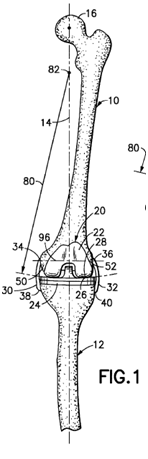 HowMedica Osteonics v. Wright Medical (Fed. Cir. 2008)
Howmedica’s U.S. Patent No. 5,824,100 claims artificial knee prosthesis. After a claim construction decision, Howmedica admitted that it could not prove infringement and appealed. Wright cross-appealed – arguing that the case was moot based on a prior settlement agreement and “release” between the parties.
In a 2-1 majority opinion Judge Dyk found that the lower court erred in its claim construction. This is a case where de novo review impacts the result. As Judge Dyk states, “[a]lthough this is a close case, we disagree.” With de novo review, simple disagreement leads to reversal.
The claim introduced a “femoral component including at least one condylar element.” The claim also required “the condylar element” have certain geometric limitations. The issue for claim construction is whether each and every condylar element must have those geometric limitations. The lower court said yes, Judge Dyk said no. In dissent, Judge Prost points out that it would have been quite easy for the patent applicant to clarify its intent.
Patent Attorney Communications: As part of its claim construction argument, Wright presented the contents of an e-mail between the patent prosecution attorney and the patent applicant considering potential limitations in the claims. The majority rejected that document as merely extrinsic evidence to be used only to “help educate the court regarding the field of the invention and can help the court determine what a person of ordinary skill in the art would understand claim terms to mean.” Quoting Phillips.
|
The letter Wright relies on, reporting to the inventor on the results of an examiner interview, achieves neither of these objectives and is of no value to the construction of the disputed claim language. |
Intent of the Release: A second issue on appeal was the impact of a prior settlement agreement between the parties. A plain meaning of the agreement released Wright from all future patent claims. In particular, the agreement released the defendant from “any and all manner of claims . . . that Howmedica . . . has, ha[s] had, or may have against Wright Medical . . . including, but not limited to, any and all claims and counterclaims that were or could have been asserted.” Both the district and appellate courts, however, found that the plain meaning should not apply because neither party intended the release be so broad. As evidence, the court relied on a parallel agreement that was much narrower.
Dear confused. Yes you are.
Claim drafting by its very nature attempts to draft language that will be durable in the face of unknown potentially infringing structures. If I draft a claim to a chair having a leg, the leg having a length of one meter, then that claim will read on a chair having any number of legs provided at least one of the legs meets the one meter limitation.
If I wanted to further limit the claim, I could say a chair having one or more legs, each of the one or more legs having a length of one meter, which requires all the legs to have a length of one meter.
I suppose the claim here could have read at least one condylar element, at least one of the at least one condylar elements having a geometric limitation -or- a condylar element, the condylar element having the geometric limitation, for greater clarity, however, I don’t think that would be required for the claim, as written, to properly read on an accused device with only one condylar element that meets the limitation.
Given the liberal nature of the CAFC these days in interpreting slightly ambiguous language in favor of the patentee (in keeping with principles of equity), with the “comprised of” case in mind, the outcome here is not all that surprising.
AllSeeingEye,
Dyk did not get this one right. Here is what Dyk writes:
“The femoral component must include ‘at least one condylar element,’ which the district court correctly understood to mean ‘one or more.’ The claim then requires that ‘the condylar element’ meet the specified geometric limitations. See ‘100 patent col.7 ll.4-5, 6-7, 9. If the patentee had intended both condyles in a bicondylar prosthesis to meet these limitations, he could have drafted claim 15 to require that ‘both condylar elements’ do so. The more natural way of drafting the claim language to achieve that result would be to require ‘each condylar element,’ rather than ‘the condylar element,’ to conform to the constant-radius geometry.”
I disagree with Dyk in several respects. First, he says, “If the patentee had intended BOTH condyles in a BICONDYLAR prosthesis to meet these limitations, he could have drafted claim 15 to require that ‘BOTH condylar elements’ do so.”
What?!?!? How does Dyk know what the patentee wanted? Perhaps the patentee intended that for any prosthesis in which there is a condylar, “the condylar” of the prosthesis must have these geometric limitations.
A more reasonable interpretation is that it is not clear whether the patentee intended “one” or “more than one” condyle have the geometric limitation. The patentee started with “at least one condylar” and later recited “the condylar”. Well, if there are two condylars, do you mean both condylars or only one condylar, Mr. Patentee???? Well, Mr. Patentee, as you know, patents are supposed to have a public notice function, and here it is not clear if you intend the geometric limitations apply to one condylar or all of the condylars, since after all you did earlier recite “at least one”. Since there are two plausible interpretations, and the PTO allowed your patent, we will assume the PTO did its job correctly and maintain the validity of your claim on the one hand, but we will not leave the public hanging as to what exactly you intended on the other hand: the narrower of the two interpretations holds and all condylars must have the geometric limitation. Next time, Mr. Patentee, tell yourself or your patent practitioner to draft more clarity into your claims.
It would have been more reasonable for Dyk to state: “If the patentee had intended claim 15 to cover either one condylar or more than one condylar to meet the geometric limitations, he could have drafted claim 15 to require that one or more of the previously recited condylar elements do so. The more natural way of drafting the claim language to achieve that result would be to require ‘AT LEAST ONE OF SAID AT LEAST ONE CONDYLAR elements’ rather than ‘the condylar element,’ to conform to the constant-radius geometry.”
Dyk’s opinion defies logic and encourages patent practitioners to write vague language into claims. From hereafter, should I start with “at least one gadget…” and later in the claim recite “the gadget has a geometric feature” in which case Dyk gives the patentee the benefit of the doubt and interprets this as the geometric feature applying to only one of the gadgets, or should I later in the claim recite “at least one of said at least one gadget…” which of course is clear and unambiguous, albeit a bit more wordy, but holding the patentee to his word.
This case affects a lot of mechanical and electrical cases already in force, and I think Dyk recognized this and decided to lean pro-patent.
Dyk said this was a close case. I disagree. What he opines is far from a grammatically correct analysis. He mucked this case up along with perhaps thousands of other patents in force. And patent practitioners are now encouraged to write more ambiguity into claims.
Associate above put it to us like this: since the claim read “one condylar element … to accomplish articulation” then the “to accomplish articulation” is determinitive of the necessary number of elements. But hold on there cowboy. The claims explicitly recite that you need “at least one” condylar element to accomplish articulation (I would have preferred to use simply “a condylar element” except perhaps in circumstances like this where there is a good likelihood that there will be more than one and I want to emphasize the point that the claim feature will read on one or more than one; or will read on one even if more than one are present). Even if you need two, I don’t agree that the reading of the element must be extended to two or to each and every as the district court did. “At least one” reads on but does not *require* two. Not sure what Prost’s point is.
Dyk got this one right.
SCOTUS
I have the same question… not sure there are too many ways to read “at least one”…specification or no specification
Wait a second. You mean if I write the claim with “at least one gadget…” and later in the same claim recite “the gadget…”, this means “the gadget” is not each and every gadget? BUT, when I write the claim with “at least one gadget…” and later in the same claim recite “the at least one gadget…”, this means “each and every gadget” ???? Does anyone agree with this, or am I missing something?
Glad to see at least someone in the Fed Cir has some respect for the law.
“Talk about over-the-top. So now we now that Judge Dyk and his clerk’s are the worst in the biz.”
Didn’t actually read the case, did you?
it could be “rest of the world”
OK, I give up. I’m a veteran pat. atty. and I’ve never seen the abbreviation ROW. Republic of Westphalia?
I’ve stopped referring to “the invention” in patent applications, but see no reason to also eliminate backgrounds and summaries. What say you?
“Unless you are interested in patent protection only in the USA.”
I couldn’t think of a better place to get it.”
Summertime is almost gone, my-oh-my.
“The letter Wright relies on, reporting to the inventor on the results of an examiner interview, achieves neither of these objectives and is of no value to the construction of the disputed claim language.”
Talk about over-the-top. So now we now that Judge Dyk and his clerk’s are the worst in the biz.
I am interested in the use of the patent attorney communications about the potential limitations in the claims.
Was this document produced in discovery as a defense? By doing so did Howmedica waive privilege?
Does this create a subject matter waiver of attorney-client privileged communications that extends beyond this document?
“Since examiners are frowned upon for making rejections over the art in the background, I think it’s actually a good strategy to disclose it up front.”
Possibly the most ridiculous thing about examining right now. There are some others, 103 exclusions (who lobbied for that one?) etc.
“The MPEP doesn’t trump the patent statute.”
That’s true, the only thing trumping the patent statute is examiner obstinence.
amirite?
The MPEP doesn’t trump the patent statute.
“Really? The MPEP does not have the force of law?”
Really. Throw it around all you like.
with the US dollar in the tanks, foreign filing is pretty expensive these days
pds: You’re a man with an agenda, right? Anyway, I’m a little surprised that you devote your “hopes” to what I may or may not be advising my clients. Bit of a waste, that, wouldn’t you say? But do keep on telling your American clients not to spend any IPR budget in Europe. That’s fine with me.
pds: Are you actually suggesting that the US is the only country where patents are necessary?
“with the 5,700 million folks outside the USA, no?”
I read this as 5,700 million forks. This I think is better and has the advantage of being poetic. Please revise.
“BTW, the MPEP does not have the force of law…blah blah blah”
Really? The MPEP does not have the force of law? Stop the presses.
Some of your clients might also want to know about the border detention actions that are available in Europe. An extremely powerful tool for a patentee. We have ITC actions here, but those are a lot more expensive to exploit.
link to managingip.com .
“Why protect IP in GB, France, and Germany when a litigation decision in one country may be different in another country?”
Um, how about because a litigation decision in one country may be different in another country? That cuts both ways. Since when is having no protection better than having some?
I hope you don’t advise all of your clients to ignore India and China. The world is changing, my friend. Certainly many patentees have no use for these countries, but companies who wish to engage in global business, alliances, licensing, etc. have to consider these two countries, each of which is big enough to host large domestic-only industries in many technology spaces. For what it’s worth, there’s no translation cost going into India if the original application is in English.
“pds: agreed, the single most important jurisdiction is the 360 million person US market. But some Americans might actually have some residual amount of business to protect, with the 5,700 million folks outside the USA, no?”
I hope you don’t advise your clients on where to protect their IP based solely upon population. Based upon your analysis, India and China constitute 2.5B people, so the client’s IP resources should be directed there?
Why protect IP in GB, France, and Germany when a litigation decision in one country may be different in another country? Sounds like a colossal waste of money to me. Combine that with the God-awful expensive cost of prosecution in Europe, and the decision is pretty clear. Besides, the patent attorneys are better looking in the States.
Lionel, I’m hurt. Up above, I unequivocably and unhesitatingly agree with another contributer, that the single most important jurisdiction in the world today is the USA. So, why do you attribute to me something else? Newby, after 30+ years in this game, I still have an awful lot to learn about the US patent system. I’m here to learn. You want me to teach you how to be an ROW patent attorney. Sorry, I don’t have quite enough time or motivation, while I’m still working hard. Maybe when I’m retired. Forgive me, please.
Meanwhile, I’m fascinated that an in-house guy tells you to write US apps, and ROW apps, with no background or summary. Do they not defer at all, to the expert knowledge that outside US counsel possesses? Finally, still nobody gets it. What’s missing in US drafting is the sequence of ever-narrower intermediate generalisations, and the increment of technical effect that each succeeding scope reduction brings. Layers of the onion. That sort of thing. Second nature to the ROW. Relative to that, US drafting looks like a pin-point (best mode) inside an echoing hall (claim 1), with no sign of any patentability-enhanced fall back positions in between, where you can retreat to, when claim 1 gets blown away.
Anyone who plans to file overseas includes a background and summary. You only need one paragraph each and you can keep it fairly broad. I do refrain from discussing prior art, but do not think it’s a problem as long as any description of the art is made up of direct or nearly direct quotes from the art.
Actually, if claims such as the following:
“1. A vehicle wherein the improvement comprises (characterized by) strobing headlights.”
work in the rest of the world. It would be easy enough (assuming the USPTO does not succeed in their claim limiting efforts) to include a few such claims in the application to provide support for a European application. When they get rejected in the states, just cancel them.
And Max, I don’t want to be an ethnocentric snob, but I believe the US market is still the most desirable market. If we keep proceeding like we have for the last 30 years, I am not sure how long that will last, but at least for the present.
“US practice would be a very different beast if examiners bothered to throw the book (MPEP) at attorneys.”
Well, as they’re not bothering to read the MPEP, they might as well do something else with it.
BTW, the MPEP does not have the force of law. In the rare instances where an examiner informs me that something or other is “required” by the MPEP (which is usually the result of the examiner punching up yet another form paragraph which he/she has never even bothered to read either), I gently remind the examiner that the MPEP binds the examiner, not applicants or practitioners.
“Uh, no. Many patent offices in RoW actually enforce their own rules and make you to put this stuff in.
US practice would be a very different beast if examiners bothered to throw the book (MPEP) at attorneys. Alas, there is no count for doing so, not to mention the seething rage this would elicit in those attorneys who have become complacent over years of flinging garbage at the PTO to see what sticks.”
I’m just going by what I’ve seen.
US Examiners would rather increase patent ‘quality’ by allowing nothing.
“Thing is, the clients who won’t allow those sorts of things in their US applications won’t allow it in their foreign applications either, so your idea isn’t very helpful.”
Uh, no. Many patent offices in RoW actually enforce their own rules and make you to put this stuff in.
US practice would be a very different beast if examiners bothered to throw the book (MPEP) at attorneys. Alas, there is no count for doing so, not to mention the seething rage this would elicit in those attorneys who have become complacent over years of flinging garbage at the PTO to see what sticks.
Max: I have noticed that many ROW applications have significantly smaller detailed descriptions than typical US cases and that the summaries are often as long as the detailed descriptions. Perhaps you can shed some light onto why the ROW applications are like this, how you typically prepare ROW applications, and how much time you take to prepare them. My gut feeling is that ROW application drafters spend the bulk of their time on the claims and the summary and then quickly add detailed descriptions that parrot the claims and summaries.
Max,
As a new and inexperienced patent attorney, can you recommended any references which points out these important differences in which you comment on for ROW applications? Thanks.
“Come on guys: admit that you have an uneasy feeling that this drafting practice (despite Teleflex) doesn’t accord with good old common sense, and can’t be what the Framers intended and so, sooner or later, it’s all going to end in tears?”
LOL. I am certainly not going to be writing any specs that way. But then I have been around long enough to see the drafting styles for both specs and claims change several times in response to court rulings. I no longer think that you can predict how things will be interpreted in ten years.
“Just one more thought: You are writing apps now, in which (to the total amazement of the rest of the world) the first thing that follows the Title, at the top of page 1, is “Brief Description of the Drawings”. Come on guys: admit that you have an uneasy feeling that this drafting practice (despite Teleflex) doesn’t accord with good old common sense, and can’t be what the Framers intended and so, sooner or later, it’s all going to end in tears?”
As I said, Max, I find this practice ridiculous and I don’t actually know any patent attorneys who voluntarily write applications like this. It’s the in-house guys who demand it.
“Lowly,
I haven’t done this, but maybe —
Since U.S. applications are often now stripped down with little discussion of the prior art, no summary of the invention, and no mention of the “invention” at all, maybe you want to add those in your ROW application but not your U.S. application.
What do others think?”
I think those are silly drafting procedures created by in-house guys. We have some clients who demand those sorts of things — ie. never use the word “invention” in an application, don’t write a summary, etc. When it’s up to me, I always write full backgrounds and full summaries. In my backgrounds, I discuss the closest prior art that I found. Since examiners are frowned upon for making rejections over the art in the background, I think it’s actually a good strategy to disclose it up front.
Thing is, the clients who won’t allow those sorts of things in their US applications won’t allow it in their foreign applications either, so your idea isn’t very helpful.
Just one more thought: You are writing apps now, in which (to the total amazement of the rest of the world) the first thing that follows the Title, at the top of page 1, is “Brief Description of the Drawings”. Come on guys: admit that you have an uneasy feeling that this drafting practice (despite Teleflex) doesn’t accord with good old common sense, and can’t be what the Framers intended and so, sooner or later, it’s all going to end in tears?
pds: agreed, the single most important jurisdiction is the 360 million person US market. But some Americans might actually have some residual amount of business to protect, with the 5,700 million folks outside the USA, no?
Lowly: I would refer you to the comment from John Prosecutor. He hits the nail on the head (Do it John. Do it. You are quite right). Am I making a “mountain out of a molehill”? Time will tell. Good luck to the US inventor, when some ROW oik puts in issue her PCT case written in the US-style, with an unsustainably wide independent claim, unhelpful dependent claims, and an inadequate or wholly absent Summary of the Invention. My tip: Find out how the ROW does patentability, before you write your client a PCT case. After you’ve filed PCT, the rights you’ve just thrown away are lost, irretrievably.
But, there I go, off-thread again. Reminder to self:stop tapping out replies to people.
Somebody said: “J. Prost is a she. She used to pick up Senator Orrin Hatch’s dry cleaning.”
Oh, please tell me it ain’t so. Prost and Moore are BOTH women??? Were it not for the fact that I admire Newman so much, I would begin to believe myself becoming sxist. ____________________________
Jepped said: “Jepson claims better not be indefinite, since the text is given in 37 CFR 1.75(e). At the very least, I think you’d be able to win on equity in front of a judge.”
Rule 75(e) doesn’t help on this issue, Jepped. I was taught that the preamble to a Jepson should include “improved” or “improvement” etc. — something like: An improved widget of the type having . . .
And then your transition is, like: wherein the improvement comprises . . .
This is the Rule 75(e)language for the transition — the rule doesn’t give the preamble language. But such a wherein clause without antecedent reference to any “improvement” sounds like 112 2d paragraph f1atulence to me.
______________________________
Lowly said: “There is no antecedent basis for “the user’s preferences.” You should have worded it as “preferences of the user.”
No, not quite. “The” does not refer to “preferences” it refers to “user’s,” and there is antecedent for “a user,” so the “the” is correct.
This use of “preference” for the first time with out an article “a” is correct form. Ergo, “the user’s preferences” is technically correct. It is also not indefinite since there is only one way to interpret it. So called “correct” (aka “ana1”) usage of “a,” “an,” “the,” and “said” is not required by 112, or by the MPEP, or by the courts. The only issue is whether there is more than one way to read the claim. There was only one way to read “the user’s preferences” as there was only one user mentioned.
But I agree with your course of least resistance approach, Lowly — using your suggestion of “preferences of the user” would have avoided having to buttt heads with a newbie examiner. But since I am prosecuting this case on my own time, I’ll probably go ahead and screw with him. I would love to see what Proust and Moore have to say about this.
Lowly,
I haven’t done this, but maybe —
Since U.S. applications are often now stripped down with little discussion of the prior art, no summary of the invention, and no mention of the “invention” at all, maybe you want to add those in your ROW application but not your U.S. application.
What do others think?
Max,
What differences should be in your proposed ROW application? Other than playing with the claims a bit to add things like multiple dependencies, what should be done?
You’re making a mountain out of a molehill.
“Unless you are interested in patent protection only in the USA.”
I couldn’t think of a better place to get it.
Permit me once again to warn: confuse at your peril a European c-i-t claim with a US Jepson claim. Do not offer Jepsons in Europe, OK? Suggestion: write one document for the USA and an entirely different one for the ROW. The one for the ROW will work throughout the world, except the USA. The one for the USA is death for your protection, in the ROW. Oh, and because of FtF, make your Paris Convention prio doc in ROW, not US, form. Unless you are interested in patent protection only in the USA.
“Jepson format claims, which used to be in fashion, have gone the way of the dinosaur in the U.S. because of the “admitted prior art” problem they will always create. By contrast, Jepson format (or a variant of it) is what Europe prefers.”
If two-part claims are done properly, the APA problem is not a problem.
E.g.,
1. A vehicle wherein the improvement comprises (characterized by) strobing headlights.
If it qualifies as a vehicle, you’re covered. No need to talk about wheels or means for propelling, etc, and all the other known elements that typically pad out modern US claims.
The trouble is when claims are born in the USA they end up carrying a lot of baggage to Europe. European practitioners are forced to keep the baggage lest they face new matter rejections.
Jepson format claims, which used to be in fashion, have gone the way of the dinosaur in the U.S. because of the “admitted prior art” problem they will always create. By contrast, Jepson format (or a variant of it) is what Europe prefers.
“You make an interesting point. As far as I know, all Jepson claims refer to ‘the improvement’ without antecedent basis. Should it be ‘an improvement?’ Are all Jepson claims indefinite?”
MPEP 2173(e): Obviously, however, the failure to provide explicit antecedent basis for terms does not always render a claim indefinite. If the scope of a claim would be reasonably ascertainable by those skilled in the art, then the claim is not indefinite
“As far as I know, all Jepson claims refer to “the improvement” without antecedent basis. Should it be “an improvement?” Are all Jepson claims indefinite?”
One could argue that an improvement is inherent to a claim, the same way a perimeter is inherent to a circle.
It was more of a philosophical musing than a practical consideration. I know they aren’t tossing out all Jepson claims at this point. It makes me wonder how important antecedent basis was back in 1917.
Jonesie,
Jepson claims better not be indefinite, since the text is given in 37 CFR 1.75(e). At the very least, I think you’d be able to win on equity in front of a judge.
“I just got a 112 indefinite rejection because “inputting the user’s preferences” in a dependent claim had, according to the examiner, no antecedent, and yet the parent claim clearly refers to “a user.””
There is no antecedent basis for “the user’s preferences.” you should have worded it as “preferences of the user.”
Babel Boy:
You make an interesting point. As far as I know, all Jepson claims refer to “the improvement” without antecedent basis. Should it be “an improvement?” Are all Jepson claims indefinite?
Babel Boy,
J. Prost is a she. She used to pick up Senator Orrin Hatch’s dry cleaning.
Does anybody see a problem with “the improvement comprising” where there is no “improvement” previously mentioned in the claim?
I just got a 112 indefinite rejection because “inputting the user’s preferences” in a dependent claim had, according to the examiner, no antecedent, and yet the parent claim clearly refers to “a user.”
Proust once again illustrates why he shouldn’t be doing patent cases. His dissent is a paragon of perverted reasoning. I don’t know where he came from, but he ought to go on back there. Maybe he could take McCain and Palin with him.
As for the contract issue, the Howmedica lawyers screwed up big time there. The firm ought to be paying all the litigation costs related to the release issue, and notifying their carrier.
Thanks WL.
Dennis, you’ve apparently misspelled “condylar” (twice) in your title for this post. Not that I had any idea how to spell it before you linked to this case…
It is pretty funny that the press release puts Dudas in the same list as Jefferson, Edison, and Wozniak. I wonder which of those gets the best “humorous banter” in this exhibit…
Thanks for the clarification, “seriously,” although there must have been at least some investment in developing these portraits as well, unless this stuff is pretty automated by now; as explained on the PTO website:
“The new “Portrait Gallery” exhibit features digital electronic portraits of United States Presidents Thomas Jefferson and James Madison; famous inventor Thomas Edison; National Inventors Hall of Fame Inductees Helen Free, who developed home testing for diabetes, and Steve Wozniak, the inventor and co-founder of Apple Computer; and Under Secretary of Commerce for Intellectual Property and Director of the USPTO Jon Dudas.
The gallery portraits, through the magic of computer-generated special effects and exclusive control software, spontaneously come to life, interactively engaging in humorous banter that highlights the history and growth of America’s intellectual property system.”
But I guess the Under Secretary probably has some portion of the budget designated for educating the public, and this would fall into that category.
“Incidentally, here in NC a hospital administrator recently got in a lot of trouble for commissioning her own portrait to be hung in the hospital she ran; I guess at the national level this type of thing is okay, although I’m confused about the distinction.”
One distinction might be between commissioning an oil painting of oneself and having your image temporarily displayed on a TV screen that is available for other uses, but what do I know?
“Whichever way you slice it, the inventorship is incorrect.”
I disagree. The “conception” of the words used in a claim is not the same as conception of the inventive device or process upon which the claim is intended to read. Describing features as optional, omitting elements for claims, broadening elements for claims, etc. are common practices that (without more facts) do not constitute invention. The inventorship issue is likely a dead end.
However, this may be another one of those “be careful what you ask for” cases in which the broader claim construction is invalidated for lack of enablement and written description. Stay tuned.
SeeingEye-
The case was not as cut and dried as it appeared.
The claim did not read, for example:
“A knee prosthesis comprising at least one condylar element, wherein the surface profile contour along the condylar element has an essentially constant anterior-posterior articular radius.”
Such a claim would easily read on the accused device, because the accused device included only one condyle having the claimed radius; the other condyle of the accused device did not exhibit the claimed radius.
Rather, because the claim at issue was a Jepson claim:
In a knee prosthesis having a femoral component including at least one condylar element … to accomplish articulation of the knee prosthesis throughout a range of flexion…
the improvement comprising:
…the surface profile contour along the condylar element having an essentially constant anterior-posterior articular radius of the condylar element ….
the dissent appears to be saying that a knee prosthesis has one or two condyles (really ANY NUMBER, but effectively one or two) *to accomplish articulation* of the knee prosthesis; and whether one or two or more condyles are used to accomplish articulation of the knee prosthesis, THAT NUMBER of condyles has the claimed constant radius geometry because it is THAT NUMBER of condyles that provides the articulation.
But the greater question, of course, is whether will the patent survive since the correct inventors have not been properly identified?
The inventor hiimself testified that the interpreted invention was broader than his invention. Therefore, there is a missing inventor: the inventor who added or abetted the interpretation that the invention covered a bicondylar device having different radii between the condyles, which was never contemplated by the named inventor. Who should get credit for that aspect of the invention? Would that be the prosecuting attorney? Howmedica’s litigation attorneys? The majority CAFC judges? Whichever way you slice it, the inventorship is incorrect.
Thanks, Caligula, for the tip; I went to the USPTO site and you can see a picture of Under Secretary Dudas once again educating children about the importance of IP, including the importance of his own contributions, and it is *not to be missed*. Incidentally, here in NC a hospital administrator recently got in a lot of trouble for commissioning her own portrait to be hung in the hospital she ran; I guess at the national level this type of thing is okay, although I’m confused about the distinction. I really must go to DC now, before Dudas leaves, to see this exhibit in all its glory and learn what contributions Mr. Dudas has made, because I am a little unclear on what they are. Also, I am concerned about his health, because in every picture of him I see he is looking up in the air, and I wonder how he manages to walk around without tripping, so I hope he is being careful.
“The Portrait Gallery [featuring me] is a great addition to the USPTO Museum,” said Under Secretary Dudas. “[thanks to me] It makes for an enlightening and entertaining history lesson that compares the humble beginnings of the IP system to the important role that the USPTO now plays in modern society [unless I can shove my ultra vires and unworkable rules through somehow].”
ROFLMAO
Maybe I’m just a jaded member of that “special interest group” that Commissioner Dudas likes to refer us patent attorneys (and patentees!) as, but I would expect a federal judge to be capable of properly reading a limitation on an accused infringing device.
Last time I checked, a claim to at least one widget element, the widget element having a geometrical limitation clearly reads on an accused device with at least one widget-like gadget having the claimed geometrical limitation whether or not the accused device has other widget-like gadgets without the geometrical limitation.
Am I missing something here?
By the way, with non-other than the patent-savvy AARP on Dudas’ side, how can he go wrong? Is he running for office or something? What a load of cuh-rap.
Dennis,
Thanks for your post.
What is the text in the second highlighted box? (I assume the first box is your summary, since it is labeled “introduction”.) Is the text in the second box your commentary or a quote from the case? Also, it refers to “these objectives”, but it is not clear to what objectives the text is referring.
What a great idea… I think that I am going to start writing letters to inventors regarding patent prosecution issues.
Comments are closed.