 Anascape v. Nintendo (Fed. Cir. 2010)
A jury found that the Nintendo Wii and GameCube infringe Anascape’s U.S. patent No. 6,906,700. The ‘700 patent claims priority to a parent application and, as it turns out, needed that priority to avoid intervening prior art. On appeal, the Federal Circuit found the asserted claims invalid — holding that parent application could not serve as a priority document because it did not describe the invention as claimed in the ‘700 patent.
In my recent article on antedating prior art, I suggest that the prevalent practice of quickly filing provisional and other patent applications has largely supplanted patentee’s need to prove a prior invention date. In order to claim priority to an earlier-filed patent document, that document “must meet the requirements of 35 U.S.C. 112 p1, as to that claimed subject matter.” These requirements include enablement, written description, and best mode.
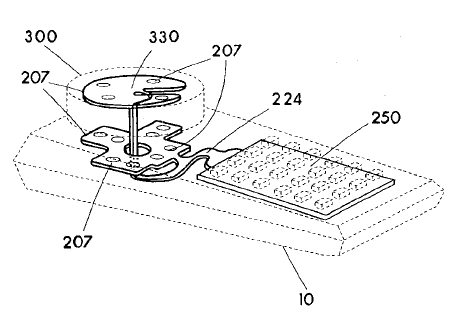
Here, the focus was on whether the priority disclosure satisfied written description requirement for the newly added claims of the ‘700 patent. Anascape’s specific problem was that the priority document identified a single “input member” that could measure movement along six degrees of freedom while the ‘700 patent claims were directed toward a controller with multiple input members that each measured fewer than six degrees of freedom.
Written Description of the Invention: The ‘700 patent’s priority document discussed prior art game controllers that were operable with fewer than six-degrees of freedom. In its analysis, the Federal Circuit refused to consider that disclosure as applicable to the written description requirement because that disclosure “is not a description of the [claimed] invention; [rather,] it is a description of prior art joysticks as generally used in video games.”
Writing in Concurrence, Judge Gajarsa writes that this particular use of the written description requirement is “best” and preferred use of the doctrine. Namely, written description should primarily be primarily used to police priority and new matter issues and other questions of inadequate disclosure should be handled by enablement. In my recent study of the written description requirement, I found that the USPTO is largely following Judge Gajarsa’s guidance in asserting written description rejections primarily to police priority and new matter issues.
Notes:
-
This decision appears to eliminate what was likely a $100 million total payout for Anascape. The decision also eliminates the permanent injunction that had been stayed pending appeal.
-
Anascape appears to be primarily owned by the inventor of the ‘700 patent, Brad Armstrong. Armstrong prosecuted the applications himself. Armstrong has several continuations pending. In addition, Anascape appears to have a still-pending (but stayed) litigation against Nintendo based on several more patents that are currently undergoing reexamination.
-
Microsoft was originally a defendant in this case, but settled in a confidential agreement.
I mean, the best mode known to the applicant at the time of filing the continuation for an invention described in a parent.Now, the same rules should also apply to the relationship between a non provisional and a Section 119 priority application.
Best Attorney
“although ping is a slippery animal. He agrees. Then declares total victory. Then he dances a jig, smirks and shouts in merriment. One wonders why?”
Gee, Ping celebrates when he wins – I wonder why?
Perhaps because winning is slippery (?)
I love the part about “He agrees.” – Ned you make it sound like me doing the flip-flopping, when it is you.
“Our discussion had nothing to do with what was required to claim priority to a provisional”
Why then, do you defend the Q & D so much Ned, – Do you think I made up that part of the discussion all by my little lonesome?
A few more circles around the bat cave boys!
I agree with you Ned. I agree with you ping. As I always say to my colleagues, I’m so happy I never have to advise a client about US patent law because it is far too complicated and illogical to give me any pleasure whatsoever. I like criticising its complexity though, just as much as others on this blog enjoy criticism of ROW patent law on the basis that it is too simple.
Max, please do not let ping confuse you. Our discussion had nothing to do with what was required to claim priority to a provisional or to a foreign filed application. We were always in agreement on that issue.
The problem we got into is what level of proof is required when one does not have to rely on the effective filing date of a provisional or foreign application to swear behind non bar prior art. This happens in US law when a reference is cited under 102(e) or 102(a), but not under 102(b).
We seem to agree on that issue as well, although ping is a slippery animal. He agrees. Then declares total victory. Then he dances a jig, smirks and shouts in merriment. One wonders why?
Maxie,
It’s OK to jump on my bandwagon (we will still have plenty of opportunity for our sparing).
My position is not one of “the two extreme positions rehearsed here“. It is not a matter of “extreme” to acknowledge that Ned is simply wrong (don’t worry – his feelings may be hurt, but he’ll get over it, and his clients will thank you). In fact you yourself, in your inimitable way, basically restate my position “announce what your inventive concept is, and support that announcement with enough description for the PHOSITA to put it into effect.” I am taking the liberty of equating your “inventive concept” to be the same as “invention as claimed”.
Of course, you forgot Best Mode (damm that un-universal law factor again), but you were talking about preserving towards ROW, rather than, as here inthe discussion between Ned and I, preserving for the US (where Best Mode is part of the baggage of full support for the claimed invention).
AS you say, the “logic of the requirement is readily understandable“, unless you enjoy driving in holy bat circles spouting IMHO law, or have taken up a “Duh” crusade against witty, charming, (and available) resilient yet delicate blog posters who do not have pet dogs.
I note what ping and Ned write about what a provisional must contain if it is to do more good than harm. I know what is needed in any non-US American jurisdiction, namely, somewhere between the two extreme positions rehearsed here, and I will suppose for the time being that the best view, taken over the long term, is that writing and filing a pro that is optimised to ROW standard will turn out also to be optimal for the US jurisdiction.
For ROW what you have to do to establish a valid priority date is announce what your inventive concept is, and support that announcement with enough description for the PHOSITA to put it into effect.
Easy to say, much harder to do. Inventors need a trained and talented patent attorney for the task.
But the logic of the requirement is readily understandable, even to an American juryman.
Statement by Ned Heller concerning how Ping flatters Ping will be taken as statements of Ned flattering Ping.
Why thank you Ned.
You know, being able to write in the IMHO-Ned book of Law almost (well OK, not quite) ranks up there with serenading the divine sarah.
I wonder if this torques RWA at all – he’s been awful quiet. Perhaps he’s enjoying his quality time with his dog. Malcolm, have you seen RWA lately?
ping, my, how you flatter yourself.
Ned,
My ultra witty post was eaten. But none-the-less, I will answer your question with a question: How much for how little?
Keep in mind the quick and dirty (Q & D) provisional will only cover just what little it does show – to wit – not much, and is not likely to cover any substantial intervening art and is also likely to induce some lackadaisical effort to complete anything of worth (read that as capable of full support for later claimed inventions (which was the point that you floundered with in your attempts to show off with case cites and which was the point that I roundly trounced you on, and which you have yet to acknowledge).
Not that I need you to publicly admit defeat, as I have mentioned, such admission will likely put an end of my fun of making fun of you (at least until the next time you decide to bandy about the case law of IMHO-Ned law).
And the choise is not so limited as you put it (something or nothing) – you do have the option of a slightly slower, but more robust provisional (nice try at stacking the deck to suit your losing point). Q & D is DOA.
ping, my point has aways been this: the primary utility of the quick and dirty provisional was to antedate intervening art showing what the provisional shows. This is all that one can expect from such a provisional.
Now the choice is not between a quick and dirty provisional and a fully developed non provisional, but between a provisional and nothing at all for months.
Now, ping, which is better: something or nothing?
Ned,
It is you that does not grasp the basic calculus. Once again you dive to the red herring of a genus/species dicussion with “disclose all the species” (your new found wrinkle of “reference discloses less than the entire invention” being the prior art reference you are trying to surmount has never been my point. The point of our jousting is a quick and dirty provisional and the required disclosure to the claimed invention surmounting a reference that speaks to the claimed invention. The to-be-surmounted reference has never been the subject of the “good-enough” support.
There is nothing obtuse here except your inability to concede, which you do with your case cites that favor my view. You keep driving in circles holy batman.
ping, when it comes to understanding an issue, you truly make one think that no amount of effort is sufficient. Reminds me of the folks who cancelled out of science and engineering because they simply did not grasp the basics of calculus.
Back to In Re Gosteli. The only reason that Gosteli could not file a section 131 affidavit to swear behind the Menard reference was because his foreign application was filed outside the United States and therefore was unavailable to prove prior invention in the United States. Since section 104 has now been amended to allow proof of invention outside the United States to members of WTO and at NAFTA countries, that problem no longer exists. Had In re Gosteli been decided today, the applicant would have been able to demonstrate that his foreign application disclosed the two species disclosed in the Menard reference. He would not have had to disclose all the species claimed in his Markush group claim.
I hope this case demonstrates finally that one does not have to disclose all the species in his or her priority application in order to have that application provide the basis for a section 131 affidavit where the reference discloses less than the entire invention. The section 131 affidavit only has to show so much of the invention as disclosed by the reference.
Please stop being obtuse.
“Failure to disagree is agreement.”
Another IMHO-Ned law?
Point in fact Ned, you are now circling to my view that a quick and dirty provisional will not help you. You have circled so with quotes of case law that buttress my position. Yet surprisingly, you have not as of yet come out and admitted that I was right in my original jousting with you.
A pity really (no, not really – because this keeps open my ability to poke fun at you).
With that, I’ll post my veriosn of the IMHO-Nedism:
“Failure to agree is agreement.”
L H
ping, since you have deigned to reply, do you now understand the issue? Failure to disagree is agreement.
ping
section 104
read the opinion .
********
Ned needs to stew on all the posts I have thrown his way. I think the light is on.
Gee Ned, someone else misapplying In re Stempel…
********
Gosh golly, ping, I mean batman, are you calling ned a Motel 6?
Your music so sweet, like the words in a song,
But I tire of being told that I am all wrong.
a constant barrage of things to cause sorrow,
But for me there’s always another tomorrow.
Don’t fret how I see how this story does end,
Judas will not be able to make an amend.
sarah, I think that you are divine
your troubles, as if they were mine.
“Judas” was but a hint,
a clue as it were
to strike against, like flint,
not to needle or bur
At least not to you,
one already so sad and blue.
So dispel the clouds, re-color the gray,
go the extra mile.
Do not despair, fight another day,
and let’s see sarah smile.
Leopold Bloom keeps asking me for a story.
Do you know the reason why
I doubt that you do.You have no idea.
It would be enough for the country to cry.
But to Leopold Bloom stop spamming my mail,
I’ll continue to report you as scum.
What it is that I have is not worth your price,
I’ll surely not keep it all mum.
Judas, sarah (with a special dedication to RWA),
So much for the golden future, I can’t even start
I’ve had every promise broken, there’s anger in my heart
you don’t know what it’s like, you don’t have a clue
if you did you’d find yourselves doing the same thing too
Genes a Girl Scout. That must make you a Priest.
“Gosteli cites the rationale in In re Stempel, in support of their reasoning. We disagree.”
Gee Ned, someone else misapplying In re Stempel…
Max, the issue I posited has been litigated and decided by the CCPA in 1973. Kawai v. Metlesics:
“We think it is now settled that an invention cannot be considered as having been reduced to practice in the sense that a patent can be granted for it unless a practical utility for the invention has been discovered where such utility would not be obvious. See 35 U.S.C. § 101; Brenner v. Manson, 383 U.S. 519, 86 S.Ct. 1033, 16 L.Ed.2d 69 (1966); In re Kirk, 376 F.2d 936, 54 CCPA 1119 (1967); In re Joly, 376 F.2d 906, 54 CCPA 1159 (1967). Therefore, a constructive reduction to practice, as opposed to an actual reduction to practice, is not proven unless the specification relied upon discloses a practical utility for the invention where one would not be obvious. We also think that proof of a constructive reduction to practice would also require that there be sufficient disclosure in the specification to enable any person skilled in the art to take advantage of that utility where it would not be obvious how this is done. This latter requirement is, of course, the so-called “how to use” requirement of section 112. It goes without saying that proof of a constructive reduction to practice would also require that the specification be sufficient to enable anyone skilled in the art to make the invention, i. e., the “how to make” requirement of section 112 should also be met by the specification.
If these are requirements which a United States specification must meet if it is to be adequate to support a reduction to practice by the act of filing the application, it follows that a foreign application, it follows that a foreign application must meet the same requirements if it is to be used to prove a date of invention. If only the United States application had to meet these requirements, the effect would be that it could be used as of its filing date to prove a date of invention which had occurred up to one year earlier. This would be an untenable position since section 104 prohibits the introduction of proof of any act other than the filing of the foreign application which could be used to buttress the claim that the reduction to practice had been complete as of the foreign filing date.
The net effect of not requiring the foreign application to meet the disclosure requirements of United States law would be that an inventor could file a patent application for promising chemical compounds in a foreign country not requiring a disclosure of utility and have up to one year to determine a practical utility before filing in the United States and yet claim an earlier date of invention. We do not think section 119 should be construed as permitting this.”
Also see, In re Gosteli, Fed. Cir. 1989, link to cases.justia.com
“As an alternative position, Gosteli contends that they can swear behind Menard, under Rule 131, by establishing a constructive reduction to practice in this country based on their foreign priority date of the two species disclosed by Menard. They reason that the use of a foreign priority date to establish the reduction to practice component for a Rule 131(b) showing is authorized by In re Mulder, 716 F.2d 1542, 1544-46, 219 USPQ 189, 192-94 (Fed.Cir.1983), and therefore, showing priority with respect only to as much of the invention as Menard discloses is needed. Gosteli cites the rationale in In re Stempel, 241 F.2d 755, 760, 113 USPQ 77, 81 (CCPA 1957), in support of their reasoning. We disagree.
27
Rule 131 requirements are quite specific. To antedate a prior art reference, the applicant submits an oath or declaration alleging acts that establish a completion of the invention in this country before the effective date of the prior art. 37 C.F.R. Sec. 1.131(a).
28
The requirements and operation of section 119 differ from those of Rule 131. Cf. Scheiber, 587 F.2d at 61-62, 199 USPQ at 784 (explaining a similar contrast between section 120 and Rule 131). Rule 131 provides a mechanism for removing specific prior art references, whereas section 119 is concerned only with an applicant’s effective filing date. Cf. id. Because section 119, unlike Rule 131, operates independently of the prior art, it is appropriate that the showing required under section 119 differs from that required under Rule 131. Cf. id.”
Max, note that foreign applicants (WTO, NAFTA) are no longer inhibited by Section 104 and can prove prior invention dates outside the US. In other words, had Section 104 not been an object, Gosteli would have prevailed by using his Lexembourg applications to show the two species of disclosed the Menard reference. He would not have had to show full support for all the species in his Markush claim in his Luxembourg priority application.
Max, there is no requirement for an effective priority claim to a foreign application that the invention be disclosed in the foreign application in a manner provided by Section 112, p. 1. I take this to mean that one must have “enablement” in the foreign application and perhaps a written description of the invention, but no requirement of a best mode. That said, I suggest that in filing the US case, one has to update or provide the best mode in the US application — effective as of the US filing date. The best mode is a requirement for a US patent application.
In the case of a provisional, the relationship of a Section 111(a) and a provisional is more like that of a CIP to a parent. There is no requirement that new matter not be added, so new matter often is. To the extent that any claim depends upon new matter, therefor, the best mode needs to be updated. To the extent that it does not, the best mode disclosed in the provisional can suffice.
Again, there are no cases exactly on point that I know of. But I think this is the way it will come out when an if the issue is litigated.
Back to foreign priority, since the requirement for foreign priority differs from US 120 benefit, shouldn’t that suggest that full 112, p.1, is not required to obtain priority?
That said, I think the result in the present case would have been the same even if the parent case had been a foreign priority case. There was no disclosure or hint of a disclosure in the parent case of an input member that was not a 6 degrees of freedom device.
nice try ping, why don’t you post some quaint song lyrics to go with that. And go sell some cookies.
“Gawd what vapid, obsequious chatter”
Jealousy and flattery, RWA.
It’s Ok to admit that this is a guilty pleasure for you. Maybe then you won’t be so dour and hung up that someone else likes to wear red pumps too.
IANAE,
Ned needs to stew on all the posts I have thrown his way. I think the light is on.
Now, the same rules should also apply to the relationship between a non provisional and a Section 119 priority application.
Why?
but Ned, in 111(b)(1)(A) I see a reference to 112/1, and I see that 112/1 requires “best mode”. So, are you indeed saying that the law is skewed in favour of the inventor who chooses to file her provisional at the UK rather than the USPTO? Interesting.
question, the case at bar did not involve a provisional. However, I have never heard of a case involving Section 112, p. 1, “support” for claims also involve a question of “best mode.”
Now, we had a case a few years back where if IIRC the Fed. Cir. said that one did not have to update the best mode on filing a continuation. So, if this memory of mine is correct, proof of Section 112. p. 1, support should not have to demonstrate best mode, and by this, I mean, the best mode known to the applicant at the time of filing the continuation for an invention described in a parent.
Now, the same rules should also apply to the relationship between a non provisional and a Section 119 priority application. The priority documents in most, if not all cases, do not require a best mode at all. However, a Section 111(a) application does. Therefore the best mode has to be “updated” on filing the US Section 111(a) application, but the priority claim is good even if the priority application has no best mode disclosure at all.
Gawd what vapid, obsequious chatter. Its like a bunch of girls scouts around here…
I won’t bother asking ping to “man up” since it would clearly ruin his chances at a poetry career, or his career in social work (greeter at Wal-Mar).
Maxie,
Tact is over rated. Far be it from me to educate anyone (where I come from, dem’s fighting words).
Not quite sure that it’s “just” an observation, ping. Looks suspiciously like an attempt to educate me. Sometimes it can be more tactful to use “one wants” or “I tend” rather than “You want”.
Be that as it may, I enjoyed your “turf” remark.
And at least you don’t use the annoying “we” form.
This is why we don’t do “$1,500” provisionals.
“Here’s a hopelessly naive comment, just to stir the thread.”
Trying to horn in on my turf, eh Maxi?
“section of the specification that sets out the prior art background.” – whether or not true, anything in this section is proclaimed by the applicant as prior art and is thusly so.
You really want to be careful what you call prior art. Just as you really want to be careful filing quick and dirty provisionals.
Just an observation.
Here’s a hopelessly naive comment, just to stir the thread. Descriptive text sufficient to support the claimed subject matter is found relatively frequently in the section of the specification that sets out the prior art background.
Any contradiction between priority entitlement under 119 and under 120 strikes me as in contravention to the spirit of the Paris Convention. Paris decrees that you don’t get priority if the earlier application is not an application for protection of an invention that is the “same” as the one you are now claiming.
So, unless you want to make it more difficult for USPTO filers to get benefit of priority at the USPTO, than it is for aliens who file their priority applications in one of the world’s other Patent Offices, should not the test under 120 amount to the “same” thing, namely, the “same” invention (even if you dress it up differently, see p 15 of the Decision, with the test “descriptive text sufficient to support”)?
Or is it already the case that the established test under 119 is “descriptive text sufficient to support” the claimed subject matter?
I see use of the priority document as evidence of prior invention is a completely different thing. On that, the US can invent any test it likes, because exploring the gap between conception and reduction to practice is something that’s a purely American domestic issue.
Just trying to provoke.
DC,
Not to be a nit (OK, to be exactly a nit),
Ned keeps leaving out the key word of “claimed” from “with respect to so much of the calimed invention as the reference happens to show.”
Let me end with: “This concept arises in the interference context wherein the issue is support for a count in the specification of one or more of the parties.”
AS Ned says: “sayest the court.”
did the provisional claim the best mode of the invention known at the time of the provisional application filing and then another mode became known and was disclosed in the regular application?
Ned – You are correct that in this case the intervening prior art would be considered 102(b) prior art when compared with the filing date of the ‘700 patent. If the prior art was instead 102(a) or 102(e) prior art, then the patentee could have potentially used the priority document (and perhaps other documents) as evidence of prior invention. And, as you mention, under In re Stempel, patentee would only be required to show priority “with respect to so much of the claimed invention as the reference happens to show.”
DC
The same may have been true had the references not been statutory bars,
It’s an important legal distinction to be sure, but Dennis does imply that it’s less relevant in fact because people are filing provisionals closer and closer to their invention date. With correspondingly diminished 112 support.
…that is, back pedal faster on those delicate porcelain bicycles.
My aren’t they pretty though!
“The same may have been true had the references not been statutory bars”
translation: backpedal faster men!
Dennis, in all fairness, you should point out that the references were statutory bars requiring the patentee to demonstrate full Section 112, p. 1 support for the claims in the parent case. The same may have been true had the references not been statutory bars, but since that circumstance was not before the court, it would be inappropriate, in my view, to state or suggest that the result would have been the same regardless.
I again refer you to In re Stempel.
It should really be written description of the claims as each and every element of the claims must be described and enabled by the priority application.
“Written Description of the Invention”
You mean …of the CLAIMED Invention…
Where is Kayton when you need him?
Comments are closed.