By Jason Rantanen
Yesterday, I discussed our conclusion that the Federal Circuit applies a stricter standard than the lower tribunals it reviews and that this preference for patentee success manifests through the intent to deceive component of the inequitable conduct analysis. In this post, I raise some broad ideas about inequitable conduct jurisprudence. The paper raises others as well, but the ones that follow offer a good perspective into what we believe may be going on.
The first idea is that the Federal Circuit might be applying a standard for intent to deceive that is higher than that required by its own caselaw. In other words, the Federal Circuit’s articulated standard – intent greater than gross negligence – might be lower then the court’s normative perspectives on inequitable conduct. At least some circuit judges might be applying a requirement more akin to knowledge or purpose. This idea finds some support in the empirical evidence. Our data indicate that patentee win rates can vary dramatically (from 40% to 100%) depending on the judge authoring the opinion, as the below graph of 14 judges who sat on the bench during the past decade illustrates.
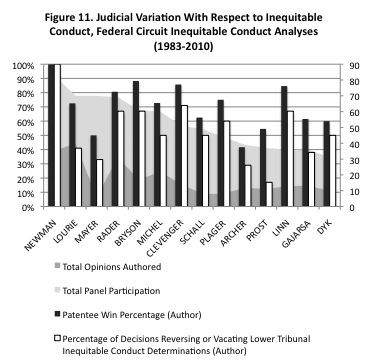 Following closely from this first idea, and also suggested by the Figure, is the notion that when it comes to inequitable conduct the Federal Circuit might be having trouble communicating its standard – particularly with respect to intent – because it is not speaking with one voice. If the mental state standard applied at the appellate level differs between judges, lower tribunals might have a difficult time “locking on” to the Federal Circuit’s standard. This problem could be amplified by the fact that, as we have shown, the Federal Circuit does not seem to have balancing jurisprudence, which theoretically would address mental state standards above the threshold. Thus, rather than having a single standard for intent to deceive that is further refined through the balancing inquiry, Federal Circuit jurisprudence might have at least two distinct (and somewhat bipolar) mental state requirements, one higher than the other. This state of affairs might produce jurisprudential variation (and perhaps confusion among district courts), and might concentrate (as we have observed) inequitable conduct’s focus on intent to deceive.
Another idea the paper raises is that uncertainty around the standard might reflect jurisprudential design (albeit, probably unintentional jurisprudential design). For example, perhaps the Federal Circuit believes inequitable conduct doctrine is necessary to protect the integrity of the patent system, but is strongly biased against successful (for the patent challenger) inequitable conduct claims. Thus, the court might desire to maintain the threat of inequitable conduct so as to encourage patent applicants to take appropriate care in dealing with the public. Yet allowing too many findings of inequitable conduct might be equally bad, as it could lead the public to question the validity of the patent system altogether, and moreover might invite the “plague” of overasserting inequitable conduct so frequently warned about. An obfuscated standard for intent to deceive might be just right for balancing these concerns, because it provides a structural context that allows the Federal Circuit to maintain the threat of inequitable conduct – and keep the patent bar in line – but rarely find inequitable conduct. In effect, this structure encourages patentees to police themselves, and also creates a mechanism by which private parties are responsible for ensuring that patent applicants do not misbehave towards the government, i.e., the law sets up a system that mostly enforces itself.
The entire paper, which also includes additional observations, ideas, and recommendations, can be downloaded here, and we welcome all comments. In addition to responding below, comments can be sent to us directly at prm.icpaper@gmail.com. If the download link does not work for you, and you would like a copy of the paper, please email the above address and I will be happy to send you a PDF.
Plum pouches of fruit and/or veggies are a quick favorite at this house.
“The Man Who Watches” should be “The Man Who Doesn’t Speak,” or at least “THE MAN WHO DOESN’T SHOUT.”
Obviously, what you be tellin aint what been written. Plain as day ya been contradickted. As for this notion that the Courts can or cannot render a patent unenforceable, ya gonna haveta domore that just say it (and I don’t mean just shout it).
Mr Kappos,
I see you are doing a great job. And I didn’t mean the current USPTO. But the damage was already done. That was what I meant to say.
I told you what they meant by unenforceability meant . . . the fees were not paid or the term had expired. There is no affirmative mention in the statute of avoiding liability based upon unenforceability. Why do you people keep pusing the charade that 1.56 means anything at all, except that an attorney registered with the USPTO can be disciplined for failing to comport with it. The courts DO NOT HAVE THE POWER TO RENDER A PATENT UNENFORCEABLE ONLY CONGRESS CAN DO THAT AND THEY HAVE BY SETTING FORTH THE TEMPORATL LIMITS OF A PATENT’S ENFORCEABILITY.
“There are no defenses mentioned in Section 282 concerning unenforceability”
contra
“35 USC 282(1):
(1) Noninfringement,
absence of liability for infringement,
or
unenforceability”
W
T
F
I paid my Fees (borrowed from my Brother) they were denied. I paid for all the Case fees. They were thrown out. I paid for things that were not neccessary, that I call extortion. I spent thousands of Dollars in mailing fees sending complaints that were either stolen before delivery or not accepted. Or I was told they are empty complaints. I spent Thousands for files that are sealed as certified and are not. I paid 5,000.00 to a Lawyer that told me I had no charges against the Atty. I paid him to sue…. He claimed he did nothing? Then we have the Copyrights, the Trademark that was switched. And then there are the many things done to force me into this Rabbit Hole. So even if the USPTO is finally through yanking my Chain. I have no Chain left. Although I do appreciate the help in making me realize who was holding the Chain.
I find only one section in Title 35 of the United States Code that mentions unenforceability. It states an absolute defense to patent infringement is non-infringement. There are no defenses mentioned in Section 282 concerning unenforceability. In fact, Section 282 appears exhaustive and restrictive, i.e., the Courts have no power to augment the defenses therein. What, pray tell, is an unenforceable patent that otherwise recite claims that were unenforceable you ask: a patent for which the maintenance fees have not been paid or the patent otherwise expired. I am absolutely convinced that absent judicial malfeasance there is no defense authorized by Congress concerning unenforceability based upon inequitable conduct. The only defense based upon inequitable conduct would be invalidity and the statute is quite clear: Invalidity can only be found by failing to satisfy Title 35. There is no duty of disclosure mentioned in Title 35 Q.E.D.
This is a clear cut example of legislation from the bench.
One statutory defense against infringement is “unenforceability”. What do you think that means, exactly?
Troll Bait ROTFLMAO
Equity is the lynchpin of Justice.
Look there is absolutely no support in the Constitution or the case law of the Supreme Court of the United States for the Federal Circuit law on inequitable conduct. That is why the law is a mess. This is a clear cut example of legislation from the bench. However, I use the term legistation loosely, because what we have here are equitable findings, which are not really a concept found in law. Rather, it is based upon equity. So what you have here is the court overturning legal actions taken by the combined efforts of the executive and legislative branches of the Federal Government based upon equity. This level of review was never envisioned by the Great Chief Justice or the framers of our Constitutional Republic, assuming of course that what we can call the current incarnation of the Federal Government a Consitutional Republic. Then again, that may be where the problem truly lies.
Jason,
Thank you for your study. Based on your knowledge of the current members of the court, what is your prediction for Therasense?
The authors seem to suggest that we should be surprised that the variance among courts in IC findings focuses on the intent prong, not the materiality prong, and that the Federal Circuit hasn’t explicated the balancing step. First, I think it is much easier for judges to assess materiality, because it depends largely on matters in the printed record. Intent, OTOH, always entails a certain amount of mind-reading, and necessarily requires courts to make chains of inferences. Second, balancing makes little sense–how do you balance things that are largely incomparable–comparing apples to oranges, as it were? I think it would be better to treat materiality and intent as separate elements. And it would really help if Federal Circuit panels would bind themselves to their own en banc precedents.
To the authors:
Good point about how mixed messages from the CAFC can lead to confusion in the lower courts. Your data supports it well.
Who is this message directed at? What actions do you hope your publication will inspire?
From the chart, it appears that the winner of the IC “hanging judge” contest [the lowest lower court reversals of IC and vastly lower than several others] is Judge Prost. [Someone from a govermental/legislative background without prior preparation, prosecution, litigation, billing or economics experience with obtaining patents, I gather from her posted bio.]
To obtain a more uniform “intent” standard, the Feds need to break it down just a bit more:
For example, they may require the finding of
– did the person (having the duty) know the withheld art was more pertinent than the art relied upon the by the PTO?
– did the person notwithstanding fail to disclose that art or equivalent art?
They may also formalize “cures.” For example, once the problem became known to the person, did he do anything to cure the problem — such as by promptly filing or causing the filing of a reexamination or a reissue, or by specifically raising the issue in a continuation?
Break it down into smaller issues that have to be resolved so that the results can be more uniform and predictable.
Comments are closed.