Warrior Sports v. Dickinson Wright and John Artz (Fed. Cir. 2010)
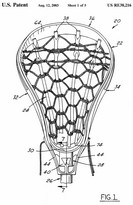 Warrior Sports makes lacrosse equipment and hired John Artz's firm to handle patent prosecution. Artz later merged his firm with Dickinson Wright and brought his clients into the crease. One case that Artz worked-on was Reissue No. 38,216. In that case, the Artz firm failed to pay the maintenance fee — allowing the patent to lapse. In their petition for revival, Artz explained that the docketing clerk charged with paying the fee had suddenly died of an unexplained brain infection and that she had been suffering from the malady during the time that the fee was due. Unfortunately, the clerk had kept her illness secret and the firm learned only later that the condition had impacted her performance.
When Warrior sued STX for patent infringement, the defendant argued that the patent had lapsed because of failure to pay the maintenance fee and – in addition – that the patent was unenforceable due to inequitable conduct during prosecution. (The inequitable conduct charge was based upon an argument that Artz had mischaracterized prior art). Rather than lose the infringement case, Warrior settled with STX (on allegedly unfavorable terms) and then sued Artz & Dickinson Wright for legal malpractice.
Federal Court Jurisdiction over Malpractice Claims: Malpractice is a state law claim and is usually handled by state courts (absent federal diversity jurisdiction). However, when the malpractice charge would necessarily require “resolution of a substantial question of federal patent law” a federal question is raised that allows-for (requires?) federal court jurisdiction. Christianson v. Colt Industries, 486 US 800 (1988).
District Court Dismissal: Both plaintiff and defendants agreed that the case should be heard in federal court. Nonetheless, the district court dismissed the case for lack of jurisdiction over the malpractice question.
Holding on Appeal: On appeal, the Federal Circuit vacated the dismissal — holding that the Michigan malpractice claim arises under patent law and therefore should be heard in Federal Court.
Malpractice Elements: In Michigan, legal malpractice has four elements: (1) the existence of an attorney-client relationship; (2) negligence by the attorney in the legal representation; (3) actual injury; and (4) that the negligence be the proximate cause of of the injury.
Case within a Case: Classic patent prosecution malpractice requires a “case within a case” where, in order to prove actual injury, the malpractice plaintiff must show that someone would have infringed a properly obtained patent. “That is, to prove the proximate cause and injury elements of its tort claim, Michigan law requires Warrior to show that it would have prevailed on its infringement claim against STX and would have been entitled to an award of damages as a result.”
Since at least one of the plaintiffs malpractice theories requires proof of infringement, the case raises a “substantial question of patent law conferring § 1338 jurisdiction.” Here, it was important that the court in the infringement case had not decided the infringement issue (it had decided claim construction).
Dismissal Vacated and Remanded.
Legal malpractice cases are interesting, given the “trial within a trial” that has to take place, especially in criminal cases, where it could result in the plaintiff having to reveal some very unpleasant information: link to lawblog.legalmatch.com
And the non-sequitur Award of the day goes to…
…yes, the record holder in this category, Sunshine Malcolm.
I thought ping prosecuted patents for Charmin.
Of course you are. Ever ready for premature, er, um, conclusions that you be.
As “recently” is quite the ambiguous term, let me help you out. Let’s start with every post on every thread for the last year.
Once that is done, then you still are not ready for any general conclusions, cause you are missing the other facots I helped you out with at 1:17 – notably, information on actual clilents and earnings from clients.
Let me know when you have that info, OK Chuckles?
Let me know how that study goe so who are the most prolific posters.
The preliminary results are in. Recently, the most prolific posters are you (ping), 6, Michael R. Thomas, and Sarah. I’m reasonably confident that those last three don’t have any paying clients. So I think I’m ready to draw some general conclusions now…
Thanks pang.
Let me know how that study goe so who are the most prolific posters.
Then le m enknow how you will attempt to correlate that with clients and client earnings. That oughta be worth a few chuckles.
ping, you obviously are not a lawyer, or rather, let me say, you should not be.
Judging from his prolific postings here, he’s obviously not a lawyer with any current clients, at any rate.
And Ned, if ya think that about me, and ya be wrong so often on matters we discuss, what does that say about you?
“If the PO had lost on ANY disputed claim term that he would still be entitled to a judgment of infringement regardless.”
What if (P)atent (O)wner lost on all disputed claim terms?
IANAE, the posture of the case was that claim construction had been completed. I would agree with this:
If the PO had lost on ANY disputed claim term that he would still be entitled to a judgment of infringement regardless.
ping, you obviously are not a lawyer, or rather, let me say, you should not be.
“it invites the firm to take a position adverse to its client”
Iza pretty sure that the firm does not have the plaintiff as a client at this point.
And since damages be too hard to place a money value (lolz once again on the infinity bucks), the clear equitable solution is an injunction againt the adverse party.
Like I sayz – Thatta teach em.
Ned: “Almost like defending a criminal malpractice claim for failing to file an appeal by stating the client admitted he was guilty.”
No, not like that at all.
Seriously, don’t you see the difference between alleging sufficient facts and being likely to win on the merits? Here’s a hint: only half of the people who do the former go on to do the latter.
Even during a trial, your litigation counsel might well advise you that you are unlikely to win. Is that a conflict of interest? What if you are convinced on a balance of probabilities that you are unlikely to win?
If you had a really weak infringement case to start with, and your lawyer screws up at trial, what damages should that entitle you to? The entire amount you claimed from the infringer?
IANAE, yeah sure. Almost like defending a criminal malpractice claim for failing to file an appeal by stating the client admitted he was guilty.
Why can’t the firm similarly say the patent was obtained by fraud because their own firm, which prosecuted the patent, committed fraud on the PTO in any number of ways! What a joke.
Why can’t the firm say they PO would have lost the case regardless due to fraud on the court committed by the firm? Where does one draw the line?
The way the Feds set this up, it invites the firm to take a position adverse to its client. The PO’s patent was, in this case, reinstated. He may be able to sue others for infringement. If the firm can prove non infringement in defense of the malpractice claim, why can’t it represent the other infringer as well? We know why?
It is unethical. It simply is not done. Disbarment material, big time.
Oh, come on, Cy. Stop conflating damages with liability. I did agree that damages was the one thing that the PO still had to prove.
Ned -o
If the client is suing you for malpractice, chances are pretty good that you are no longer in a position that you need be concerned with their interests. It be pretty good bet that they done already fired you.
Unless ya run into that exceptionally rare case where you are forced to sue your own firm for malpractice. The Chinese Wall for that is some sight.
And thatta make some argument to the judge – see here judge, we just gotta assume that infringement done took place, cause like I wouldn’t be wantin money on a bogus patent or nothin like that.
Trust me.
Ned-o like, dontcha have to actually be in the assignment chain for assignment estoppel to take effect?
Cy,
Since when does infinity dollars make a patentee “whole”? Wherez would they put it?
Even assuming for arguments sake that we accept Crazy Ned’s premis of assumed infringement, the easy remedy to make the patentee whole is injunction. That damm lawyer be injunctified from practicin the invention for the rest of the term.
Thatta teach em.
Cy Nical, if a firm defended a malpractice claim where they represented the PO in court, alleging the patent to be infringed, I would think it unconscionable for them to take the position in any court, adverse to the interests of their client, that the patent was not infringed. They are switching sides and they cannot be allowed to do that. The only question on the table is whether there was malpractice, and whether it caused the alleged damage. It has to be assumed in a case like this that the infringement allegation was true.
Heck, Ned, why stop there? That complaint probably asked for an injunction, too, on the basis of the incalculable harm that continued infringement would cause. In the malpractice case, we should just assume infinity dollars for the damages, since the law firm is estopped from claiming that anything less would make the client whole.
That would certainly streamline the case.
Ned: “I would think it unconscionable for them to take the position in any court, adverse to the interests of their client, that the patent was not infringed.”
That’s why they wouldn’t take that position.
They’d argue something like “we alleged infringement because that’s sort of a requirement in an infringement suit. However, as we advised Client at the start, there was always a certain probability that the court would find for the defendant. We now argue that the ‘certain probability’ is a pretty high one.”
After all, it’s not like a whole lot of litigators refuse on principle to take on clients who have less than an 80% chance of winning.
Cy Nical, if a firm defended a malpractice claim where they represented the PO in court, alleging the patent to be infringed, I would think it unconscionable for them to take the position in any court, adverse to the interests of their client, that the patent was not infringed. They are switching sides and they cannot be allowed to do that. The only question on the table is whether there was malpractice, and whether it caused the alleged damage. It has to be assumed in a case like this that the infringement allegation was true.
There is a doctrine of assignor estoppel that may be relevant here. That doctrine prevents an assignor of a patent sued for infringement to assert the patent is invalid. The same policy grounds should be applicable here to prevent one’s own lawyers to adopt an adverse position against you in defense of a malpractice claim.
Further, I think, that if a law firm even alleged such a repugnant defense, all responsible should be disciplined or even disbarred.
This guy better watch out:
link to theglobeandmail.com
Who knows – it might be NAL in disguise.
With all due respect, Cy Nical, I find it hard to believe that Michigan law would permit a lawfirm to assert in defence of a malpratice action that the matters it alleged on behalf of the client were lies. If I am right on this, the fact of infringement is irrelevant.
Ned, my guess is that the defendant law firm here is clever enough to find room to argue that their claims on behalf of the client were not “lies,” met Rule 11, but were still not likely to succeed. Surely you don’t believe that all losing cases are based on “lies,” do you?
Here’s my summary of the case. I wish they had tried the infringement issue because I would have understood why we pay so much for my son’s lacrosse sticks . . . .
link to pharmapatentsblog.com
Oops, sorry for the double post.
Waitress, another coffee please.
that be just an observation, mind you.
(but my observations are golden)
Not 6 (and not a lawyer either)
Your practice tip is off. There is simply no way to avoid risk. Thus the prudent thing to do is to do the work well, communicate clearly (and in writing) and choose clients carefully (it is OK to say “No thank you” to a potential client who has a background of switching firms or litigation against her counsel).
Aint no stoppin some from litigating.
Not 6 (and not a lawyer either)
Your practice tip is off. There is simply no way to avoid risk. Thus the prudent thing to do is to do the work well, communicate clearly (and in writing) and choose clients carefully (it is OK to say “No thank you” to a potential client who has a background of switching firms or litigation against her counsel).
Aint no stoppin some from litigating.
“That’s not it. We all know who you think NAL is, but it’s not her.”
Lulz, you wish. By “we all”, I think you mean maybe just you. But it’s nice to know your opinion on the matter JD. I disagree. And I think if you had the evidence in front of you you’d agree with me.
“I do recall you claiming that your office was just down the hall from her former SPE though. Somebody please post a list of all the junior examiners who are on the same hall as SPE Georgia Epps of AU 2878. We’ll read a few OA’s and identify 6 from whichever one routinely has quintuple negatives.”
You seem to think that NAL was wrong when she said I loved misdirection and briar patches. She was quite right on that point though. I have my tricks. We play with the toys the gods give us. “was” you said, lol.
If you ever go looking for an OA from me though, it’d be a lot easier to simply ask around a few firms for any OAs with a prima facie case set forth. You’ll know it is me immediately 🙁
In other news there is a shtstorm of ice out there tonight in DC, watch your step in the morning.
Ned: So they lost the patent. Big deal. They want to get damages for the patent being dead, they need to prove it’s worth something. That means they need to prove that SOMEONE infringed it, and then prove the amount of damages for infringement they would have been awarded but for the loss of the patent. Or they need to show that someone was willing to buy the patent for big bucks, but the deal fell through when it turned out the patent was dead. Lots of luck with that. Maybe you didn’t notice but in the Anglo-American tort system, courts only award money for actual harms, not theoretical harms. Heck, there’s not even standing to bring a case for theoretical harm.
The only tangible case where infringement was alleged and lost was the one against this one accused infringer. So that’s the only basis the patentee has for seeking damages for malpractice. But it’s never a foregone conclusion that the patent will be found valid or infringed, and I see nothing inconsistent with allowing the same firm that acquired and/or asserted the patent from raising a defense showing that it was likely the patent would have been found invalid and/or not infringed. Suppose the client got the patent but didn’t do a prior art search. Why, in defending itself, should the firm be precluded from doing its own search and if it finds hitherto undisclosed killer prior art, showing why the patent is invalid? The patent’s already dead, and the firm isn’t revealing secrets communicated by the client, so there’s no breach of duty to the patentee. If you say the firm is estopped from raising those arguments, then you may as well shut down the whole patent law business.
Although there are a few practice tips to be drawn from this. First, law firms probably shouldn’t be in the renewal fee business, or they should get a good insurance policy if they are. Second, if you prepared or prosecuted a patent for someone, you shouldn’t litigate that patent, because if you get sued for malpractice in procuring or maintaining the patent and there IS estoppel, you’ll only be estopped from asserting invalidity. At least you won’t be estopped from asserting non-infringement. (Of course, having a different firm litigate also ensures that communications made in preparation for litigation will remain confidential, even if the communications made during the procurement phase are discoverable.)
And why can the defendant not deny infringement, thus necessitating its assumption and thereby making the fact of it irrelevant, thus supporting your completely assumed view?
Lies, instead, have nothing to do with the truth of whether infringement was actually in play and simply was not reached in a case at law.
If justice has any say in this, Warrior does not get to cut short its losing case on the merits of infringement, and then get to try to skin the lawyer who was losing that case.
There is no doubt that the case within a case doctrine applies here. The patent owner has not quite “won” here. At least not yet.
With all due respect, Cy Nical, I find it hard to believe that Michigan law would permit a lawfirm to assert in defence of a malpratice action that the matters it alleged on behalf of the client were lies. If I am right on this, the fact of infringement is irrelevant. It should be assumed there was infringement because the defendant cannot deny it.
The question then becomes one of damages, which is subject to expert testimony. I don’t know if this part of the case involves substantial issues of federal law.
Still, as you say, completely foreclosing any remedy because one particular product doesn’t infringe can’t possibly be right.
It’s not right. And, not surprisingly, the Federal Circuit doesn’t even suggest this. One of Warrior’s claims is that its then-pending suit against a competitor was rendered worthless due to the alleged malpractice. The Federal Circuit simply says that to prove this particular claim, Warrior will need to prove that their infringement case was good, which means that the federal court has original jurisdiction, and should not have dismissed it. That’s it.
The Federal Circuit didn’t need to explore all of Warrior’s possible remedies to decide whether the District Court had jurisdiction. This is not a remedies case. There is no radical limiting of remedies express or implied in this decision. The patent owner wins this round. All is good with the world.
“Anyone else notice how the discussion has moved off-issue here?”
I noticed. But it’s a boring issue, so I’m not bothered by that.
Anyone else notice how the discussion has moved off-issue here?
“And also on the other hand, the new NAL is mad at me, very much so, as the old NAL probably was right before leaving after I mentioned her IRL name a couple of times (nobody seems to have picked up on the clues I dropped that it was referring to her though so she shouldn’t be that mad).”
That’s not it. We all know who you think NAL is, but it’s not her.
I do recall you claiming that your office was just down the hall from her former SPE though. Somebody please post a list of all the junior examiners who are on the same hall as SPE Georgia Epps of AU 2878. We’ll read a few OA’s and identify 6 from whichever one routinely has quintuple negatives.
Lulz
“Actually, Noise, ”
It does sound an awful lot like her doesn’t it? Back from motherhood so soon are we NAL?
“Let me have my crush on Noise.”
To be sure she’s not horrible looking irl. Until, I wager, you get to know her lol.
Could there possibly be another person with the exact same amount of ana l retentiveness that NAL has which is poasting us up some roasted poast? Impossible to say, these are lawlyers we’re talking about. But, on the other hand, it is very difficult for NAL to disquise her characteristic writing style, where her “being an arse” comes straight to the fore, practically irrespective of the topic being discussed. And also on the other hand, the new NAL is mad at me, very much so, as the old NAL probably was right before leaving after I mentioned her IRL name a couple of times (nobody seems to have picked up on the clues I dropped that it was referring to her though so she shouldn’t be that mad).
” NAL then NAL be IANAE ”
Nah ping. But in related news, you’re a tard.
Ned: “it seems to me that the Federal Circuit is here saying that the patent owner will have no recovery at all for loss of the patent unless he can proof that in this case that the patent covered a particular infringer’s product. This can’t be right.”
Well, they’d have to show actual injury, which is much easier if you can say “we’d have had 33 million in our pockets but for the invalidity”, and much harder if you have to resort to “this highly-impartial expert with an advanced degree in Theoretical Prospective Marketing thinks he knows how many more sticks we might have sold”.
Considering that the infringement defendant was described as a “competitor”, I presume that any valid patent would have conferred at least some market advantage to the patentee in any event, and losing the patent would have resulted in some injury. On the other hand, if they couldn’t have prevented this competitor from selling its lacrosse sticks, what good would the patent have been against any of their other competitors?
Still, as you say, completely foreclosing any remedy because one particular product doesn’t infringe can’t possibly be right.
It strikes me that something is radically wrong with Michigan malpratice law, or the Feds interpretation of it. The nonpayment of the maintenance fee was a proximate cause of the loss of the patent. This caused a loss of the patent against all infringers, not just a particular infringer in a particular case. The malpractice had nothing to do with the particular case, it had to do with the patent itself.
The only connection to the particular case that might be relevant relates to the issue of damages. In order to get damages for loss of the patent that caused the loss of the case, one might have to demonstrate infringement. But regardless, I think one could reasonably assess the value of a patent by expert testimony regardless of whether the patent covered a particular infringer’s products. If such testimony were permissible, I can see no substantial federal law issue here at all.
But circling back, it seems to me that the Federal Circuit is here saying that the patent owner will have no recovery at all for loss of the patent unless he can proof that in this case that the patent covered a particular infringer’s product. This can’t be right.
Problems is Cy – ya be accusin eveyone of bein Noise (and now Dim!) and ya sound more like Mikey and Sunshine every day (not sayin that the trio be a sockpuppet, well not sayin that seriously at least).
I be concerned that ya starting ta slip into some kind O psycho state. That market is saturated here.
We need a rallying call for good Ol Cy.
Oh come on, ping. You’ve got your schoolboy. Let me have my crush on Noise. It’s the small things in life that make it worth living, no?
Oh lookie, another windmill.
Oh wait – that’s for Sunshine, not Cy.
hmm.
Oh lookie, another NAL.
Nope does not have the panache needed.
Helps me out here peeps. We need a rallying call for good Ol Cy.
Lolz here Cy – Dim is NAL? Hey, I was just joshin abouts that earlier. Cause if Dim be NAL then NAL be IANAE and whole bunches of chuckles here bein orchestrated artifically like. Who knows, if that be the case, then this all could be an invention of Mikey, and Heavens Above!!, even my lovely sarah may not be real.
Oh, and just an observation, what Dim is getting at above is that any intervening rights obtained don’t last forever. Ya gets them for that period and only longer to match investments made during that period based on equity. The lapse aint a free forever pass.
Lacrosse be a cool sport an all, but seriously, exactly who made the decision to accept less in a settlement? By accepting less, the Warriors weren’t actin very warrior like and it be they that created the money difference that they be blamin on the lawyers. By puntin early, their “no-mas” means “no-moula”.
Now this inequitable angle slice. Either this be interesting from the dont-say-anything angle or it be boring from the everyones-charg-em-with-IQ angle.
Too early to tell on that one.
It seems that you either must be spoon fed with “exact words”, otherwise you have trouble understanding the law, or you are too lazy to actually fully vet yourself of what the rules are. … Do you also understand that this lapse period is constrained for the equitable points under the law and is not an open wide free for all? Do you understand how the exception and the general rule apply?
Actually, Noise, I understand it quite well, thank you. But you might want to read the statute again, if you’re truly interested in this topic. There are two things going on in there. The first is that there is NO liability for ANYONE for use, manufacture, sale, offers to sell, or importation during the lapse period. This is precisely a “free for all.” The second element of the statute is that the court, using equitable considerations, may ALSO allow any of those activities to CONTINUE even after the patent is revived. Equitable considerations have nohing to do with the immunity for liability during the lapse period – these considerations apply to the court’s discretionary power to allow activities to continue.
You’re certainly correct insofar as Warrior is probably exaggerating when they say that there is no possibility of enforcing the patent against future sales, although they can’t do it against any inventory built up before revival and there is a substantial risk that a court would disallow any claims against parties who invested in and launched products during the launch. But they are arguing that the patent is effectively worthless now because of the intervening rights accrued by the defendants here and by others, PLUS the inequitable conduct roadmap developed during the aborted litigation.
I’m certainly not here to defend Warrior’s damages calculation. They’ve got a long way to go before they prove causation and the extent of damages, and they’ve certainly got every incentive to inflate their damages estimates at this stage of the litigation. My only points were that their cause of action was not mooted by the revival and that it’s not ridiculous to suppose that the damages exposure here is substantial. If you disagree, that’s fine with me, but I don’t think you’re going to trip me up on the law on this particular topic.
By the by, I’m impressed by your ability to pin down annual lacrosse equipment sales so quickly, but $1M/year sounds a little low to me. Where did you get your figure?
Cy,
I can only imagine that this “Noise” (Noise Above Law ?) made a lasting impression on you. It seems that you are seeing her everywhere, and now it is my turn. Following IANAE’s misdirections is never a good idea. Truth be told, I do wish I had her knowledge and ability to deal with those who wish to cloud issues. I will have to settle with my limited experience and ignoring the clowns.
But let’s stick to the things worth talking about here.
You raised a good point about intervening rights. I replied with the specific rule governing those rights and the appropriate link to the section of law that governs the particular exception that you pointed out.
I will repeat that here:
This fully open-ended statement contrasts with the language of 35 U.S.C. 41(c)(2):
“the court may also provide for the continued practice of any process that is practiced, or for the practice of which substantial preparation was made, after the 6-month grace period but before the acceptance of a maintenance fee under this subsection, to the extent and under such terms as the court deems equitable for the protection of investments made or business commenced after the 6-month grace period but before the acceptance of a maintenance fee under this subsection.”
You now claim that you are “not sure what you mean by “equitable portion…”.
I do not see why you are having this trouble understanding the law as written. It is clear that “to the extent” (my apologies for not bolding that portion of the quote, but I trusted that you can read the entire quote) is a limiting factor for the court to apply any ruling based in equity for the defendant’s protection during the lapse period. Perhaps it is that you do not understand how an exception is applied to the general rule and the limitations of that exception. The exception is limited to the factor that I pointed out – anything beyond this factor reverts to the rule – which in part is:
37 CFR 1.378
If the Director accepts payment of the maintenance fee upon petition, the patent shall be considered as not having expired, but will be subject to the conditions set forth in 35 U.S.C. 41(c)(2). (emphasis added)
It seems that you either must be spoon fed with “exact words”, otherwise you have trouble understanding the law, or you are too lazy to actually fully vet yourself of what the rules are. Your self-appointed role as watchdog here is a sloppy fit for your evident skill set. While you do raise good points (and I am thankful for that), you tend to wander off and focus on rather obscure distractions. I guess that this is better than the clownish comments from others who only delight in pure distractions, so it is worth the minor distractions for the valid points you do bring up.
Back to your point of “Warrior is entitled to no reasonable royalty (and no treble damanges) for any product manufactured or sold during that 5 year period.”. Yes, I pointed out the five year period and noted that I lacked the facts to actually calculate the real amount left on the table from this element. However, I pointed out that this time period is outside the likely heavy investment period of start up, and in no way covers all future sales as indicated in the Warrior complaint. I am not sure if you understand this point. Do you? Do you also understand that this lapse period is constrained for the equitable points under the law and is not an open wide free for all? Do you understand how the exception and the general rule apply?
Also, a quick perusal of annual lacrosse equipment sales puts the high side at roughly $1 million dollars annually. So even best case the Warriors would have been left with a claim of $33 – $5 = $28 million dollars. The fact that the Warriors decided to accept the very low amount that they did indicates some other reason than the five year window was driving the decision.
Perhaps you would like to discuss what you think is actually going on here instead of chasing the sockpuppet fantasies?
I doubt that the equitable portion of the five years of lapsed rights comes close to the $33 Million claimed by Warrior…
I’m not sure what you mean by “equitable portion of the five years of lapsed rights,” Noise. The issue is that, because of the lapse, Warrior is entitled to no reasonable royalty (and no treble damanges) for any product manufactured or sold during that 5 year period.
There may be enough on the table to fight for.
Indeed. The patent was effectively not in force between October 2004 and May 2009. STX knew of this from at least January 2007, and probably knew it significantly earlier – they would have been well within their rights to manufacture as many lacrosse stick heads as they liked. Also, the complaint in the malpractice suit alleges that at least one licensee stopped paying royalties as a result of the lapse, and that other competitors swooped in.
I certainly don’t know all the facts, but I suspect that Dickinson Wright’s insurance carrier is less than thrilled.
The cases go back to 1999. It appears that only ongoing business expenses (not start-ups) would be affected in the intervening period.
I doubt that the equitable portion of the five years of lapsed rights comes close to the $33 Million claimed by Warrior, but I do lack the facts on this matter, so it must be left as a pure speculation.
Cy,
In fact, the petition for reinstatement actually was not granted until May 1, 2009.
There may be enough on the table to fight for.
Cy,
My bad on the start of the suits. There may be some investments between 2004 and 2008.
Cy,
That would be interesting. Good catch as even though in the case of petition to reinstate for lapsed payments, the law provides that the patent is treated as if the lapse did not occur (see 37 CFR § 1.378), there is a provision under 35 U.S.C. 41(c)(2) for the possibility of rights gained during the lapse.
While in this particular case, the patent lapsed in late October, 2004 and there were quite a few cases in action between the two parties (one I noted filed in March 2008), there is an error in the claims of New Warrior regarding rights going forward (outside of the intervening period). Warrior complains “The defendants’ malpractice… “led to the conclusion that the ’216 patent could not prevent STX in the future from selling lacrosse head products otherwise infringed in the ’216 patent.”
This fully open-ended statement contrasts with the language of 35 U.S.C. 41(c)(2):
“the court may also provide for the continued practice of any process that is practiced, or for the practice of which substantial preparation was made, after the 6-month grace period but before the acceptance of a maintenance fee under this subsection, to the extent and under such terms as the court deems equitable for the protection of investments made or business commenced after the 6-month grace period but before the acceptance of a maintenance fee under this subsection.
Further, the suits began in 2004 – before the lapse. It is exceptionally not likely that there will be any such “start-up” investment costs that would demand a high equitable return to STX.
So it appears that the malpractice claim, while viable for some damages is rather weak for the full damages claimed. The equitable damages would not be for the ongoing infringements past the value expended during the lapse period – likely minimal. Warrior has no doubt already spent more on new lawyer fees than they could hope to receive from any court decision.
If the malpractice claim rests on the maintenance payment, then there is no case as the Office has accepted all payments (8th and the remaining 12th). That issue is moot.
Uh, not quite. There is the small matter of intervening rights arising during the lapse.
As I will not comment on the walking debacle known as 6, this case seems to hinge on an action by Warrior Sports that has been eclipsed by reality.
“Rather than lose the infringement case, Warrior settled with STX (on allegedly unfavorable terms) and then sued Artz & Dickinson Wright for legal malpractice.”
If the malpractice claim rests on the maintenance payment, then there is no case as the Office has accepted all payments (8th and the remaining 12th). That issue is moot.
The only remaining issue (besides actual infringement)is
“(The inequitable conduct charge was based upon an argument that Artz had mischaracterized prior art)”
Take these two away and no lawyer can be charged with malpractice for a case of pure infringement. The malpractice claim evaporates.
Ned,
Along the lines of our discussion, this is the very real danger that we face if we follow the path of our discussing prior art in the hopes of putting any type of substance of that art “on the record” in order to gain a “consideration”. That same level of “consideration” is gained by merely listing the reference on an IDS – and the IDS inoculates both the patent “consideration” and the seemingly inevitable inequitable conduct charge. You only add risk by that prosecution strategy.
Do you have any idea what you have done to me? I have to go through the rest of my life like this! WHY?
If you go back. and reread all of my Mailings sent to Bar after Bar, you will see that everything has already been said over and over.
There are some people commenting here who would feel more at home reading an Oprah Winfrey blog that will leave them feeling warm and fuzzy…
Howz that “intelligent” ta mock the dead, 6?
The fact that you still can’t see the lack of class in your comment – no matter why you said that comment, is actually more sad than somethin that brings the chuckles.
Its truly amazing your lack of ability to think like a normal human being.
I thought the tardation was likely limited to pingertard, but since apparently more of you are more sensitive than you are intelligent, my making that comment was to highlight that they didn’t even bother to tell the court what this supposed disease was and how in the world nobody noticed that it was affecting this woman’s work until quote un quote “later”.
The situation is regretable, sure, but the lack of specificity is suspicious.
I am one of the first to defend people who are afflicted by either disease or insanity etc. on this site, but the suspicious nature of legitimately healthy people pushing the blame off on this MYSTERIOUSLY debilitated clerk is rather suspicious.
He ll, having ONLY a mere clerk in charge of paying a patent maintanance fee seems a rather unresponsible practice. Although I don’t know, maybe it is your unresponsible industry’s standard operating procedure.
“Rather than lose the infringement case, Warrior settled with STX (on allegedly unfavorable terms)”
According to the opinion, the settlement with STX was for $275,000 (much closer to a “nuisance” settlement than an exposure/injunction based settlement). Also, Warrior’s original lawsuit against Dickinson asked for in excess of $33 M in damages, presumably the amount they were seeking in the STX case.
Almost as interesting as the factual background is the fact that the Akin Gump case clearly vested federal courts with exclusive jurisdiction (since infringement, a substantive issue of patent law, would need to be decided in order hold the lawyers liable). Personally, as I discussed in my Gametime IP post about the Warrior v Dickinson case, I think this case illustrates the lengths judges will go to rid the dockets of patent cases.
end of italics
6,
EABOD and DIAF.
fify.
6,
DIAF.
With warmest regards,
Obvi
6
You’ve written too many ignorant things on this blog to count, but never figured you to be just flat out cruel. Sarcasm’s fine with peers, but whoever this unfortunate docketing clerk was she had a family. Dial it back.
6
I don’t think that even third world starving indigents would take the job of insulting the dead.
Poor does not mean classless.
Thanks for the link 6. Long time since I last checked out The Onion. My mistake.
So guys, I’m thinking about outsourcing my own job.
link to theonion.com
Nothing like defending a prosecution malpractice claim by arguing invalidity of the same patent that you sold to your ex-client as patentable.
What does “prevailed on its infringement claim” mean? What if the asserted claim wasn’t actually valid? Is validity presumed? Is invalidity a defence?
And is there here a “squeeze” on the accused patent attorney firm. At this point it would be convenient if the claim in suit could be demonstrated to be not infringed and/or not valid.
A deadly one – shoe taste good there 6?
There are some with a blunt end of a pencil and then there are those who have no lead whatsoever.
“unexplained brain infection”
An infection of stup id, irresponsibility, negligence, or all of the above? I mean really, what kind of infection are we talking here?
Comments are closed.