Over 1,000 false marking lawsuits have been filed in the past two years. The flash of opportunism was triggered by recent court rulings that the statutory-authorized $500 fine per offence could be calculated on a per-article basis. Thus, the false-marking of one million paper cups could result in a maximum $500 million fine. The false marking statute – 35 USC 292 – sets a maximum fine but does not set a minimum. Thus, it is also possible for a court to set the fine at well under a penny per offense.
Although most of the lawsuits are still pending, about 180 settlements have been reached. Justin Gray of GrayOnClaims and the Foley firm has been tracking these settlements through the use of FOIA requests and has made the settlement information public. Although patent settlements are not usually publicly available, false marking settlements become public because of the punitive fine received by the US government.
Of the settlements reported thus far, the average value is $53,404 and median is $40,000. This takes the total settlement value to just under $10 million. The lowest settlement has been $500 and the largest $350,000. Of course, it may well be that the largest potential settlements are still pending.
As the chart shows below, settlements have been on the rise over the past few months.
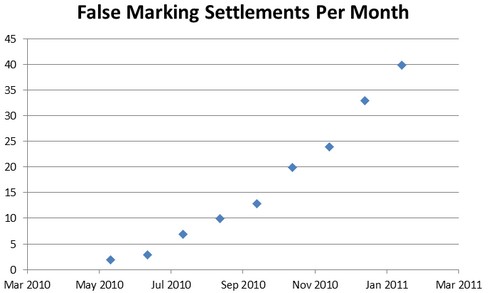
A few plaintiffs dominate the settlements. The top-five settlement plaintiffs are associated with over half of all settlements and settlement value. Patent Group LLC has settled the most cases thus far (37) while Promote Innovation LLC has the most revenue ($899,000). Patent Group LLC self identifies only as a Texas limited liability corporation represented by Ken Good of Tyler Texas. Promote Innovation LLC is also a Texas LLC represented by the Antonelli firm of Houston (former Weil Gotshal attorneys).
I pulled up the docket for Promote Innovation’s case against Roche. The complaint alleges that Roche falsely has continued to mark its ACCU-CHEK diabetes monitoring kits as covered by patents that were held unenforceable due to inequitable conduct back in 2005. See Roche Diagnostics Corp. v. Apex Biotechnology Corp, 374 F. Supp. 2d 673 (S.D.Ind 2005) (holding the patent and is progeny unenforceable).
Going back to the question of rapidly evolving interpretations of the statute (or not), was the holding by the CAFC that a now-expired patent number can be actionable false marking a reinterpretation or not?
I would ask them why they thought it OK to mark anything with a patent number that they knew that they did not have rights to.
What conceivable reason is there but to fool the public?
I am a relator in a 292 case. The invalidity of the patent was upheld in a published opinion by the Ninth Circuit Court of Appeals 33 years ago. During the motion to dismiss Defendant’s attorney admitted that the reason they didn’t know the patent expired was that they never had any rights in the patent. What do you say . . . false marking or not?
To quote that great and illustrious ping:
“Hmm, incentive to simply follow the law…
Then the law works, yes?”
link to patentlyo.com
“I like the middle ground, if you will, proposed in the current legislation, which limits the cases to competitors, and where harm must be shown as in any other case of competitive damage.”
Except that many patent owners won’t accuse other patent owners of false marking for fear of investigation into their own marking practices. That is where the benefit of the qui tam provision is realized. Moreover, some of the harm of false marking goes unreported because some of these markings do actually deceive in a way that never comes to light.
The only “problem” with this law isn’t really a problem at all. The sole reason there are so many defendants/lawsuits is that companies simply ignored the law because there was no perceived penalty for breaking it for so many years.
If left alone, this area – and the number of suits – would settle down on it’s own for sure. And, markings would be more accurate than in past years for the simple reason that people are policing now as they haven’t been in the past.
…and that about captures the sum total knowledge that Sunshine will be bringing to the table.
Cepts hayseed – this aint a competitive damage law. Never was meant to be. So how can ya arrive at middle ground that wasn’t part of the ground ta begin with?
Bust me a tag.
Anonymous
I agree. The “counting” was all over the map. That did not bode well for business expectations. The Fed Circuit had to resolve that issue, which they did, albeit with unflattering results.
I had considered that the Court never liked the way the statute was written in the first place, and interpreted in the manner of Bon Tool just to get Congress to clean it up. (Just a thought)
It’s true that the prior interpretation left no room for incentive – a cost/benefit analysis at $500/false marking occurrence (rather than per widget) would justify doing nothing, especially if “intent to deceive” is so arduous to prove. I like the middle ground, if you will, proposed in the current legislation, which limits the cases to competitors, and where harm must be shown as in any other case of competitive damage.
Further – the law itself wasn’t changed since 1952 – ya need ta actually check out the legistlative record – the changes from “ceiling” to “floor” were quite deliberate.
As to Anonymous point of “incentive” – that the various courts got it wrong and prevented the actual legislative incentive (also captured in the record) aint a problem with the 1952 law.
The current “reaction” frenzy aint got nothin ta do with the law and your notion of “was it really that “correct” to begin with?”. Clearly – if the law had been followed fromthe beginning, we would no have had the complacency (and disrespect) for patent market that has allowed this “cottage industry” to take place. People would have been on top of the situation from the get go and marks decades old would have been properly retired.
If you are talking about offense “counting”, the law wasn’t “re-interpreted”. The courts were divided on that issue prior to Bon Tool. That is, there were cases counting offenses numerous different ways, including the way adopted by the Bon Tool decision.
If you are talking about “intent to deceive”, then – yes – the law was re-interpreted.
“Invigorated” is not an inaccurate term in the sense that it was really the clarification of the law and the spot light that was put on it that resulted in the explosion of cases. And, of course, prior to Bon Tool, not many were following the law simply because there was no “incentive” to do so. That last part resulted in the existence of quite a few potential defendants.
“recently invigorated with a correct court reading”
Statutes are subject to interpretation. That’s where the courts come in. This is a classic example of how changing interpretations, in relatively short period of time, affect business practices and expectations.
The law wasn’t “recently invigorated,” it was re-interpreted. That is the Federal Circuit’s purview; however, there can be draconian results when adverse ramifications of the new interpretation(s) aren’t thought through. Solo Cup forced the Court to back-pedal and rely on “intent to deceive the public” more than it ever had to before.
Then the deluge of False Marking suits brought in “enhanced pleading” requirements, that are tantamount to a Fraud pleading to remove the cases, if possible, at the pleading stages.
The law is being re-interpreted as we speak at such a fast pace, one must ask was it really that “correct” to begin with?
ping, it’s your misquote at 1:06 PM. It’s the misquote that I pointed out to you at 1:11. It’s the misquote that you are trying to cover up now by kicking up dust.
Now we see why – ya can’t remember what ya done seen just thirteen minutes apart.
O great – here we go again with the geometric “there I showed you” schtick.
Was that the miquote of Mar 16, 2011 at 12:58 PM compared to Mar 16, 2011 at 01:11 PM ?
Those personality breakouts are occurring again – faster and faster…
“Not too long ago…”
Um that change was actually almost 60 years ago. true that it was recently invigorated with a correct court reading, but as indiacted by others on these threads – attorneys been joking abou the retirement fund for some time.
As for the rest of the reactionary crowd – includin the Ohio judge who shot to pieces his own argument about the lack of government access – by granting that very access (one great big D’Oh! there) – weza need to watch for future developments – but hten again that be true for all law. Hayseed – that dont change the law as it is NOW.
shine look directly above in this comment thread.
Do ya see anything amiss?
Yes, your misquote which I already pointed out to you.
“Ya follow the law or not.”
A note on following the law – which is usually statutorily based, and then laced with judicially created doctrine. First, one must actually consider and state what the law really is. Not too long ago, it wasn’t every widget marked, but the separate occurrences of false marking. Then, it became every widget.
Next, the law required enhanced pleading (FRCP 9), which as we now know from yesterday, means with particularity that would generally preclude statements made “on information and belief,” where there’s really no “information” presented.
Then, as we know, at least one district court (N.D. Ohio) has ruled the law unconstitutional under the Take Care clause of the US Constitution.
So, follow the law that is subject to changing interpretations, and then, I guess, you are open game. It’s really as simple (and as fair) as that.
Sunshine look directly above in this comment thread.
Do ya see anything amiss?
Really – when the item is as clear as black and white – such comments of yours wins the point for me.
Danke Sir.
ping, not sure why you’re putting “fluffy” in quotes. I don’t think I’ve ever used the word.
Also, your sarcasm meter needs adjusting. I never read the i4i brief. Why would I bother?
Nice – now go and review just how many times my observations done been captured by the “fluffy” coounsel who presented this to the “fluffy” Supreme Court.
Hint: ya gonna need more than your fingers and toes.
“Fluffy” indeed.
In the early 2000s, it was a common patent attorney joke that False Marking lawsuits were gonna be our retirement fund as no one really filed such suits even though we could see a potential lawsuit on products in the stores almost every day. Apparently, that no longer is true.
As Groundskeeper Willie on The Simpsons so eloquently spoke when he caught Homer and Bart siphoning off the decades-old cooking grease from the elementary school cafeteria, “Ach! Me Retirement Grease!”
Read the i4i brief yet,
Yes, I read that twice through immediately after it became available.
LOL.
My “fluff” against you r be otchin – I win that any and every time Sunshine.
Read the i4i brief yet?
Keep fluffing, ping!
“t seems like there is a balance of sanctimoniousness.”
Um, no.
Ya follow the law or not. If ya violate the law, then you are open game.
It really is as simple as that.
It seems like there is a balance of sanctimoniousness. False marking is only a violation, if it meets the scienter requirement. I am confident that many of defendants are careless, confused or lazy. If so, they are not guilty of false marking. The plaintiffs are opportunists, and if the real party is a front for the lawyers themselves, I’m not sure that it’s barratry, since there’s really no client. If not barratry, it’s not criminal and probably doesn’t violate any formal ethical rules. It’s surely unprofessional. What’s the universal answer on the Ethics exam? “It’s not unethical but I wouldn’t do it.”
“crime definitely pays”
Hmm. Would the “crime” in this instance be the actual breaking of law or the going after those that actually break the law?
Seriously Phillies Sweep, can you be any more sanctimonious?
Wow. I considered doing the false-marking shakedown on unsuspecting companies long before it became popular, but I decided I’d rather be able to look at myself in the mirror. Thanks, Dennis, for confirming what Woody Allen said in “Take the Money and Run”: crime definitely pays. It’s good to know that there are still lawyers out there giving the rest of us a bad name and making a good living while doing so.
DC, I’m surprised: you posted on false marking, but not about yesterday’s BP Lubricants decision (link to cafc.uscourts.gov), in which the CAFC held that the heightened pleading requirements for pleading fraud apply in false marking cases too. Considering the vast majority of false marking complaints allege “XYZ is a sophisticated company with many patents and therefore should have known better”, without the requisite particularity required for pleading fraud, I’m guessing there will be a lull in settlement activity for a while and a rash of motions to dismiss. On the other hand, the CAFC gave the plaintiff in that case the opportunity to amend its complaint, so we probably (unfortunately) haven’t seen the end of this particular form of legalized extortion. At least not yet.
Promote Innovation LLC
Just had to see it again. LOL.
Comments are closed.