By Dennis Crouch
Earlier this week, I directed your attention to the fact that the Board of Patent Appeals (BPAI) now has a backlog of more than 20,000 pending appeals. The appeal backlog continues to rapidly rise. Each month for at least the past year, the BPAI has disposed of only about half of the number of cases that it received. USPTO Director David Kappos and his senior staff recognize the appeal backlog as a serious issue. Their initiatives include more judges; a soon-to-be-announced new Chief Judge, and potentially raising the fees associated with filing an appeal (perhaps only if the PTO is given fee-setting authority).
For a number of reasons, the Board of Patent Appeals (BPAI) typically writes an opinion in each and every case decided on the merits. I wanted to see whether the Board’s opinion writing methods have changed as some sort of response to the growing backlog.
For today’s study, I downloaded all of the BPAI’s published ex parte merits decisions from three specific time periods: February 2009 (407 opinions), January 2010 (455 decisions), and January 2011 (457 opinions).* I then wrote a script to count the number of words in each decision and graphed the results.
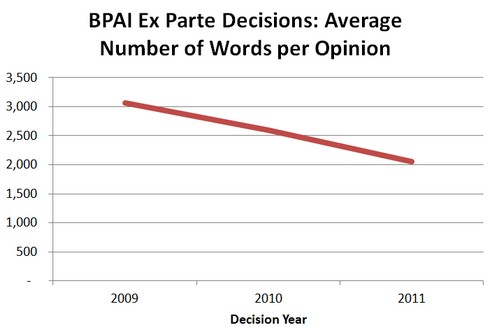
As the chart shows above, in a two-year period the average number of words per BPAI opinion has dropped from over 3,000 words per opinion to just about 2,000 words per opinion. A few large opinions each year skew the average upward. However, the change in the median word length is even more dramatic. The median opinion from February 2009 includes 60% more words than the median opinion from January 2011. As a check, I also included the outcome (Affirmed, Affirmed-in-Part, Reversed) and technology center as control variables. Those did nothing to reduce this reported effect.
Of course, the number of words in an opinion does not necessarily indicate that the decisions are lower quality or even that the opinions are lower quality. However, the change at least suggests that the BPAI judges are spending less time drafting the opinions.
Jason Rantanen has written several recent posts on the Federal Circuit’s Rule 36 affirmances. In those cases, the Federal Circuit simply affirms the lower court decision without writing an opinion. “Rule 36” refers to Rule 36 of the Rules of Practice of the Court of Appeals for the Federal Circuit. That rule provides the court with express permission to enter a judgment of affirmance without opinion when the court determines that the lower court should be affirmed and an opinion would have no precedential value. The BPAI does not have a parallel to Rule 36 in its standard operating procedures.
Notes
- * I used February 2009 because in a glitch for January 2009 data.
- I was just directed to Aaron Feigelson’s recent post on this topic.
I think that Ex parte Frye (a decision in which Director Kappos and then Deputy Director Barner participated) and the way the FedCir has treated BPAI decisions in the comparatively recent past (comments along the line of “we reverse and remand because there’s nothing in the decision we can review”) would prevent any sort of Rule 36-style decision.
If the proposed patent reform legislation passes with its current provisions ending fee diversion and enabling USPTO fee-setting authority, then I can see little reason why the BPAI should not be able to appreciably cut into and reduce its backlog. It’s a big “if,” certainly, but it’s also looking much more feasible this year than ever before.
“shifting the burden of persuasion to the applicant”
Cause it be the applicant fault, dammit Gumby.
“No one issues a rejection when they believe the applicant should be issued a patent.”
LOLOLOLOLOLLOL – reject-reject-reject- huhwhat?
The stompin I gave ya aint good enough? (Yeah, I know, ya used to horse hoofs beatin on your head).
What is such a big deal in that patent?
With not very special dispatch from what I heard.
Dear Director Kappos –
The solution to the Appeal backlog is to make a fair system even more fair by raising the fees so that we can hire more judges and shifting the burden of persuasion to the applicant.
But not only that, the solution is to require applicants to only file claims that should be allowed and to not let applicants get away with generating paper that looks like a application, but is just gibberish and wild assertion.
No one issues a rejection when they believe the applicant should be issued a patent.
If you want me to not reject an application, have applicants produce decent applications and claims.
My main man be kidnapped again. Cleraly, the question and answer be concernin why the current practicioner dont out himself.
So faux-IANAE, whoever ya are, are you doubting the existence of the “blacklist” now?
is going to get the paractitioner of record in that case put on the PTO “blacklist,”
Since when do you have to be the agent of record to read a file wrapper and form an opinion on it? Litigation counsel do it all the time.
Anyone know how the BPAI handles the special dispatch requirements of reexaminations?
The examiner gets no due process and needs no explanation. What he needs, at times, is a swift kick in the….
“No one files an appeal when they believe the examiner is correct.
If you want me to not file an appeal, produce decent rejections or allow my application.”
Right. On. The. Money.
7,146,407
I am not the attorney of record.
Why is it so difficult for you to comprehend that publicly raking a particular Examiner over the coals in a particular case, even anonymously, is going to get the paractitioner of record in that case put on the PTO “blacklist,” making it much harder for them to do their jobs?
Dear Director Kappos –
The solution to the Appeal backlog is not to make an unfair system even more unfair by raising the fees.
The solution is to require examiners to only reject claims that should be rejected and to not let examiners get away with generating paper that looks like a rejection, but is just gibberish and wild assertion.
No one files an appeal when they believe the examiner is correct.
If you want me to not file an appeal, produce decent rejections or allow my application.
“BTW, why are you switching my spelling to a French-style variant. Entertaining yourself again, are you?”
Cause, I just cut and paste from your post (which seems that you just cpied from cbird. So Iza guess that you have an answer to your own question, or perhaps ya wanna ask cbird instead of me?
“One starts from the position that the EPO Examiner is intelligent, and has surely identified an issue of substance (even if he can’t express his point perfectly) which, unless thoughtfully addressed, will bring the patent down after issue.”
Um, no.
One starts with an objective viewpoint of the examiner’s written word. If their are points that are not clear, a phone call is in order, or failing that, a written response addressing the unclear portion can be made.
One does not start with an assumption that “something must be amiss, just because the examiner says so.”
Maxie – if you had any dealings with examiners in the US, you would know better. Yet, still you want to comment on US practice sight unseen. You really wanna put the chuckle factor in a higher gear, dontcha?
prevent => preSent
when an examiner has a ridiculous stance and refuses to consider that it might be erroneous, the only response is to appeal.
Why is it always so difficult for the Examiner-bashers to prevent specific xamples of Examiners trying too hard to do their job?
Give thanks to that Examiner, for allowing the chance to address all validity issues before grant, for they might not be curable, after issue.
I keep saying the same thing, but I get shouted down by the others who would rather the court not pay too much attention to validity issues after the patent is granted.
Preventing a problem and ignoring the problem are kind of the same thing though, right? Po-tay-to, po-tah-to?
ping, I suspect that any person who has been a PTO Examiner for any length of time is very well aware what “adversarial” means. BTW, why are you switching my spelling to a French-style variant. Entertaining yourself again, are you?
6: your comment chimes in with my recent experience with instructing associates from US law firms. The ones with the better sense of how to look after their clients are not adversarial, just dogged in their reasonable pursuit of a claim which, while rendering the patent resistant to European-style attacks on its validity, nevertheless achieve 100% of the scope that is achievable, in Europe. One starts from the position that the EPO Examiner is intelligent, and has surely identified an issue of substance (even if he can’t express his point perfectly) which, unless thoughtfully addressed, will bring the patent down after issue. Give thanks to that Examiner, for allowing the chance to address all validity issues before grant, for they might not be curable, after issue.
I recently had a two sentence decision from the board, they stated they agreed with me and the Examiner should issue the case.
Pretty amazing…
The PTO could probably reduce the number of appeals if they would train their examiners to not stick with stances that are non-sensical. I don’t file many appeals, but when an examiner has a ridiculous stance and refuses to consider that it might be erroneous, the only response is to appeal.
Maxie,
As you can see, ya don’t need to be from mainland Europe to have no real understanding of what “adversariel” means.
6 – context, man, context. Ya gotta remember ta use the proper meaning of a word in its context – not just some Broadest Unreasonable Interpretation.
“I think US patent prosecutors will tell you that they are not all intrinsically “adversarial”, it’s just that they have no choice, if they must serve the best interests of their clients in their jurisdiction, overseen by the courts of the USA.”
On the other hand, all the really good lawyers have recognized that they do have a choice and that being “adversarial” is rarely, if ever, the best approach.
Hope you don’t mind me asking you, cbird, but I see you write “we” and I therefore guess that you’re not a patent attorney, right? I think US patent prosecutors will tell you that they are not all intrinsically “adversarial”, it’s just that they have no choice, if they must serve the best interests of their clients in their jurisdiction, overseen by the courts of the USA.
Or perhaps you are from mainland Europe, which has no real understanding of what “adversarial” means.
The PTO is not supposed to be a “business”. If it were, it could have competitors.
Hey, I just had one come back that basically said “what applicant’s counsel said. Examiner, try to learn the law for next time kthxbye.”
I would say part of the reason for the decline in opinion length is the Board’s continuing adaptation of the Judicial Opinion Model it had adopted in 2008. In that year, during which I was a Patent Attorney with the Board, Chief Judge Michael Kelly decided the Board’s role was for appeal of examiner errors, and not for a de novo re-examination as had been previously. All the APJs and patent attorneys were trained in the judicial writing model, as taught by the National Judicial College. After the training, there was a long period of trying to apply the principles to the various types of appeals seen at BPAI. There was a great emphasis on the formalistic compliance with the judicial writing principles taught. Over time, though, the Board appears to collectively have evolved its writing style to a more practical level.
I also noticed the glitch in January 2009 data (on the FIP-BPAI database on Westlaw/ThomsonReuters). I told them about it; hope they fix it sometime soon. Kind of ridiculous that an extra 5000+ BPAI opinions are coded as Jan. 1, 2009.
Dennis, the last post at http://www.1201tuesday.com linked to a BPAI decision (ex parte Schmieding) that contained almost no words.
Maybe if examiners were motivated to examine the claims to discover what might be patentable rather than just rejecting all claims and rushing to a final or RCE, the number of appeals being filed would go down significantly.
And I know prosecutors add to the problem by overclaiming, but it seems to me we would all be better served if patent prosecution were less adversarial.
We have seen in increase in briefer decisions where the Board simply refers the reader to large chunks of the Examiner’s arguments in the record. An inherent risk to such a practice is to simply miss where the Examiner’s position goes off the rails by failing to really hold the positions being taken to a rigorous review. There is nothing like writing something down to increase one’s comprehension and to discover a flaw in what appeared, when initially read, as a reasonable and logically coherent position (who hasn’t had that eye-opening experience when writing a non-infringement opinion?).
This message would have been shorter if I had more time.
Anyone who writes legal responses that have word/page limits knows that distilling the message down to a compact form takes time and effort. Anyone also knows that if the time is forced down and the words are forced down as well, that quality almost automatically suffers.
As to FKARK – one would need to gauge throughput (as in time per decision) which reveals the opposite of what you indicate.
I believe Samuel Clemons is purported to have written a letter to a relative that said WTTE, “I’m sorry this letter is so long. I didn’t have time to write it properly.” So, maybe the BPAI is now taking the time to write their decisions more properly, eh.
I disagree that less words = less time. Any good writer knows that being brief is more difficult than being wordy.
Don’t reall see a problem here, assuming the original OA was sufficiently detailed. Every OA has “findings of fact” and “conclusions of law” the same as any Board decision, even if not labeled as such.
“”What the Examiner said.””
lulzlulzlulzlulzlulzlulzlulz.
Allocating to the applicant is not “bungling” it is good business.
When BPAI decided my case their opinion was very short:
“What the Examiner said.”
(BTW, this posting form doesn’t work with Firefox 3.6.13 anymore. The POST and PREVIEW Buttons don’t appear.)
Hmmmm …
Windy raises an interesting and worthwhile point/question …
Also wondering how the chart might look if the average number of words in the corresponding briefs (adding word count from all briefs filed/case together may be best).
Could the decisions be getting shorter–at least in part–because the briefs are shorter as well?
Fewer args = shorter decisions?
I called it!
DC: “Of course, the number of words in an opinion does not necessarily indicate that the decisions are lower quality or even that the opinions are lower quality. However, the change at least suggests that the BPAI judges are spending less time drafting the opinions.”
My my, how very carefully worded. That is a commendable quite commendable not to jump to conclusions (as apparently I have).
I would be curious to see the graph if the y-axis was “average number of words / number of claims, per opinion.” The graph shown suggests to me that opinion quality has gone down, not surprising since the BPAI is also bungling the burden of proof lately as well.
Comments are closed.