This is a guest Post by Michael J. Mazzeo, Jonathan Hillel and Samantha Zyontz[1]
Our analysis of a new dataset challenges the assumptions on which the Patent Reform Act is based and questions the need for damages law reform. Damages provisions of the Patent Reform Act, the latest version of which was recently introduced for vote in the Senate, are premised on concerns that awards are “too often excessive”[2] and those large verdicts featured in media headlines “represent the tip of the iceberg” of excessive awards.[3] Last week at the inaugural Samsung-Stanford Patent Remedies Conference, we presented a very different picture of patent infringement damages.
In our prize-winning study, “Are Patent Infringement Awards Excessive?: The Data Behind The Patent Reform Debate”, we compile a dataset comprising infringement awards from over 300 cases decided in US federal courts between 1995 and 2008. We build on a proprietary dataset from PricewaterhouseCoopers, supplementing it with information about the litigants, lawsuits and economic value of the patents-at-issue. Using standard statistical techniques and regression analysis, we search for evidence of “excessive” awards. Certain of our key findings are summarized below:
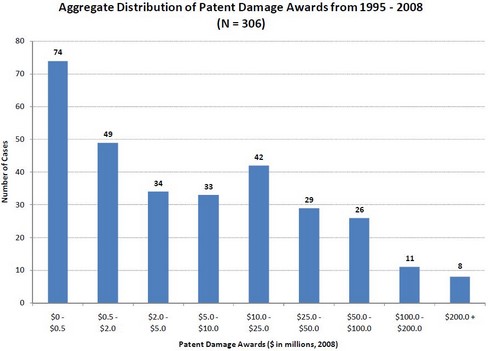
1. The eight largest awards represent nearly half of the total amount of damages in our dataset. As shown below, the distribution of damages is highly skewed, and awards in the largest eight cases represent over 47% of cumulative damages.
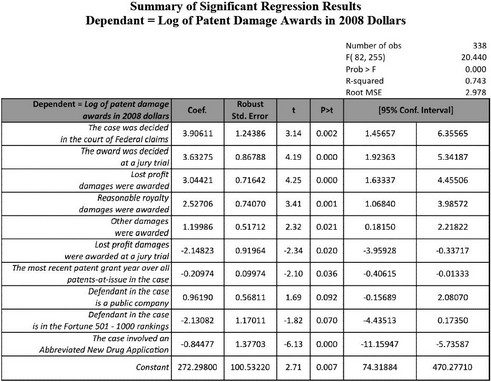
2. Patent infringement damages are highly predictable. We perform an 80-variable log-linear regression analysis that explains nearly 75% of the variation in the observed awards. As shown below, the first-order results of our regression indicate that juries and large defendants are correlated with higher awards.
3. The largest awards are not outliers of our model. We calculate predicted values for each award in our dataset, based on the factors present in each case. The residuals graph below shows the difference in logs between the actual awarded amount and predicted value on the horizontal axis with the corresponding damages award level plotted along the vertical axis. The largest residuals do not represent the largest awards, which are situated above the $200 million line:
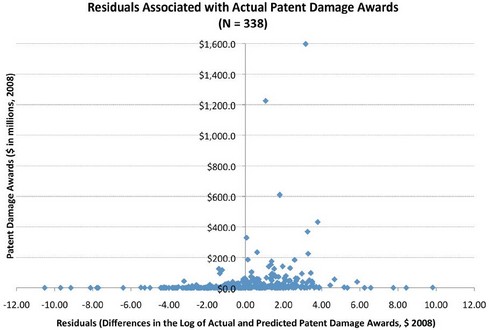
Taken together, our empirical analysis does not reveal evidence of a systematic or pervasive problem of “excessive” patent infringement awards. It is quite clear that a very small number of very large awards exist; however, these awards are very rare and serve to skew the distribution immensely. Furthermore, damages generally (including the largest awards) are highly predictable using our model.
As the Patent Reform Act restarts its route through Congress, legislators should refrain from passing reforms designed to address systematically “excessive” patent infringement awards. Nonetheless, as we continue to analyze our dataset, specific areas in need of targeted reforms may be revealed. A draft of our study report, including descriptions of our methodology, findings and questions for future research, is available on SSRN at: http://papers.ssrn.com/sol3/papers.cfm?abstract_id=1765891.
——————————————————————————–
[1] Michael J. Mazzeo is an Associate Professor in the Department of Management and Strategy, Kellogg School of Management, Northwestern University, and a Faculty Associate at Northwestern University's Institute for Policy Research; Jonathan Hillel is an Associate at Skadden, Arps, Slate, Meagher & Flom LLP; Samantha Zyontz is a Senior Research Associate at the Searle Civil Justice Institute, Law and Economics Center, George Mason University School of Law.
[2] Senate Report on the Patent Reform Act of 2009, S. Rep. 111-18, at 8 (May 12, 2009).
[3] Senate Report on the Patent Reform Act of 2007, S. Rep. 110-259, at 12 (January 24, 2008).
“Patent infringement damages are highly predictable. We perform an 80-variable log-linear regression analysis…”
Spoken like a true economist.
Perhaps the main problem with patent litigation damage awards is not with supposedly-“excessive” awards, but with the lack of an articulable baseline for determining damages. Maybe the awards have indeed been generally consistent, but it’s problematic that no specific standard for them appears to exist. Certainly it contributes at least to a perception that something is wrong. Though of course the media doesn’t help much, either; apparently they find it irresistible to report billion-dollar verdicts, and often fail to note that such awards don’t constitute the norm.
If you really believe what you just said about business and the development of inventions, you are tragically misinformed.
What I said was that if the patent system promotes keeping your invention secret until just the right moment, rather than promptly filing an eventually-published patent application, the system is doing the opposite of what it’s supposed to be doing.
Typically, there are lot of ideas and a lot of dead ends. One never truly knows what will work until it does work.
Right. That’s what provisionals and broad claims are for. If you’ve invented something that is ready for patenting and you’re sitting on it because it’s not ready for commerce yet, and someone else beats you to the patent office, too bad for you. You haven’t actually given the public anything, and you don’t deserve anything in return. What you actually have is what we typically call a “trade secret”, which you can and should kiss goodbye once someone else publishes that secret.
What we argue for is the simply opportunity to allow us to wait until we have something that works before we need to file anything.
You have to do that anyway. Until you have “something that works”, you don’t have an invention or an enabling disclosure. But at that point, you need to file something, if a patent is what you really want.
The patent system shouldn’t let you wait until you have “something that sells”. Imagine the chaos in the pharmaceutical industry. The patent lasts 20 years, and that’s plenty of time for you to further develop your “something that works” into something you can sell.
Paul–
Good point. All asserted claims were held invalid for inadequate WD, and the DC judgment was actually reversed.
In Centocor Ortho Biotech Inc et al v. Abbott Laboratories et al., No. 2010-1144 (Fed. Cir., Feb. 23, 2011) the 2009 Johnson & Johnson’s biotech unit Centocor $1.67B damages award was killed on appeal for the patent being 112 invalid. I wonder how many other of the extemely large average-affecting jury verdicts in this study have met a similar fate on appeal?
The one thing absolutely needed is willfulness reform as it is found much more often than it should be.
bust me a tag right some.
O that crafty Michel dude, still tryin to spread his influence…
“We can do so again, but why try if the audience will not listen.”
Because it causes chuckles?
“The patent system isn’t supposed to let you develop your entire business before you file an application, or sit around until someone else files for the same invention before you pounce. If that’s what people are doing, it’s a flaw in the system that should be corrected. Besides, if the small inventor can do it, he can just as easily fall victim to it.”
Man, IANAE, you really need to spend some time inside a business to understand how things are done. If you really believe what you just said about business and the development of inventions, you are tragically misinformed.
Typically, there are lot of ideas and a lot of dead ends. One never truly knows what will work until it does work.
What we argue for is the simply opportunity to allow us to wait until we have something that works before we need to file anything. Otherwise, we will have to file on every idea whether or not it works just in case that idea eventually is IT.
Which of those two do you think would least offensively apply to prize-winning scientist Marie Curie?
But the real value in a FTI system is not the contest between two rivals to the same patent, but the grace period. It allows one to continue to invent/develop as long as it takes, comfortable that if someone else does disclose something, one still has one year to get a patent application on file.
You shouldn’t need to “invent/develop as long as it takes”. The inventing is done once you can write an enabling disclosure. If you still need more time for “inventing”, you don’t have an invention yet, and it shouldn’t bother you if someone else files an application for what you haven’t yet invented.
Furthermore, if you’re that complacent in not getting your invention to the PTO, you might well have abandoned, suppressed or concealed the invention. You certainly haven’t shown any interest in patenting it, selling it, or disclosing it to the public.
The patent system isn’t supposed to let you develop your entire business before you file an application, or sit around until someone else files for the same invention before you pounce. If that’s what people are doing, it’s a flaw in the system that should be corrected. Besides, if the small inventor can do it, he can just as easily fall victim to it.
IANAE, we’ve tried to patiently explain the advantages. We can do so again, but why try if the audience will not listen.
As to deep pockets and all that, note the interference will occur much later in time than the date of invention or filing. By then, the owner of a successful invention will have gotten his business off the ground and will have the money to invest in an interference.
But the real value in a FTI system is not the contest between two rivals to the same patent, but the grace period. It allows one to continue to invent/develop as long as it takes, comfortable that if someone else does disclose something, one still has one year to get a patent application on file.
Jonathan Hillel said above…
“Not moot. Only the willfulness criteria were removed; the more central damages amendment in S.23, the “gatekeeper” standard for compensatory damages, remains.”
The report I have of the latest Manager’s amendment says it will: “Strike all damages language remaining in the bill — including the gatekeeper, sequencing, and recodification of current law as subsection (a) which was the “grand compromise” brokered in the last Congress by Senator Dianne Feinstein (D-CA), then-Senator Arlen Spector (R, then D-PA), and Senator Leahy. The bill now makes no changes to 35 U.S.C. § 284″
??
I thought “prize-winning” was reserved for livestock and apple pie recipes.
See the work of Ron Katznelson
Okay. Where’s that?
“model included 80 variables”
Obviously, my name (and my methods) needs to be investigated.
IANAE,
See the work of Ron Katznelson if you really want to see why start-ups so desparately need the FTI system. Yes, he includes hard data, and yes that hard data has been shared manytimes over the course of the efforts to weaken the current system by complicating “the race to file.”
Then again, I am sure that you are well aware of this and that you are simply on your typical troll patrol.
there are others, startup, who desperately need a FTI system. These are the facts.
Why, exactly, do start-ups so desperately need the FTI system? What advantage do they really get from it?
I haven’t seen any indication that big companies are any better than individuals at racing to the patent office, even on the not-as-common-as-they-would-have-you-believe occasion that BigCo and Joe Inventor actually do come up with the same invention. Certainly not better by enough to overcome any significant difference in dates of invention. Even if they do, I haven’t seen any indication that Joe Inventor would stand much of a chance in an interference against a company with good internal record-keeping procedures, even if he could afford one.
The only demonstrable advantage to either party in FTI is that BigCo is much more likely to be able to afford an interference if it comes to that. Which means that BigCo still always wins if it files first, and sometimes wins if it files second. Joe Inventor should be racing to the PTO even today.
If getting a patent is important to you, you should structure your affairs so that asking the PTO for a patent is a high priority and gets done quickly. If your other priorities are more important than getting a patent, that’s your business decision to make. That’s all there is to it.
It’s not the government’s job to be charitable to people who think along the lines of “I guess I’d like a patent, but doing this other thing with my invention that implies I don’t want to keep it to myself is more important to me”.
I’m sorry Paul, but many here have been arguing against the whole concept of junking the FTI patent system that has stood the test of time. In contrast to the many excellent defenses of the current system posted by so many for so long, the proponents of “harmonization” have YET to articulate even a single understandable reason WHY it is necessary to move away from FTI. What problems are they trying to solve. What advantages are there to Americans as a whole in a FTI system?
None of that has been articulated. Rather the proponents simply state something along the lines of the following:
There is a desperate need for patent reform. We must do something.
But there is never any articulation of what the need is and why the fix has anything to do with the alleged problem.
Major companies are already on a first to file system, but there are others, startup, who desperately need a FTI system. These are the facts. They cannot be ignored. Doing away with FTI substantially harms startups without providing any perceptible benefit to anyone else.
But there is a subtle issue here, is there not? If big companies can suppress startups, what are they doing?
This whole venture is a fraud by big business who are feathering their own nests and suppressing future competition. It will harm American big time.
Call a halt now!
Your model included 80 variables … what was the original candidate list of variables? How did you narrow down the list to the final 80, did you use something like stepwise regression?
On the contrary – “[t]he fact that 75% percent of our damages data fits the regression” proves only that it’s a poorly fit regression, but proves nothing regarding the presence or absence of systemic error. Indeed, statistical analysis of empirical system results is not capable to detect system error, absent a good understanding of the baseline desired results.
“normative positions of what patentees should be entitled to are not necessarily good grounds for overhauling damages legislation across all cases”
That is the pot calling the kettle black–you have just stated your own normative position.
In addition, by saying “not necessarily”, you have admitted implicitly that normative positions of what patentees should be entitled to may in fact be good grounds for overhauling damages legislation.
So the real questions are: what are the bases of the normative position, to what extent are those attitudes and perceptions supportable, and how are they in fact used in policy-setting?
Can you expound on precisely what you mean by “erroneous”? You may be touching on something worthwhile here, I’m not sure.
Yes, that was a prize-winning comment.
I wonder if it violates the canons of ethics prohibitions on self-laudatory statements.
Quite right that there are different ways to define “excessive”, but normative positions of what patentees (or any specific type of inventor/original assignee/acquirer) should be entitled to are not necessarily good grounds for overhauling damages legislation across all cases. The fact that 75% percent of our damages data fits the regression cuts against the notion that damages awards are systematically erroneous (one measure of “excessiveness”). The fact that large awards fit our model shows that, though they are the tail of the distribution, they are not unpredictable. And the finding that awards are largely predictable further undercuts the notion that patent trials are a high-stakes gamble from a damages perspective. As an empirical study, the point here is to inform the debate with real world data to identify where the real problems lie and which concerns are overblown.
“I’ve only read this summary here, but the authors seem to be defining “excessive” as “larger than the algorithm we devised to explain patent damage awards would predict.” If that is indeed the point of the study, then I see a circularity problem. But I think it also misses the point that when most people speak of excessive damages, what they really mean is that the damages are out of proportion to, or larger than necessary to right the wrong. So the results of this study could also justify the conclusion that all damage awards are too large (and predictably so).
Of course the reason why a study like this will never show an accurate picture is that it can’t take into account what many in the trenches know experientialy: Many of these patent awards go to litigants who have not actually invented anything useful and have never had any intent of doing anything with their patents other than litigating them. The question of what is an appropriate damage award in such cases is a philosophical question, not a math problem.
”
Indeed, perhaps we should look to “actual damages” to determine what an appropriate award would be.
In our prize-winning study
ugh…
“but it is the only game in play”
And you consider that a rational basis for acceptance?
No, Paulie, your place is right here with the rest of the wankers.
“but at least it should be debated on a rational basis”
Wrong blog. Try the Eskimo’s place, or better yet, for you, try the Patent Hawk.
Many of these patent awards go to litigants who […] have never had any intent of doing anything with their patents other than litigating them.
That’s the only thing you can do with a patent.
Contrary to some of the automatic knee-jerk assumptions by opponents of any changes in patent law that permeate many other blog comments, it is not honest to simply accuse this Bill of being anti-patent legislation without pointing out facts supporting that view. In fact, S.25 contains several highly PRO-patent-enforcement provisions, such as elimination of “best mode” defenses, a Section 10 system to eliminate all fraud or inequitable conduct defenses, etc.
I have no personal position on this legislation one way or another, but at least it should be debated on a rational basis. Furthermore, it is now far to late [after six years of bi-partisan work on this bill to get it to the Senate floor] to still be suggesting pie-in-the-sky academic proposals. The present bill may not be well drafted in places, but it is the only game in play.
I’ve only read this summary here, but the authors seem to be defining “excessive” as “larger than the algorithm we devised to explain patent damage awards would predict.” If that is indeed the point of the study, then I see a circularity problem. But I think it also misses the point that when most people speak of excessive damages, what they really mean is that the damages are out of proportion to, or larger than necessary to right the wrong. So the results of this study could also justify the conclusion that all damage awards are too large (and predictably so).
Of course the reason why a study like this will never show an accurate picture is that it can’t take into account what many in the trenches know experientialy: Many of these patent awards go to litigants who have not actually invented anything useful and have never had any intent of doing anything with their patents other than litigating them. The question of what is an appropriate damage award in such cases is a philosophical question, not a math problem.
What patent.drafter said.
Ping–
My comment was made merely to point out one source of the perception that damages awards are excessive–that is, the attitude that NPE’s are not worthy of the same rights or protections as are practicing entities.
In point of fact I do not agree with that proposition, but there are many who do, and that attitude is but one of many sources for the excessive damages perception that are not at all considered by the referenced paper.
If trolling happens, it won’t be from me!
But maybe you can patent a method of making funny numbers…
Not moot. Even if this passes the senate (and given the contention here, that’s not yet a gimmie), ya still gotta get by the House and man they will be peeved that they have not been consulted prior to all this wrangling.
Paulie, how many years in a row (or is it ROW) now has “Patent Reform” been padding the Congress’ coffers?
” We perform an 80-variable log-linear regression analysis that explains nearly 75% of the variation in the observed awards.”
I like the conclusions made. However, multi-variate statistical analyses basically are junk. Particularly when only 75% of the observed variation is “explained” (e.g. correlated, without demonstrated causation). Even more so, when the conclusion is that the analysis has rendered any outcome “predictable” from a starting set of knowns that may or may not include all 80 variables considered in the statistical study.
So, again – I like the conclusions. Too bad they lack support in the synopsis here presented.
That first graph cries out for a 3d pie chart to better illustrate the statement “awards in the largest eight cases represent over 47% of cumulative damages.”
For example, make the arc of each pie slice represent the contribution to the cumulative total, height of each slice represent its associated category of damages (e.g. $0-0.5 M), and number each slice according to how many cases in that category.
Then we would have a meaningful graphic …
“The issue has been considered particularly in light of NPE’s, and to what they “should” be entitled based on the underlying “wrong”. ”
WOW, what a cue-in for subjective and arbitrary trolling.
Let’s run another 500 comment (C)onstitutional (C)omment (T)hread on the “wrong” of having the (F)undamental (R)ight to (E)xclude violated.
yummy.
Reportedly the venue provisions have also been eliminated by the most recent amendments. Are they not?
Just because they call it “reform” doesn’t mean it is. What it will do is help large corporations maintain their monopolies and kill their small entity and startup competitors (which is exactly what they intended it to do) and with them the jobs they would have created. According to recent studies by the Kauffman Foundation and economists at the U.S. Census Bureau, “startups aren’t everything when it comes to job growth. They’re the only thing.” This bill is a wholesale slaughter of US jobs.
Please see link to truereform.piausa.org for a different/opposing view on patent reform.
link to docs.piausa.org
Thanks for your update on the latest S. 23 amendments.
But isn’t the enforcement of District Court judges “gatekeeper” functions (to exclude legally improper damages tests evidence and jury instructions) also already recently being enforced by the Fed. Cir.? In particular, Lucent v. Gateway (Fed. Cir. September 2009), plus two E.D. TX D.C. decisions in which Judge Randall Rader [now Fed. Cir. Chief Judge] sat by designation: Cornell v. HP (March 2009) and IP Innovation v. Red Hat and Novell (March 2010).
[Even Judge Ward reduced his last-July E.D.TX jury award of $52 million in LaserDynamics v. Asus Computer International down to only $6.2 million [11%], as the largest amount properly supported by the evidence. Presumably the legislation is intended to make it clear that this is truely enforceable law not subject to the variant whim of some D.C. judge, or other Fed. Cir. panel, to ignore?
The present proposals for venues are quite obsolete. There is no reason that arbitrations cannor occur by webcam totally eliminating the travel expense of both litigants.
This paper has all the hallmarks of somebody trying to make a name for themselves, right down to the presence of a colon in the title.
Hey weary lexicographer, are you also a grammarian? Is it even grammatically correct to follow a question mark with a colon?
The question of whether a damages award is perceived as “excessive” must be considered in relation to the perceived wrong, not in an absolute sense as in this paper (unless I am mistaken). The issue has been considered particularly in light of NPE’s, and to what they “should” be entitled based on the underlying “wrong”. This paper totally ignores that reality.
The paper’s conclusion that “our empirical analysis does not reveal evidence of a systematic or pervasive problem of “excessive” patent infringement awards” is absolutely true.
Unfortunately, it is only true because the authors looked in the wrong place.
With the correct changes in limiting the start of trials to two years damages can be drastically reduced compared to 15 year average in our present system also this will level the playing field in court or arbitration and also improve the incentive to create invention. Adding requirements such as written notice via registered mail from patent office of infringements from plaintiffs complaints to uspto will also limit damages.
Re: “Patent infringement damages are highly predictable.”
{Certainly not for juries or for the parties, which is where it matters, especially for the settlement negotiations by which 97% of patent suits are resolved before trial, and for risk analysis.]
Re: “juries and large defendants are correlated with higher awards.” Not exactly a revelation, and of course “juries and large defendants” comprise almost ALL of the increasing numbers of troll suit defendants and lucrative settlement extractions, which is the problem the legislation was really for.
Nor are awards of only a “few” million dollars insignificant to many companies, especially after adding a few million dollars more in legal costs for their unsuccessful defense.
Not moot. Only the willfulness criteria were removed; the more central damages amendment in S.23, the “gatekeeper” standard for compensatory damages, remains. Interestingly, our variable for enhanced damages did not factor highly in the regression.
Moot issue even if correct? – now that the S.23 provisions on patent infringement damages was reportedly removed by amendment on the basis of the problem having been addressed by the case law. [In re Seagate Technology, 497 F.3d 1360 (Fed. Cir. 2007)]
Comments are closed.