by Dennis Crouch
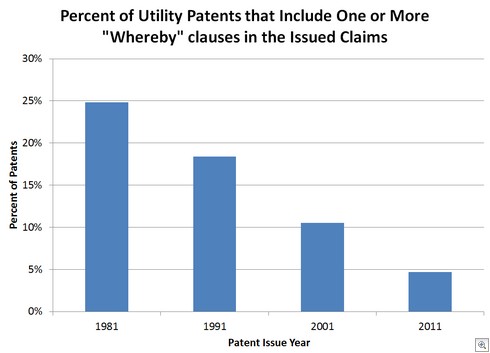
I see the above chart is indicative of patent applicants’ shift away from filing patent applications that particularly identify the inventive features of the inventions being patented. “Whereby” clauses have traditionally been used in patent claims as a mechanism of particularly identifying the new result of the claimed invention. In his guide for inventors, David Pressman recommends “adding a ‘whereby’ clause to specify the advantage or use of the invention to hammer home to the examiner, or anyone else who reads your claims, the value of your invention.” Patent It Yourself (2009).
As the chart shows, whereby clauses have fallen out of fashion. I attribute the reduced reliance on the whereby clauses as largely driven by a perception that whereby clauses do not narrow the claim scope during prosecution but may well be limiting during a later infringement analysis. Even if not limiting, a whereby clause may also cause a patentee to lose face before a jury if the cited advantage turns out to not exist or already be well known in the prior art.
In Hal Milton’s recent article, he focuses more on the identification and disclosure of the new result and not on particularly claiming the new result. This particular statistic that I have identified here does not pick up whether applicants are identifying the new result within the specification (outside of the claims).
Note: I created the chart above by counting the number of patents that included the word “whereby” within the claims and then divided that sum by the total number of utility patents issued during the relevant time period.
The applicability I cited was directly related to functional claiming: e.g. “I claim process step A whereby it results in 1.” In this case the result is a positive affirmation of an already stated process step and can be considered optional. In the alternative “a processing unit wherein the processing unit comprises a x86 architecture” would not be optional.
As a general rule examiner reject every clause of a claim with actual art. However, results of known steps are sometimes sent a 112 objection to have it positively recited in the record why the result is not optional.
Classic examiner mentality is the same as the classic practitioner: play dumb. Until practitioners get behind the disclosure and start working with examiners to actually define what a patenting entity is actually entitled to, as opposed to say… the entire IP of the internet in a single claim, Examiners will continue to act such that arguments and disclosures are required to rebut baselessly broad claims and determine if adequate enabling disclosure has occurred.
“Given that fact, a blanket prohibition on them, in the USA, would be unthinkable. It’s just a matter of where to draw the line.”
Maxie, draw the line?? You need a line??? In the USA we just need the Diehr doctrine. Applications of a concept does the trick. Or if ya wanna get fancy Applications of real world technology to specific industrial processes. SCOTUS, gets it and now so does the CAFC. Let’s hope in the next 5 years the PE’s at the PTO will get it too. A BPAI decision and memo should set them straight.
In contrast, the middle classes are there to pay the bill and to be laughed at by the elites. See, e.g., the Patent Bill.
_______
There is no law that says you have to stay middle class, or ignorant.
It will take at least a generation of patent attorneys and judges, before a jurisdiction switching from FtI to FtF adopts FtF standards of specification-writing. I know the requirement for an enabling disclosure is left unchanged by the Bill. Every patent law requires an enabling disclosure.
As to the prior user exception, I have compared the respective texts, and have more than 30 years of experience with the European right of continued use on which the Bill’s provision is modelled. What is the basis for your declaration that I am “completely false”? It strikes me as a reckless declaration. Can you convince me it is not?
“The prior user exception in its newest manifestation is not extensive at all. It is narrower than the very narrowly drawn and seldom useful “right of continued use” in Europe.”
Completely False.
“Discrepancy of specification length,” has nothing to do with “enablement requirement.” Please read the posts: the enablement requirement is not affected by the proposed FTF change. You are in too much a hurry to shill your view. At least stop and understand the issue before you recklessly shill over it.
The prior user exception in its newest manifestation is not extensive at all. It is narrower than the very narrowly drawn and seldom useful “right of continued use” in Europe.
If FtF does not drive out much of the verbiage in US-drafted specifications, why is it that apps written in FtF jurisdictions are invariably about half the length of those written in the USA?
Here’s a thought for you. Judges know that in FtF it is a “race to the Patent Office” whereas in FtI, they are thinking that the drafter can take as long as they like, to paint their picture of your invention. How long does it take, till the picture is finally ready for filing? How tolerant are judges, of any deficiency of drafting, when they know you have had all the time in the world, to get it perfect?
If that does not explain the discrepancy of specification length, between USA and ROW, what’s your explanation?
“you might be surprised how much raw power FtF gives to the party who was, as an indisputable fact, first to file.”
Hence, the extensive prior user rights insertion. Why bother with the patent system at all if you can simply disregard what anyone else does?
“FtF drives down enablement requirements”
On its face, this statement is complete nonsense as enablement is not related to the filing issue (one needs the same level of enablement in both systems).
That’s funny Ned, about the Patent Bill (the rest isn’t funny at all, of course).
You see, from outside the USA, it looks like First to Invent is an elegant way to ensure that BigCorp Goliath has endless opportunities to kick sand in little David’s face, all the while laughing at him.
As many commentators have pointed out, you might be surprised how much raw power FtF gives to the party who was, as an indisputable fact, first to file. Corporate bidders will scramble to be the one to become David’s successor in title, or to take an exclusive licence from him. That’s not what happens today, is it?
Once David has got as far as enabling his inventive concept, the additional cost of filing on it is trivial. Furthermore, FtF drives down enablement requirements.
The Bankers get richer because they are protected by US government. In contrast, the middle classes are there to pay the bill and to be laughed at by the elites. See, e.g., the Patent Bill.
Who said anything about “forced” rules? What would you say: is there divergence or convergence, as science continues, slowly but surely, to unravel the Laws of Nature? If there is convergence, how much is it “forced”?
I follow EO Wilson’s theory of “consilience”, to get from the Laws of Nature to the Laws of Patents. I was impressed by Stephen Jay Gould, writing on convergence of baseball batting stats.
The world gets ever smaller but, so long as it adheres to Westphalia rules, America has perfect freedom to enact whatever laws it pleases and what international conventions it joins. Nobody ever said anything else. You see “forced” where there is none. Whatever is it that is making you so anxious?
We see divergence in the USA, I agree. The bankers get ever richer while the middle classes get ever poorer. Is that perhaps what makes you so anxious? It should do.
“Convergence, I think it’s called. It is everywhere you look. If you can bring yourself to look at it.”
Divergence is also everywhere you look. If you can bring yourself to look at it.
Shilling for a forced international set of rules ignores the fact that there is not an international set of laws. It is not entirely clear that even having a single internatioanl set of laws is desired, much less advantageous.
Well well, old friend, it is an appeal that keeps you away, but nevertheless you can’t resist joining in, eh?
Europe has to struggle with the statutory prohibition on business methods as such, while you are free to patent anything under the sun made by man so long as it is within “useful arts”. Of course business methods live, no question of that. Just look how many business method patents the EPO issues, each week. Given that fact, a blanket prohibition on them, in the USA, would be unthinkable. It’s just a matter of where to draw the line.
Let’s take this up again, ten years from now, and see where we are with it then.
Remember how, thirty years ago, UK and Germany used to be at opposite extremes on claim interpretation, with peripheral and central claiming respectively? But, free of statutory restraint, they have drawn together to such an extent that in some cases (Mabuchi Motor, for example) England finds literal infringement while Germany finds the same claim not even infringed under its Doctrine of Equivalents.
Convergence, I think it’s called. It is everywhere you look. If you can bring yourself to look at it.
” it simply expresses the intended result of a process step positively recited'” Hoffer v. Microsoft Corp., 405 F.3d 1326, 1329, 74 USPQ2d 1481, 1483 (Fed. Cir. 2005.”
This is correct and if I recall its what David Pressman originally taught. I have not read the latest edition of his book. But Whereby clauses in process claims should merely summarize the claim and its intended result. When done this way their is no limiting effect.
@ Maxie, You still have tight pants for business methods? Look, Maxie as long as Diehr is controlling precedent, and Bilksi 14 made that clear, Business Methods live. The UK/EPO is not the USA.PO. Thank God!
Now back to work on my appeal.
Another examiner that selectively quotes from the MPEP. As I noted above, this same section of the MPEP also states:
The determination of whether each of these clauses is a limitation in a claim depends on the specific facts of the case. In Hoffer v. Microsoft Corp., 405 F.3d 1326, 1329, 74 USPQ2d 1481, 1483 (Fed. Cir. 2005), the court held that when a “‘whereby’ clause states a condition that is material to patentability, it cannot be ignored in order to change the substance of the invention.” Id.
Perhaps YOU need to read the MPEP.
2111.04 also states “The determination of whether each of these clauses is a limitation in a claim depends on the specific facts of the case. In Hoffer v. Microsoft Corp., 405 F.3d 1326, 1329, 74 USPQ2d 1481, 1483 (Fed. Cir. 2005), the court held that when a “‘whereby’ clause states a condition that is material to patentability, it cannot be ignored in order to change the substance of the invention.” Id.
Classic examiner — ignore that the case law requires that an analysis be performed based upon the specific facs. Instead, as I have seen in many instances, examiners adopt a per se rule that anything after “wherein” or “whereby” is optional.
I did mean the kind regards. It’s not likely I’d get too worked up about anything on here.
But if you really think you’ve won something, whatever.
Basically, the former Exr indicated that the PO treats the element recited in a whereby clause as optional, which means it might occur or it might not. Doesn’t matter either way. Seems unlikely that any claims drafter is going to put optional elements in a whereby clause, but the PO (this time induced by the CAFC) seems to think that “whereby” and “optionally wherein” are synonyms. Again, whatever.
You then stated, “I have no problem understanding that the use of the word ‘optional’ here as signifying that the clause that starts with ‘whereby’ is not necessary to the claim because the effect does not optionally occur – the effect is already captured by the other existing claim terms, making the entire ‘whereby’ clause unneccesary for legal effect.”
If you understand “whereby clauses are considered to show ‘optional’ material” to be equivalent to “the effect does not optionally occur”, then you are saying “optional” and “required” are synonyms.
Alternatively, you are saying that “optional” and “unnecessary” are synonyms.
If you are saying either of these things, then we will have to agree to disagree.
At least you are a gracious loser, Bio PatAtty (even if you don’t mean the kind regards).
If you say so.
Best of luck to you.
Correction:
I avoid the “basic BioPatAtty’s version of English comprehension” like the plague.
Highly advisable to all, as the first symptom is that those infected act like imperial a_ sses who make wildly incoherent statements and act like what they said actually makes sense.
Too late for you.
The problem with “technological” is that it has no well understood meaning. It is a term that has no long history of prior judicial interpretation for anyone to fully understand it.
That is a central problem with a lot of the Kappos-Armitage-Griswold “reform” bill. It introduces terms that have no well understood meaning anywhere in judicial history for terms long well understood. That can only lead to chaos and uncertainty.
“examiners are on tight time deadlines resulting in non-nuanced rejections. “If in doubt, throw it out.””
When I was an examiner, the motto was “when in doubt, pass it out”…in other words, when you don’t have the art, allow the claims instead of trying to stretch the references. Of course, that was the mid-1990s. The next administration took on an anti-allowance stance and an entire generation of SPEs and examiners will still have that mindset even with the pro-allowance stance of the Kappos regime.
Basic English comprehension still seems to avoid you like the plague, doesn’t it Pete?
“But we are not arguing practical prosecution here.”
Yes – we were arguing basic English comprehension in the present context of practical prosecution.
PriorPTO, why are you so slow to recognize BioPatAtty’s superior mental powers? Why are you so slow to be able to practice in the mode that will be law in 3-5 years.
No, wait…
US readers are usually troubled by the notion of the “reasonable starting point”, supposing that resort to the specification to fix the “reasonable starting point” (and hence the “objective technical problem”) is pure hindsight and ex post facto analysis.
But, in a First to File jurisdiction, it isn’t.
You see, the validity of the claim is judged by:
1. The prior art universe prior to the date of the claim and
2. what the inventor announced as her invention (which is also prior to the date of the claim because the drafting activity is necessarily anterior to the date relevant for the validity of the claim).
You see, the date of the claim can only be a PTO filing date, the date of constructive reduction to practice, if you will, the date of giving birth not the date of the act of conception.
I suspect that, even though you tell me that prior art up to the PTO filing date is available for obviousness attacks nevertheless, because of First to Conceive, obviousness thinking in the USA is bedevilled with the philosophical notion that obviousness is as of conception, and so the inventor’s description of what she invented is somehow disbarred from being used as the starting point (if you will) for the obviousness analysis.
Yes Prior. We’ve been though that. Asked and answered. The MPEP says that they are considered optional, and the reg is based on a CAFC case. Thus, we all have to move forward accordingly.
But we are not arguing practical prosecution here. The CAFC occasionally (being charitable) and the PTO frequently (also, unfortunately, being charitable) comes up with this type of stupidity. So we all adapt. I’ll use wherein and whereby clauses, and you (or your current brethren) will ignore them.
That’s the state of the law today. But who knows what it’ll be in the 3-5 years when the apps actually get picked up for examination?
Maybe you haven’t read the MPEP lately. Considering that it is the source for the rules which patent examiner’s have to follow in examining applications they, as I was, are bound to follow the guidelines set forth therein, it would most likely be in your’s and your client’s best interest to know the current PTO interpetation of the law for claim drafting. 2111.04 specifically brings into question the use of “wherein” and “whereby” clauses and states that the use of such language may not be given patentable weight: A “‘whereby clause in a method claim is not given weight when it simply expresses the intended result of a process step positively recited'” Hoffer v. Microsoft Corp., 405 F.3d 1326, 1329, 74 USPQ2d 1481, 1483 (Fed. Cir. 2005.
if you say so, Pete. Continue to look at claims that have whereby clauses as just a series of steps with an outcome that doesn’t matter. So long as you get your desired rejection, there’s nothing wrong with the world. No need to examine a claim in its entirety. I guess that requirement must have been written as a whereby clause.
Oh, I get it. By “basic English comprehension”, you meant “basic BioPatAtty’s version of English comprehension.”
Silly me for not noting the difference. How could I have simply used actual basic English comprehension in this situation?
Part of the fall-out is Kappos now introducing “technological” in his “fix” for business methods in “tax patents” in the Bill, so that only “technological” ones get through to issue.
You call it “fall-out” like it’s a bad thing, Max. But this is precisely how it is supposed to work. “Technical character” might indeed be the best approach to subject matter, but if the statute and case law precedent don’t provide sufficient support, then the Supreme Court can’t sua sponte announce this as the standard. If policy makers (of which Kappos is certainly a well-qualified one) think “technological” is the correct fix, then changing the statute is the right approach.
You just don’t get it, do you? What is “reasonable”, to that legal fiction the PHOSITA, might be “unreasonable” to the named actual real life human inventor, I agree.
What is “reasonable” might depend on whether we want obviousness in the PTO to be judged objectively or subjectively. Which do you prefer?
Will someone please tell Hardworking that MaxDrei was speaking of his own subjective conjectural and wishful thinking opinion, and not an objective reasonable view of the actual situation.
It is doubtful that anybody will be able to disabuse MaxDrei of his malady. If even the most powerful legal minds at the highest levels of the legal system writing in ever so clear terms cannot disabuse him of what he chooses to believe in, what hope is there to make that horse drink?
For the rest of us, the fact that “technological” has been affirmatively divorced from the useful arts means that the real world we live in will just have to be more boring than the fantasy world MaxDrei has chosen to inhabit.
The insane always have the more fun places.
If you interpret the term “optional” as such, you are the poster child for the farce that is BRI.
Congrats.
BioPatAtty,
There is plenty of basic English comprehension in the present context.
I have no problem understanding that the use of the word “optional” here as signifying that the clause that starts with “whereby” is not necessary to the claim because the effect does not optionally occur – the effect is already captured by the other existing claim terms, making the entire “whereby” clause unneccesary for legal effect.
Perhaps the reason you get grief in your applications is because of your basic English comprehension.
The power of the strong US patent system is most definitely not aligned with poor examination (of any kind).
Doubts must be removed in a proper examination. The rules require such. Kappos was clear on this.
Only telling (even if you are not listening – this is not a new message).
OK, but I’m still convinced that SCOTUS read the Bilski Amicus Briefs that urged a construction of “useful arts” that ties it to “technology”. Me, I fondly suppose this issue was at the heart of the 5:4 then 4:5 split on the patentability of “business methods”. Part of the fall-out is Kappos now introducing “technological” in his “fix” for business methods in “tax patents” in the Bill, so that only “technological” ones get through to issue.
Pure conjecture and wishful thinking, I know. But I have yet to be disabused of it.
“Let us be clear, the European c-i-t claim should NOT be compared with a Jepson claim.
A c-i-t claim is meaningful only in the context of the EPO problem and solution approach to obviousness, in which D1 is indisputably a ‘reasonable starting point’.”
Sorry MaxDrei, but despite your plea, the comparison is apt.
Also, the fact that the D1 reference cannot be known to the applicant prior to her writing the application (the applicant does not have the right to decide just what D1 is), makes your use of the phrase “indisputably a ‘reasonable starting point’.” false – a starting point after the applicant has completed their submission is not a true starting point, much less a reasonable one, and far less than an indisputably reasonable one.
The rest of your statement, thus, is flawed.
Thanks for the cite. But “intended result” does not equate to “optional”. If it is practice to give it no weight, then there’s another bit of stupidity to thank the CAFC for. Strangely, if the whereby clause had been affirmatively recited as a step (in Minton, “efficiently trading…” as a method step), we’d not be having this discussion. And everyone knows that is what was being claimed in Minton. But apparently, everyone can ignore that, I guess.
If by “explicitly sanctions broader construction in examination than in litigation” you mean constructing something so ridiculously broadly that art that no one who ever spent more than 3 seconds in the relevant field would consider even remotely applicable, then I agree with you.
“Whereby” is optional? Seriously? If my claim is essentially, Do step A, step B, step C, whereby effect 1 occurs” means that effect 1 only optionally occurs? Is there any basic English comprehension going on over there at all?
No wonder BRI is a flipping mess.
And I get grief about using “optionally wherein…”?
Now where on Earth did that bright idea come from (and did SCOTUS already have it mind, when deciding whether or not to ban all business methods, without exception)?
I have little doubt that the Kappos team is quite familiar with the EPO’s “technical character” approach. I’m less confident that Justice Kennedy spends much time on a comparative analysis of the US and European patent regimes. I think the “technical character” approach makes a lot of sense, and would simplify things. But the current statute doesn’t have a hook in there for it, in my opinion, so the Court couldn’t adopt it even had it wanted to.
Let us be clear, the European c-i-t claim should NOT be compared with a Jepson claim.
A c-i-t claim is meaningful only in the context of the EPO problem and solution approach to obviousness, in which D1 is indisputably a “reasonable starting point”. The first part of the 2-part form of claim admits ONLY that its features are disclosed, in combination in D1, and therein enabled. It is NOT an admission about anything else in the prior art universe.
As such, a correctly formulated EPO c-i-t claim can be your best advertisement of non-obviousness. But one that is incorrectly formulated is a concrete boot.
Let us then keep our fingers crossed then, you and I, that some other reader does understand. I think I can’t make it any plainer (except that “have it mind” should read “have it in mind”).
“A propos “technical” is it true that a Manager’s Amendment to the Bill, drafted by the Kappos team, allows tax patents, but only so long as they are “technical” methods? Now where on Earth did that bright idea come from (and did SCOTUS already have it mind, when deciding whether or not to ban all business methods, without exception)?”
I am confused by what you are saying – I do not understand the point you are trying to make here MaxDrei.
Dennis,
More significant than “whereby” clauses in identifying the invention in the claim is the old Jepson format which put in the preamble all of the “old” feature(s) and then identified the “new” feature(s) with a transitional phrase such as “wherein the improvement comprises.” The Jepson format is analogous to the European style claim that identifies the novel feature(s) of the invention by the transitional phrase “characterized in that.” Jepson format fell out of favor for the obvious reason that what was recited in the preambled, being “old”, was considered an “admission” by the courts (especially by the Federal Circuit) that these “old” features were prior art.
“Part of the reason having a quota/production system is such a horrible way to run a patent office”
This just proves the common sense adage of “You do not get what you want, you get what you measure.”
Anyone with real world experience will recognize this.
My understanding has been the reverse. I have been practicing since ’99 and I was taught not to use whereby clauses, but to use wherein clauses for limitations we wanted to count.
Is not the “If in doubt, throw it out” a necessary consequence of the much-treasured and US-unique “Strong Patents” system. The power of a duly issued patent is so great, it should only issue when all doubts are assuaged. The stronger the patent right, the more the PTO must listen to any well-founded doubts harboured by the Examiner
Only asking.
“If in doubt, throw it out.””
Sounds a lot like reject-reject-reject (given the pervasive must-doubt all applications to begin with mindset of the Office of inNOvation.
Perhaps this is precisely the type of lack of examination quality that Kappos attacked with his “Quality does not equal rejection” stance…
Actually, the Italian inventor/owner kept paying post-issue annuities from 2000 to 2007, at least in Germany and in the UK. All that time he was surely eating the direct product of his patented process, and receiving constant olfactory reminders of what a great invention he had made.
For the record, the 3-member EPO examining team that signed the Notice of Allowance was Bodart/Perney/Beugeling.
Hal Milton might find the drafting of interest. Read it and you really want to try the inventor’s cooking recipe. Practical drafting tip: Tell the Examiner a palatable, even better an appetising story of technical progress, that he will readily bite on, feed off, and swallow, and you are well on your way to issue.
A propos “technical” is it true that a Manager’s Amendment to the Bill, drafted by the Kappos team, allows tax patents, but only so long as they are “technical” methods? Now where on Earth did that bright idea come from (and did SCOTUS already have it mind, when deciding whether or not to ban all business methods, without exception)?
Never a dull moment, these days, eh?
From Milton, page 605:
“The placement of the shank under the hinge plate was done for a reason, and it appears that the patent preparer did not ascertain that reason.”
All very sad. But, in my experience with inter partes oppositions at the EPO, I can see (with the benefit of hindsight) that this happens, nearly every time a patent preparer drafts a patent application. It must be all very frustrating for the engineer inventors, who cannot understand why nobody in litigation is talking about the real invention.
This I think is why you don’t get to be a Registered UK or German or EPO Patent Attorney until you have satisfied the examiners that you are competent to draft not only claims but also their accompanying specifications.
Not that I’m any defender of the EPO (joke) but I do see this thing goes back to a 1996 filing date. A lot of bad things were going on, back then.
Since then, the EPO has been busy with its “raising the bar” programme. I doubt the Fly can bring so many laughs from present day EPO examination practice. We know that, these days, the EPO does not allow claims till it has searched them.
But does the claim lack novelty? It issued from the USPTO too. If you know it lacks novelty Malcolm, I think you should tell. At least the USPTO and the EPO have a duty to grant, unless they can show that the claim fails to meet one or other provision of the statute.
Black, go back and look. You are suffering from imperfect recollection. Max merely quoted from the EPO’s MPEP. The quote began with the words “As a general rule….” You and I (and a few others, I dare say) break it all the time.
The EPO Guidelines is careful to make a distinction between functional clauses and statements of results to be achieved.
During the course of its obviousness analysis, the EPO parses the claim into a solution to an “objective technical problem”. No solution, no patent. Thus, a claim that does nothing more than set the problem to be solved is ill-placed to pass the obviousness examination. But some still get through, as Black kindly notes.
Examiner didn’t bother with the recipe claim, which probably did not belong to his field.
i.e., he was German.
Good freaking lord.
That is a very, very dramatic trend. Too striking to be caused by uncoordinated changes by patent drafters. It must have an institutional basis. Somewhere I’ll bet you’ll find a PTO directive on this.
To check this hypothesis you might run the search on pending, un-examined applications. If the trend is caused by external forces, the whereby rate should be closer to the 5% range even prior to exam. If caused by PTO, it should be closer to the 25% range prior to exam.
Whereby clauses are in a sense preambles at the rear end of the claim. Preambles and whereby’s both provide context, often where context is not needed or advisable. It amazes me how practitioners throw in contextual limitations that have no purpose other than to use the claim to tell a story. Tell the story in the frekkkin spec.
My guess is you would find at least a 3:1 ratio in use of whereby’s in process v. entity claims. In process claims the preamble often says something like “A method for spaying a cat, comprising the steps . . . .” and the drafter just has to tag onto the end . . . “whereby the cat is spayed.”
But in entity claims, whereby clauses can be necessary to distinguish from the art. Max says that in EPO practice claiming results is not permitted, but I believe that is not entirely accurate. There is an exception where if claiming the results is necessary to set forth the subject matter, it is permitted.
Should have also said that the rule isn’t brightline and suppose to be a case by case analysis, but nuanced analysis requires time and examiners are on tight time deadlines resulting in non-nuanced rejections. “If in doubt, throw it out.”
Reality = The pencil gets short in the biweek before the end of quarters and really short in the biweek before the end of the fiscal year. Part of the reason having a quota/production system is such a horrible way to run a patent office if the objective is quality.
The decline is simply explained by what is in the MPEP.
MPEP 2111.04
Claim scope is not limited by claim language that suggests or makes optional but does not require steps to be performed, or by claim language that does not limit a claim to a particular structure. However, examples of claim language, although not exhaustive, that may raise a question as to the limiting effect of the language in a claim are:
(A) “adapted to” or “adapted for” clauses;
(B) “wherein” clauses; and
(C) “whereby” clauses.
A “whereby clause in a method claim is not given weight when it simply expresses the intended result of a process step positively recited.” Minton v. Nat’l Ass’n of Securities Dealers, Inc., 336 F.3d 1373, 1381, 67 USPQ2d 1614, 1620 (Fed. Cir. 2003)
Enough Said.
Check out MPEP 2111.04 for the reason why examiners treat whereby and wherein clauses as they do. A “whereby clause in a method claim is not given weight when it simply expresses the intended result of a process step positively recited.” Minton v. Nat’l Ass’n of Securities Dealers, Inc., 336 F.3d 1373, 1381, 67 USPQ2d 1614, 1620 (Fed. Cir. 2003)
The old pencil test… funny thing about the pencil test, as the biweek lingers on and the pencils get shorter so does the “size” of a claim that is deemed allowable.
A carefully devised and well drafted claim needs no “whereby” clause. That’s why there are REAL patent attorneys, and then there are guys who write books, and teach. Woe unto him who spends too much time listening to the latter for guidance.
FIND THIS SCRIPT PLEASE
I would very much like to oblige you, but, alas, I’m no longer in a position to. Perhaps someone else will.
But reality can be funnier than fiction. European Patent EP809960 was granted with one independent claim that reads as follows:
1. A method of cooking pasta, characterised in comprising the steps of:
laying at least a first layer (4) of tomatoes or tomato sauce on the bottom of a pan (1) of anti-adhesive material:
uniformly laying the pasta (3) to be cooked on said first layer (4);
covering the pan (1) with a lid (5) and bringing said first layer (4) to the boil; and
keeping the tomato boiling until the pasta is completely cooked.
The claim passed to grant unamended, judging from a comparison with the A1 publication.
The USPTO examiner granted the counterpart US6228413 with a somewhat narrower claim:
1. A method of preparing thin and long pasta and a sauce in one pan, the pasta being uncooked prior to preparing the pasta and sauce, the method comprising steps of:
laying at least a first layer of tomatoes or tomato sauce on the bottom of a pan of anti-adhesive material provided with a set of valleys, the valleys configured to generate flows of steam therein, a portion of the first layer being positioned in the valleys;
uniformly laying the uncooked thin and long pasta on said first layer of tomatoes or tomato sauce;
covering the pan with a lid;
bringing said first layer of tomatoes or tomato sauce with the pasta to boil;
keeping humidity within the pan at a constant rate by collecting condensed steam, generated by moisture in the tomatoes or tomato sauce, on the lid and returning the condensed steam to the pasta and the first layer of tomatoes or tomato sauce;
mixing the pasta and the first layer of tomatoes or tomato sauce; and
keeping the first layer of tomatoes or tomato sauce boiling until the pasta is completely cooked.
There are several more independent claims of the same ilk.
This did not prevent the patent from being ridiculed in the US press, including IIRC the New York Times.
The EP patent originally had a claim for the cooking pan, which is apparently what had been searched. It was deleted, since it lacked novelty. Examiner didn’t bother with the recipe claim, which probably did not belong to his field.
This reminds me of a hilarious sketch performed at the EPO in Munich many many years ago and whose script was published in the in-house rag. The setting is an OP or an examiner’s office, I don’t remember anymore, and the cast comprises the examiner(s?), the representative, and the applicant/inventor. The brilliant invention is a method to boil an egg, formulated in highfalutin gibberish. The patent eventually gets granted out of sheer exhaustion, and I think the examiner may have been committed afterwards…
FIND THIS SCRIPT PLEASE
1)boiling an egg for 3 minutes; with
2)cooking an egg until it is done.
as long as the applicant does not amend the claim during prosecution to state that “whereby rendering the egg more edible” and arguing that D1 to D10 do not teach or suggest this “feature” at all (toute ressemblance avec… etc. etc.).
This reminds me of a hilarious sketch performed at the EPO in Munich many many years ago and whose script was published in the in-house rag. The setting is an OP or an examiner’s office, I don’t remember anymore, and the cast comprises the examiner(s?), the representative, and the applicant/inventor. The brilliant invention is a method to boil an egg, formulated in highfalutin gibberish. The patent eventually gets granted out of sheer exhaustion, and I think the examiner may have been committed afterwards…
George,
Thank you for injecting a bit of legal-realism. Sometimes it is not the actual quality of the claim, the well-thought out legal argument, or even the finely tuned legal understanding that carries the day.
It is an understanding of the foibles of human nature and pandering (in this case with a ruler) to the lowest common denominator of those humans.
Some patent attorneys include a long preamble and a whereby clause to make the independent claim longer — because examiners tend to allow lengthier claims.
Size does matter.
Hmm…
I think this would apply to every claim defined in wholly functional language at the point of novelty.
Compare:
1)boiling an egg for 3 minutes; with
2)cooking an egg until it is done.
Where the invention described is boiling an egg for three minutes results in a solid, edible egg, just so, suitable for serving a princess.
Yet, Max, I will suggest to you that it is quite common in Europe to allow claims functional at the point of novelty. Am I wrong? (I think here mainly of means plus function claims.)
I think as a general rule, one has to prove everything in the body of the claim to prove infringement.
Ideally, you are right. But when in the Office and in face of BRI, such clarifications will get the claim allowed.
That leaves one in court to argue that the whereby clause did not change the scope of the claim. That is not impossible.
I was taught also that whereby clauses might be mistakenly taken as limiting by the Examiner, and not limiting by the courts. Don’t know that my “mentors” had any basis for that. This is opposite of the hypothesis of 7 and Dennis Crouch. Probably depends on the specific claim language. But as long as they are part of a complete set of claims, a few claims that use whereby clauses for clarity could be a good thing.
“where the effort is to clarify claims without introducing new limitations.”
Adding surplusage to a claim is not the answer.
If you are required to add anything to a claim, you are admitting a change (a new limitation). If you seek only to “clarify,” and the claim in truth remains the same, then the clarification should only be in an argument (with its attendant estoppel effects).
If it’s in the body of the claim, then it should carry weight no matter if at the PTO or courts.
Agreed (“Should”). That doesn’t make it so. You’ve got the institutional ‘broadest reasonable interpretation’ standard that explicitly sanctions broader construction in examination than in litigation.
Even if the courts were to try holding the line on USPTO management in this regards, in addition to the classic principal-agent control problem that exists between the courts and the USPTO management, you have the added complexity that there is not merely one patent office, but literally thousands of them — each occupied by one examiner. The variation from one to the other is more striking than I care to contemplate.
The only utility I see for whereby clauses is in reexaminations and reissues where the effort is to clarify claims without introducing new limitations.
Examiners seem at times amenable.
Are we talking about claiming an “intended use?”
I agree. I dropped whereby clauses when Examiners started insisting that they’re not relevant as limitations to the claims, and therefore will not be considered to evaluate patentability. Including a clause that doesn’t help in prosecution but may harm in litigation seems like a bad plan.
Boffo – Bingo
“2-series group”
What’s a 2-series group? Is that someone with a reg. no. in the 20,000s?
And I bet he has better things to do than police blogs for spelling errors.
SOP
I bet he can spell “practitioner,” though.
“and (most importantly) to distinguish between the two.”
“Excellent advice, as far as it goes.”
MaxDrei – you are correct that it is excellent advice – as far as it goes. I have lead the horse to water, but if the horse refuses to drink, well, then, you are correct again – the result is really boring.
Much like the typical postings from that horse, wouldn’t you say?
“Who in the world is Hal Milton? ”
Yet another 2-series practicioner.
With the (well-deserved) beatings other 2-series pracicioners have been receiving for slipshod legal analysis, the rallying cry for everything “old-school” has been sounded.
Since the 2-series group cannot lead, and refuse to follow, it is merely time that they get out of the way.
“In Hal Milton’s recent article . . .” and
“A well known patent attorney, Hal Milton . . .”
What is this, the Hal Milton show? Who in the world is Hal Milton? If Mooney weren’t an Examiner, based on the press Hal Milton has got over the past two days, I’d say Mooney was Hal Milton!