By Dennis Crouch
The USPTO's Board of Patent Appeals (BPAI) has an incredibly large backlog of ex parte appeals pending – more than 25,000. In 2006, that figure was less than 1,000 pending appeals. Since then, the backlog has grown month-after-month-after-month. Cases being decided by the BPAI now were fully briefed more than two years ago, and began the appeal briefing process more than three years ago. Most of those are on applications filed at least five years ago with priority claims reaching back even further. The current USPTO solution is to hire more Administrative Patent Judges – 100 new judges this fiscal year with at least that many arriving next year. I agree that this is an important part of the solution. However, in my view simply hiring more judges is insufficient.
The following chart looks at the number of BPAI decisions each month. The pattern reveals the results of a performance rating system (i.e., quota system) used to judge the Judges. Ordinarily, BPAI judicial performance is reviewed two times per year, and that process is reflected in a systematic incentive for the judges to do more work at the end of the fiscal year (September) and at the midpoint (March). The chart shows those months as the high-points for BPAI output and the subsequent months as low-points.
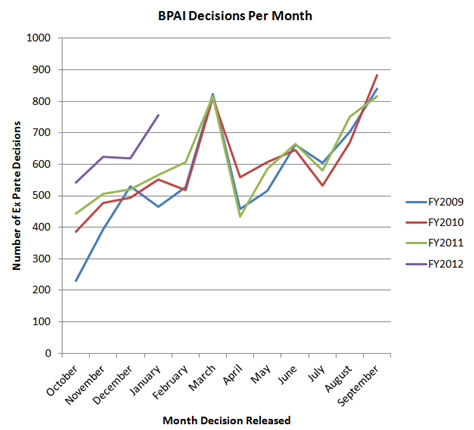
It seems to me that the current cadre of Administrative Patent Judges have proven that they have the capability of increasing their throughput by 60% or more in any given month. But, the Judges only act on that capability when properly motivated. I hate to play the "if I were manager" game, but once these phenomena are recognized, a likely general solution is fairly obvious – provide motivation for the Judges to more often work to their potential. Economists have shown that people almost always act in their own self-interest – that's why personal incentives work. However, in a team environment, personal incentives are rarely sufficient. Most highly successful teams also rely on team and other goal oriented incentives that suggest a culture of success. In my mind, the chart showing high-effort-as-deadline-approaches suggests a commitment to personal achievement but also a lack of commitment to the broader timeliness goal of ex parte patent appeal administration. Of course, timeliness is only one variable in the time-quality-cost equation, and the other important elements cannot be ignored.
As the PTO moves to more than double the size of the Board, now is the time to make structural changes to ensure a better future for this important segment of the Office.
Note - A key feature of the chart above is that the figures for FY2012 are significantly higher than for prior years. Unfortunately, the increase in productivity is still only slowing the growth of the backlog. With the increase in judges, I expect for the backlog to begin declining by the end of this fiscal year. Further, once implemented, the proposed increased appeal fees will also tend to reduce appeals filed.
Inland Northwest Realty website featuring real estate in Northern Idaho. Inland Northwest Realty for buying and selling real estate in Bonner, Boundary, and Kootenai Counties of Northern Idaho.
I’ve heard from people that actually write those decisions that putting out 2 a week and reviewing 4 a week is hard work.
For your reading pleasure:
link to patenthawk.com
10 years ago I applied to a position at the University of Minnesota.
The application was going nowhere, so I forgot about it and moved on.
ALMOST 3 YEARS LATER I get a telephone call one day, informing me that I had been selected to interview.
“For what?”, I asked. I had, of course, entirely forgotten about the application and moved on with my life. I just laughed and told them to take a hike.
“as was the case with the 120 argument”
LOLZ at 6 on the 120.
I recall you getting spanked big time on this at the Patent Hawk’s place. Nice to see you finally admit that 120 was so ‘conclusive.’
Try: 35 U.S.C. 112 paragraph two.
The Office (under Tafas) is forbidden to make rules affecting substantive rights. Your addition affects the substantive rights as outlined under 35 U.S.C. 112 paragraph two by increasing the requirement for patentability. This action is not allowed to be made by this administrative agency.
Show me the statute that forbids requiring a definition as was the case with the 120 argument and I’ll gladly say you win the day.
The obvious case to include on any discussion of Office Rule Making is, of course, Tafas v. Kappos.
The last word: link to patent-ideas.com
Oh, right, the “wide leeway” of the PTO’s “inherent authority” argument. Gee, I seem to remember Mr. Toupin arguing in front of the Fed. Cir. that In re Bogese gave the PTO “wide leeway” in its “inherent authority” to limit the number of continuations an applicant could file under section 120. I also seem to remember J. Prost stifling a laugh when Mr. Toupin made that ridiculous argument.
Keep positive, dude. If they don’t take you, in 5 years you’ll look back and say “good.” If they do take you, in 5 years you’ll look back and say “good.”
pssst … I’ll lend you my Purple Heart for a 10-point boost in your score. Meet you at the corner news-stand. Bring cash.
I apologize for the double posting. Didn’t see that the comments ran onto a new page. Gets me every time.
Sounds to me like you must be a white male over 40yo.
Not a chance.
Come to Canada! Always hiring hard working white guys. Bring your chain saw.
I keep losing my reply comment to you. Maybe it was too long. My main point is that they want highly qualified and experienced people and then when you interview, they basically say why would you come and work for that amount of money? Look if it was just money, I would never have worked for the PTO in the first place! Examiners made precious little when I started in 1986.
I LOVE being an examiner! Much more than being an attorney. I actually love searching, but that is kind of geeky so I shouldn’t talk about that.
Mostly I learned that I could basically work out most case issues by calling the attorney and making a deal. I had great SPEs who trusted my knowledge and judgment. Those were the days! Most Examiners I deal with seem a bit micromanaged which is sad.
OK, will try to post this before it is eaten by the system.
Sorry AAA JJ, Michael R Thomas is busy at the moment. Perhaps Sarah will translate 6-speak into something recognizable.
So like 6 to pass the buck.
It all comes downto one thing. If you want a quality examination, you need an examiner capable of giving a quality examination.
Sorry ebiumfiber, got your point and inartfully offered the only thing I could see as a remote negative. I wish you well and good luck getting into the system (and changing it from within).
Who are the “big boys” who are applying? I would think with 25 years of experience I would somehow fit into the “big boy” category (despite being a chick and not a boy).
I’m guessing OPM leaned on them for a new vacancy announcement as the old one had KSA-type questions that are supposedly no longer permitted.
Whatever- the new vacancy announcement favors my qualifications since the questions are multiple choice and I get to pick the highest level for each question (since I have all that experience, supervise other attorneys, teach patent law courses, etc. etc.).
As far as staying- I stayed a lot longer than most of my peers with law degrees. And my leaving, had they bothered to ask, had a lot to do with an ex-husband patent examiner in the same group- now retired. He was eager that I move on after law school and so I did. Which is why I came back as an electrical rather than a chemical examiner (and also since I mainly did electrical work). But that also did not turn out well, although it was an amicable divorce from a short marriage. So an unusual fact pattern, had they been interested in knowing why I left or if they had concerns about staying for the future.
Yes, that is what they want- and how long would such a person stay? There is no litigation-style work at the Board so such people would leave in a heartbeat- sure, send the litigators off to the Solicitor’s Office- they DO argue cases at the CAFC. But the Board? I think they asked about cross-examining witnesses and such in the previous vacancy- what witnesses are cross-examined at the Board. Huh? Whatever. Wouldn’t it make sense to have people who have been examiners AND attorneys? People who have seen both sides of the process? Sigh. But not going to beat my head against the wall over this any more because I really don’t think they know who or what they want. It’s just easier to collect resumes (underwear gnomes, anyone?) than to actually hire and integrate new people into the organization. It makes me sad because, in the old days, the best and most experienced examiners became Board members and they were really good- I knew a few personally before they become Board members and had nothing but respect for them. I can’t say I am impressed in that way anymore…
If, according to a court, it might already be reasonble for us to require information about an explanation of technical material in a reference I hardly doubt that it is beyond the scope of the office’s rulemaking authority to expand the rule to include instances where a requirement of an explanation of the definition of a term. Indeed, we may already have that authority under the current rules although we are not currently encouraged to use such a procedure.
Indeed, in the course of making their holding, the court noted that the Office is authorized under section 1.105 to require any information that is either relevant to patentability under any nonfrivolous legal theory, or is reasonably calculated to lead to such relevant information. A definition for an ambiguous term is certainly information that is relevant to patentability under any and all nonfrivolous legal theories.
Also in Star Fruits Newman, champion of what is no doubt your ta rd-view of the lawl, is soundly rejected on all fronts. But that is generally only notable only for lols, not pertaining to the merits of this discussion.
What is so hard to understand? I mean, operating with a tar d brain such as your own I can understand how it might be mildly difficult but still. Exerting even the smallest efforts should suffice.
In star fruits the court noted that the office utilized its rulemaking authority to make explicit the inherent authority it already possessed. Through a similar rulemaking the same might be achieved with respect to the suggestion made by Michel. The courts, having already given the office a wide leeway in Star Fruits may well see fit to do the same in similar rulemaking designed to implement his suggestion. And the office may well benefit from Star Fruits having shown the judiciary is willing to give the PTO a wide berth of authority in making rules.
I’m not really sure how this is so hard to see, since it is so blatant, but I will presume you have simply forgotten what happened in Star Fruits.
So here:
link to ll.georgetown.edu
Umm, who ever sees the depositions? It was all for one optical systems company that I wrote a series of patents for, pre-IPO. The first patent, filed in 1995, had the last continuation of some kind filed just last year. They have been widely licensed and used against competitors. So I really doubt I have a bad rep about that. One Markman opinion had chunks of paraphrasing from my non-infringement opinions…the point is that I am pretty familiar with litigation, not that the Board does any litigation!!
My mother is begging me NOT to take the job if it is offered since she is so horrified about the process…
“I said that the executive might benefit from star fruits if it tried to implement such a changing of the rule.”
There’s no keeping up with “reasoning” like this.
“I said that the executive might benefit from star fruits if it tried to implement such a changing of the rule.”
There’s no keeping up with “reasoning” like yours. If there’s anybody who posts here who has any idea what you could possibly be talking about, please speak up.
The dictionary? You clearly have no idea how to do your job correctly.
“How are the facts in that case even remotely applicable to a scenario where an examiner ”
Did I say that the facts in that case even remotely are “applicable” to a scenario where an examiner anything. I said that the executive might benefit from star fruits if it tried to implement such a changing of the rule.
I know you’re 98-99% tard, but try to keep up.
“So the backlog is caused by Applicants constantly having to tell you that your BUI is U?”
Pretty sure that ambiguous terms have nothing to do with BUI or BRI. Maybe you should consult your dictionary so you will know why.
I agree, those accountable, the officers of the court known as lawltards, have been totally asleep at the wheel.
Idk about that, I may have called him a tard a time or two, but it seems that he is coming a long way from legal-induced tardedness to a thoughtful member of the patent community. Remember, as a judge he was tasked with something totally different than he is now tasking himself with. Perhaps, in some small way, my calling him a tard because of some decision that he was forced to write in some fashion due to precedent helped him see that it was time for him to leave the judgeship and advocate for better solutions to the issues facing us than the judiciary was able to produce.
Re-posting this. Must have got inadvertently deleted.
Babbel Boy said…
Let’s run some back-of-the-pay-envelope numbers here.
Dennis says that the PTO is hiring 200 APJs over 2 years and that will double the number they now have, which, by my calculation must mean there are now 200 active APJs. (I got that by multiplying 200 by 2 to get the the final number and then taking half of that to get what they have now. With me so far?)
Look at the graph. Take a high point, say March. 800 ex parte decisions. 200 APJs. Divide.
What?? Are these b’crats only putting out 4 ex parte decisions per capita per month???
No. It’s not quite that bad.
Dennis’ data are not per capita. Those 800 decisions are really 2400 individual “decisions” bundled in 800 packages of 3 APJ decisions each.
So, if we assume each APJ contributes the same amount of time to each decision – which is bonkers crazy but giving them the benefit of the doubt – then the per capita output is 12 ex parte decisions per capita per month. Tops. The average is probably closer to 8. A bit over 2 decisions per 40 hours = 20 hours per APJ per decision.
In reality, only one APJ writes the decision, so the simplifying assumption that all three contribute equally is, well, as I say, bonkers crazy.
In my wildest guess I would not have said it could take more than a day, much less half a week, to dispose of one appeal. I have never seen a decision that went much, if at all, beyond the briefs, which can be read in 45 minutes. Both of them.
Are the data screw’d, or are my calculations, or is this the laziest group of lawyers on the planet. What other responsibilities to these people have?
(BTW: are they hiring yet??)
Reply Feb 15, 2012 at 07:58 PM
“had the office noticed and defined a single word or two.”
Sounds like those A C C O U N T A B L E have been asleep at the wheel.
“and they’re probably worried you’ll join on and then quit”
Reminds me, does anyone have the examiner turnover rates the last time a “hire-us-out-of-a-backlog” approach was taken?
How well did the approach work?
As Hal Wegner might chime in, at least the rate of things getting worse is almost under control…
“That way they may benefit from Star Fruits.”
How are the facts in that case even remotely applicable to a scenario where an examiner “demands” that an applicant provide a definition for an allegedly ambiguous claim term?
I see you’ve been well “trained” in the PTO-style of case law citation.
“Soooo… it sounds like they started getting applications and now they’re seeing the big boys start applying…”
U r so dum.
“What else do I need to do to qualify? The interview was a mock hearing where I had 15 minutes to monologue my qualifications and then there were 5 minutes of rebuttal as to why they should not hire me- they said that I would not be attracted by the salary- kind of an inappropriate question because the salary is posted- and this is the agency touting work/life balance!!”
As anyone that is looking for a “permanent” hire is looking for they’re looking for someone that will stick around, and they’re probably worried you’ll join on and then quit. It seems from your brief mention of your record that is what you’ve been doing.
On the other hand, perhaps they’re looking at your record and thinking you are more material to become a CAFC judge instead. Who knows?
Even so, you’ll probably get the job. Maybe you should have told them a little bit about why you thought this job in specific was perfect for you for at least the next 10 years.
“These are some very fine people who would make even better APJs that I would so I have no idea why their applications were tossed.”
Did you check the terrorist watch list? Also, have they been prosecuting “software” or “business method” applications? As that is the rough equivalent to being a terrorist in the patent field either of those might be a problem.
“But now the whole process seems to have started over with a completely different set of questions and they are NOW asking for 10-15 years of experience.”
Soooo… it sounds like they started getting applications and now they’re seeing the big boys start applying and all of a sudden your app doesn’t look as good. Sorry brosensky, sounds like they did exactly what they told you they were looking to do.
So the backlog is caused by Applicants constantly having to tell you that your BUI is U?
Maybe you should actually try using BRI.
The executive can exercise its inherent authority to pass a rule allowing such a procedure and let it have binding effect before the office at least, the courts would have to play along of course after issuance.
Likewise, they could just amend the “requirement for information” section of the rules already on the books. That way they may benefit from Star Fruits.
“The comment on litigation is PURE speculation, at best. Trust me, litigators will ALWAYS find terms they find ambiguous.”
Whether or not they can always find another you is irrelevant to whether or not taking out a few key ones in patents with very ambiguous terms being used is wholly irrelevant. One can barely spit without hitting a case that would have been resolved from the outset had the office noticed and defined a single word or two.
“Also, explain to me how defining “a few key ambiguous terms” would reduce the backlog?”
Not having to continually reject certain apps because of ambiguous terms being used and them having to constantly come back and say “nuh uh that’s totally not what we meant” while being allowed to never say what they DID MEAN (and that nonsense does go on) will most certainly assist in lessening the backlog.
Pr …ick
Sent from iPhone
So?
Sent from iPhone
Used!
Sent from iPhone
Sure. There’s the issue of work/life balance (which the PTO touts very prominently in its job postings), the ability to live pretty much anywhere you want and work from home, and the knowledge that there is zero accountability and liability. Do you think the APJ’s who got Leithem, Stepan, In re Klein, etc. colassally, phenomenally, and outrageously wrong faced any consequences for the truly crxppy work they put out in those cases? I highly doubt it. They’re still there, getting paid. What’s that worth to you? If you f’ed up a client’s work as badly as those APJ’s f’ed up those decisions, would you still be getting paid?
Your experience is typical of my interactions with the public sector–lots of highly-principled policy pronouncements, but when the time comes to actually DO something, the failure is palpable.
But, I will re-iterate: In the public services as they are currently conceived and implemented, THERE IS NO COST OF FAILURE.
The costs of failure are all externalized.
In fact, failure is often rewarded.
Precisely what incentive do you think there is for the PTO to expeditiously review your application, or to stay in touch with you as they promised?
There is absolutely no individual accountability in the public service, in any meaningful sense–and where the rubber hits the road, “the government” is represented by an individual, or a small number of individuals–an examiner, for instance, or an interview committee, or a diversity manager, or a meter maid.
Because elected representatives have over decades proven themselves incapable of effectively negotiating under a collective bargaining paradigm, for whatever reason, a viable attempted solution is to remove that paradigm and replace it with another, in whole or in part–which is what we see slowly happening in various jurisdictions around the country.
Although government services will never be offered in any sort of a competitive environment, there are ways that delivery of those services can be improved, and be made more efficient, and part of any real solution must address the individuals at the individual level.
At this point, you should ask yourself if you really want to be enmeshed in the type of environment that is now providing to you such a low level of convoluted “service”–I have been there, and I personally don’t need to be enmeshed in it again. It is stacked with a certain “kind of person”, which in my experience is as much the result of a selection effect as of anything else.
Be warned–what you are experiencing in the process of application IS ONLY THE BEGINNING.
I hope you make the best decision for yourself.
There were several GROSSLY unqualified APJ’s hired in April-May 2011. So unqualified that it should have been a scandal. I guess the thought now is to have the pendulum swing as far in the opposite direction as possible and not hire anybody who hasn’t argued at least 10 cases before SCOTUS.
The EPO approach, of writing a prior art objection on the back of a BRI, is indeed strikingly effective, especially on cases written in the USA. That’s because Europe does not rely on File Wrapper Estoppal. Without the crutch of FWE, the claim just doesn’t make it to issue until it, standing alone, is clear in itself.
“His answer – “not my problem.” That was very telling.”
Telling of what? That one administrator doesn’t solve every problem on demand?
Stoll was a hard worker and a straight shooter. The implication here that he didn’t care about this particular problem paints a picture that does not fit the man I know.
“I can quote chapter and verse from Walker on Patents”
YAWN. retread canned discussion like from a million threads…
“held that claims using functional terms at the point of novelty were indefinite”
YAWN. retread canned discussion like from a million threads…
Nope- I have been interviewed and my application is in permanent limbo while they “get more applicants” (their response to my constant requests for the application status). 25 years of experience as an attorney and an examiner in chemical and electrical groups (two different stints). Have worked extensively in electrical, chemical, and mechanical prosecution, opinion work, and litigation support. Have an LLM in IP law and high grades for all my degrees. Perfect “500” performance reviews as an Examiner (when that was the rating scale), great production, plenty of appeal and interference experience. Even applied for the new Detroit positions. Also applied to the completely NEW vacancy announcements which look very different from the old ones.
Not sure what they are waiting for- they even are hiring retirees for double dipping rather than picking “young blood” such as my merely 47-year-old self.
Have had highly experience friends who didn’t even make it to interview (at least I got that far).
Whatever. Maybe they are waiting for the reincarnation of Judge Rich before they can hire.
“AND been deposed numerous times about patents that I wrote that were involved in litigation.”
Not to read too much into this, but maybe you have a bad rep associated with the personal connection…
Aside from that, good luck to you (and others as you indicate).
So should every spec essentially be a thesaurus? Is that what he needs to construe a claim term?
Isn’t that the same CJ you’ve called a tard so many times on this site before?
Please do stand with him. He could use the company.
IANAE, alternatively, simply reject under 112, p. 1/2 if a claim term is not used in the specification.
“AAA JJ informs us above that there’s nothing for examiners to do during the first biweek of October.”
That’s not what I wrote. I wrote that everybody at the PTO goofs off the first bi-week of the FY.
You have the reading comprehension of a patent examiner. Maybe it’s time for you to call it a day.
During a Q&A at a CLE event last March, I asked former Commissioner Stoll what was being done to address this problem. His answer – “not my problem.” That was very telling.
I applied to be an APJ back in September for different technologies. Was told I was qualified and even interviewed in November. 25 years of experience- 6+ as an examiner (one stretch as chemical, one seven years later as electrical). An LLM in IP law, high grades for undergrad, law school, and LLM. Worked as in-house counsel, law firm, and the last 9 years in Asia (but doing US and foreign prosecution). I am still being “considered” but they are saying they need to gather MORE applications before they can make any decisions! Lots of questions about litigation (depositions, discovery). Does any of that happen at the Board? Not the Board I know. But I have been actively involved in litigation support AND been deposed numerous times about patents that I wrote that were involved in litigation.
In addition to my undergraduate engineering degree (MIT, GPA 4.7/5.0) I am doing a communications technology bachelor’s degree in my “spare time” focusing on wireless networks (computer and mobile phone) and network systems. Most of this tech was not around when I graduated in 1986.
What else do I need to do to qualify? The interview was a mock hearing where I had 15 minutes to monologue my qualifications and then there were 5 minutes of rebuttal as to why they should not hire me- they said that I would not be attracted by the salary- kind of an inappropriate question because the salary is posted- and this is the agency touting work/life balance!!
They have completely re-done the vacancy announcements to make experience count for something- it seems to me the system was geared to hire ex-CAFC clerks. I am sure these are people with many skills but there is something to be said for having actual prosecution experience.
I even complained to OPM that applicants are just sent to a black hole to await the time when the Board finally feels it has enough applicants to make a decision (not sure when that will be).
So don’t hold your breath that they are hiring so many people that the backlog is going away. I filed an appeal brief in September and can’t even get an Examiner’s Answer- by the time that case ends up in the queue, well, it will be many years before I ever hear what happens.
I came all the way from Asia for a 20-minute interview at my own expense and then am put on permanent hold. I can’t say that it’s been an experience that inspires confidence in the system.
I have had friends with similar levels of experience to my own but they did not even get an interview as not being qualified. These are some very fine people who would make even better APJs that I would so I have no idea why their applications were tossed.
The new vacancy announcement (open until MAY) is totally different and does not have the usual statement that previous applicants need not apply. There are even two NEW announcements for DETROIT. Not sure how that will work out but I applied for those as well.
If you look at the people applying for the Examiner jobs, they are getting the same run-around (as can be seen on the Just a Patent Examiner blog). It’s very sad because the better-qualified applicants will eventually just become completely disillusioned with the process and give up.
If anyone has any insight into what on earth is going on, I would love to hear it. I only got an answer as to the status of my application after numerous phone calls and finally complaints to OPM since candidates are supposed to be told of their application status. But now the whole process seems to have started over with a completely different set of questions and they are NOW asking for 10-15 years of experience.
My head is spinning.
As someone who’s only a little over three years out of law school, I say — but it looks like APJs make about what I make (and I’m not at the top of the market). Does someone with 8-10 years experience really want to take that pay cut and become an APJ?
Yet the practice continues.
If Michel is seeing them too often, it means they’re getting issued too often. And why wouldn’t an attorney try for them, when they’re sometimes allowable and often the infringed-iest claims in the whole patent?
Still, I don’t think it’s that frequent that claims are truly ambiguous, when read in context with a mind willing to understand. A lot of what Michel sees is generated by the nature of high-stakes adversarial proceedings where (1) the result depends on the meaning of technical words, and (2) ambiguity is a complete defense.
Having examiners put definitions on the record during prosecution is ridiculous. Let the examiner identify the ambiguity if it exists, or else take his broadest reasonable interpretation and try to find art.
Ambiguous claim terms cause enormous havoc in patent cases because they have to be construed. Still the practice illustrates something fundamental in the patent law and it is this:
The patent attorney is trying to capture the essence of the invention without being limited to the details of the embodiments. This requires “functional” claiming to a degree. Even though one is entitled to claim “cover” what he discloses and enables from his disclosure, a countervailing policy requires that the claims be definite so as to clearly both include and exclude. Vague terms, having no clear description in the specification, inherently fail this notice function.
As a result, the Supreme Court in several cases, held that claims using functional terms at the point of novelty were indefinite. The policy they said was that such claims were damaging to the public because of the lack of clear demarcation regardless of the fact that they could be construed to be limited to the disclosed embodiments and equivalents in court.
I think the Supreme Court is right and has always been right on this issue. Those cases are not overruled. The patent office should rely on them, but they are faced with the Federal Circuit that believes that if a claim can be construed, is not indefinite. But this rule flies in the face of declared Supreme Court policy.
So what Judge Michel is arguing for, a definition, is required in my opinion under the Supreme Court policy. The patent office is entitled to require a definition or give one themselves that people reading a patent in its prosecution history can rely upon the definition to know exactly what is claimed by patent.
6, if anybody has a very good solution, other than simply rejecting under section 112 paragraph 2, let’s hear it. The problem identified by Michel, ambiguous claim terms, is as old as claims themselves. I can quote chapter and verse from Walker on Patents where he excoriates patent attorneys for using broad and indefinite terms in claims.
Yet the practice continues.
AAA JJ, I think the problem they, the Federal Circuit, complain about the most is where a claim term is not used at all in the specification.
hmmm…
chum
yes, but not in the way it is being used above.
“about poor quality”
Quality does not equal “reject.”
“we’d have noticed by now.”
Hello McFly.
We’ve noticed.
“Oh, so having a definition of a few key ambiguous terms in certain ambiguous claims would not reduce the backlog (and as a side effect reduce litigation)?”
The comment on litigation is PURE speculation, at best. Trust me, litigators will ALWAYS find terms they find ambiguous.
Also, explain to me how defining “a few key ambiguous terms” would reduce the backlog? Try to be as detailed as possible. I know, that is going to be very difficult for you dumass, but try … still, I won’t hold my breath.
nice post with the graphical representation. thanks for sharing.
But if one does the leg work, and the other two wanna shrug their shoulders and say, “Eh, whatever you wanna do is fine by me” then I guess that’s technically 3.
Isn’t that what happens today?
What in the sam hill are you talking about?
There is absolutely nothing wrong with breadth, in and of itself.
Breadth that is not supported, breadth that reads on prior art – those are separate issues. And we all know whose job it is to indentify that, amirite?
“So he addresses the issue”
No. Most definitely not. What he did was not address the issue. Not in the least. The real issues remains unaddressed and festeres to this day.
“The graph above suggests (as Leopold implied) that a lot of this untracked preparatory work gets spread about evenly over a six-month period”
The graph itself says nothing of the sort.
Such pure conjecture may be true, then again it may not. But let’s not confuse what can be culled from the graph with wishful excuses.
“What did you have in mind by your post?”
That you inform yourself before you comment?
Were you not the one that also had no clue as to the status of the Tafas case?
Ned makes it a self-practice right here.
Funny site there. They must have forgotten that the physical addresses of practitioners of record are readily available. AAA JJ informs us above that there’s nothing for examiners to do during the first biweek of October. So a foliage road trip could potentially include a side trip for an off-campus interview. That’s just the kind of efficiency we’re looking for out of the PTO.
Does anyone know of a corresponding site where lousy attorneys are routinely called out by name?
“Case law is pretty clear that there is no requirement for applicants to define every term. ”
And nobody said there was… however, the CJ does recommend that we start demanding definitions of certain problematic terms. He didn’t say every single one.
“Judge Michel is lookig for something that would make a CAFC judge’s life easier — not something that will reduce the backlog.”
Oh, so having a definition of a few key ambiguous terms in certain ambiguous claims would not reduce the backlog (and as a side effect reduce litigation)? :/ You’re kind of dum aren’t you?
I know, right? Michel even had the nerve to suggest during today’s presentation that some claims over-reach. Apparently he missed the memo: all claims are patentable. Nothing is too broad.
“He wants definitions, and demands for such on the record.”
Case law is pretty clear that there is no requirement for applicants to define every term. Otehrwise, specifications would be 200 page tomes. The claims are written for those skilled in the art — not CAFC judges that are too lazy to have their clerk’s research the meaning of a term.
Regardless, the burden is on the Examiner to set forth claim constructions — if deemed needed. If both the Examiner and applicant implicitly agree on the meaning of a term, why waste time putting it in writing when there is a HUGE backlog of applications to deal with.
Judge Michel is lookig for something that would make a CAFC judge’s life easier — not something that will reduce the backlog.
Ah yes, the Dudas bashers are out in droves lately. Wasn’t the Dudas crackdown a result of you people whining about poor quality of allowed claims? So he addresses the issue, and now you whine about that. Make up your minds…
Let’s run some back-of-the-pay-envelope numbers here.
Dennis says that the PTO is hiring 200 APJs over 2 years and that will double the number they now have, which, by my calculation must mean there are now 200 active APJs. (I got that by multiplying 200 by 2 to get the the final number and then taking half of that to get what they have now. With me so far?)
Look at the graph. Take a high point, say March. 800 ex parte decisions. 200 AJPs. Divide.
What?? Are these b’crats only putting out 4 ex parte decisions per capita per month???
No. It’s not quite that bad.
Dennis’ data are not per capita. Those 800 decisions are really 2400 individual “decisions” bundled in 800 packages of 3 AJP decisions each.
So, if we assume each APJ contributes the same amount of time to each decision – which is bonkers crazy but giving them the benefit of the doubt – then the per capita output is 12 ex parte decisions per capita per month. Tops. The average is probably closer to 8. A bit over 2 decisions per 40 hours = 20 hours per APJ per decision.
In reality, only one APJ writes the decision, so the simplifying assumption that all three contribute equally is, well, as I say, bonkers crazy.
In my wildest guess I would not have said it could take more than a day, much less half a week, to dispose of one appeal. I have never seen a decision that went much, if at all, beyond the briefs, which can be read in 45 minutes. Both of them.
Are the data screw’d, or are my calculations, or is this the laziest group of lawyers on the planet. What other responsibilities to these people have?
(Are they hiring yet??)
OK, I will. What section?
It might be better for anyone reading this thread to be less oblique.
What did you have in mind by your post?
Thank you. Someone is paying attention.