Terms of Use & Disclaimer

  • Terms of Use

  • Patently-O on Facebook
    Connect with Patently-O readers.

Dec 26, 2007

Counting Design Patents

ScreenShot003

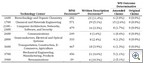
In 2007, Samsung Electronics received over 550 design patents — the most ever issued to a single company in one year.  Sony holds the most design patents, and is followed closely by Nike. The following table shows the company awarded the most design patents each year:

ScreenShot004Louis Zarfas is the primary examiner associated with the most issued design patents. Mr. Zarfas has allowed over 16,000 design patents since his first (as a primary) in 1978. Over 1,000 of those design patents relate to shoe designs claimed by companies such as Nike, Reebok, AVIA, Asics, LA Gear, Rockport, Sketchers, Wolverine, Keds, Louis Vuitton, Timberland, Berluti, and Kangaroos.

Recently issued design patents (issued 2000–2007) were, on average, pending for 16.2 months. Companies with at least 100 design patents during that period had about one month less pendency than those with fewer patents. Nike has prosecution down to a science — and averages less than 9 months pendency (filing to issuance). Toward the other end of the pendency chart, Apple averages over 21 months.

During the 2000–2007 period, approximately 75% of examinations were handled by primary examiners without any assistance from an assistant examiner. As with utility patents, the pendency for cases without an assistant is significantly less than for those with an assistant. Here, the difference is about two months.

 * These numbers are based on a recently compiled dataset of 300,000+ design patents issued since 1976 on file with DDC.

Dec 20, 2007

Does Size Matter? Counting Words in Patent Specifications

The following chart does not tell us whether the size of the patent document makes any difference. It only tells us that the average patent has grown considerably over the past twenty years.

ScreenShot002

To create the chart, I obtained a sample of 10,000 patents issued between January 1977 and December 2007 and counted the number of words in the description of the claimed invention. This excludes claims, title, abstract, references, and other identifying information.  To amplify the results, I added two trend-lines. The first trend-line runs from 1977 to 1987 and has essentially no slope — indicating that description size remained steady over those years. The second trend-line runs from 1987 – 2007 and has a clearly positive trend-line indicating that the number of words is increasing over time.

Dec 06, 2007

Patent Litigation Trends: Survey Results

PatentLawPic124Fulbright & Jaworski recently released some results from its survey of 300 GC’s (and AGC’s) at large US & UK companies. Results:

  • Very large companies (>$1B) are much more likley to be hit with charges of patent infringement than are smaller companies (<$100m).  Unlike smaller companies, the very large companies also claim that the quantity of charges are on the rise. A small percentage (~3%) of companies with a revenue greater than $100m have defended against more than 50 claims in the past three years.
  • For most defendants, the major concern is not the potential for an injunction, but rather the cost of litigating.
  • The very large companies are also more likely to be on the plaintiff side asserting their own patents. The report claims a close correlation between company size and likelihood of enforcing its patent claims through litigation.

The report is free after you provide your contact info: Link. I can also e-mail a copy to you.


Nov 27, 2007

Why Design Patents Need Not Satisfy 35 U.S.C. § 101?

PatentLawPic11935 U.S.C. § 171 is a unifying provision – briefly stating that “except as otherwise provided,” the entire Patent Act applies equally to both utility patents and design patents.  Thus, design patents must fit within the requirements of §§120 and 112.[1] On the other hand, § 122 expressly exempts design patents from the publication requirements.

The enigma is § 101 and its definition of utility. Section 101 includes no explicit exception for designs. But, even a novice observer would question how a non-functional ornamental design can at the same time be “useful?”

The Supreme Court appears to have answered this query in Footnote 5 of its 2001 opinion in J.E.M. Ag Supply v. Pioneer Hi-Bred.[2] In that case, the Court held once again that the patentable subject matters scope of 35 U.S.C. § 101 is “extremely broad” and that the scope for utility patents certainly includes plants despite the existence of § 161 “plant patents.” 

In Footnote 5, the Court briefly compares § 101 utility patents with § 161 plant patents and § 171 design patents. “Patents issued under § 161 are referred to as ‘plant patents,’ which are distinguished from § 101 utility patents and § 171 design patents.”[3] 

The implication from the Court’s comparison is that design patents are not subject to the requirements of § 101 (despite the lack of any statutory exceptions). Thus, a patented design must be “new, original[, ] ornamental [and] an article of manufacture.” However, the design need not be useful.


[1] In re Daniels, 144 F.3d 1452 (Fed. Cir. 1998).

[2] J.E.M. Ag Supply v. Pioneer Hi-Bred Int'l., 534 U.S. 124 (2001)

[3] Id. at fn. 5.


Sidenote: The Apple iPod design patent (US D549,237 filed Aug 24 2005) appears to be identical to the company’s trademark design application (Serial No. 78925932 filed July 2006). A continuation patent has also issued which also claims the screen shape. (US D542,808) Interestingly, in the trademark case (response to a rejection), Apple admitted that the “rectangular video screen design is functional.”

Aug 09, 2007

Overall, has your company made money from the patent system?

On August 7–8, 2007, I conducted a simple survey through Patently-O. [See Survey].  Readers were asked whether the patent system, taken as a whole, had been positive (made money) or negative (lost money) for their company.  The results below show the responses of 131 corporate employees who are all highly involved with their company patents.

The results here follow a predictable pattern: On average, pharmaceutical companies see patents as a profit center while software companies see patents as an overall loser.  (At 95%CI, Software & EE results each differ significantly from Pharm results).

PatentLawPic010

Notes:

  • Next time: Is this an important question?
  • The Survey [LINK]
  • Bessen & Meurer: Negative Return on the Patent System
  • On the process:
    • The above graph merges responses from small corporations with those from large corporations. It also excludes individuals at law firms, government entities, and educational institutions. 
    • Individuals responded to the question: “Overall, has your company made money from the patent system?”  There were three potential responses: “Clearly positive (made money”, “Unsure whether positive or negative”, and “Clearly negative (lost money).” For the graph above, these responses were converted to a simple numerical scale: 1, 0, and -1, respectively. The y-axis above ranges from -1 to 1.

Sep 18, 2006

New Patent Law Scholarship

  • MortarboardPatent Reform: Matthew Sag and Kurt Rohde, Patent Reform and Differential Impact. Sag (DePaul) and Rohde (MBHB) want to get patent reform rolling — they suggest that we throw-out the chaff because it slowing down the process. Their differential impact approach helps us focus on reforms that will stop the abuse of “bad patents.” 
  • Software Patents: Robert Merges (Berkeley), Patents, Entry and Growth in the Software Industry. A decade ago, everyone predicted that software patents would turn the industry on its head.  Professor Merges finds that software patenting has not been earth shattering.  Big companies have adapted and “new firm entry remains robust.”
  • Federal Circuit: Professors Nard (CWRU) and Duffy (GWU) suggest that we rethink the CAFC experiment and the virtues of uniformity in their new article, Rethinking Patent Law's Uniformity Principle. CAFC jurisprudence is becoming a bit stale and would benefit greatly from at least one other sister-court deciding patent appeals.
  • Takings: Adam Mossoff (Michigan State) is quickly becoming known for his studies on the history of patent jurisprudence. In the wake of Zoltek, where the CAFC refused to protect patent rights under the takings clause of the Fifth Amendment, Mossoff took the court to task — especially for its continuation of the untrue myth that “patents were never secured as constitutional private property in the nineteenth century.”  In his new article, Mossoff concludes that “[i]t is time to set the historical record straight, and to recognize that nineteenth-century courts applied the Takings Clause to patents, securing these intangible property rights as constitutional private property.”
  • Google Scholar: For those of you who do not know about it, Google Scholar is getting pretty good and should now be on your agenda for most prior art searches. http://scholar.google.com.


Aug 29, 2006

Scherer on Compulsory Licensing

In 1977, noted economist F.M. Scherer wrote a monograph entitled “The Economic Effects of Compulsory Patent Licensing.”  At that time, there was pending legislation on compulsory licensing of nuclear technology.  In some ways, Scherer’s analysis thirty years ago can serve as the starting-point for determining whether to issue an injunction in our post-eBay environment. Specifically, Scherer argues that compulsory licensing should not be favored when any of the following are true:

  1. The patent holder’s share of the product market averaged less than 20% over the preceding five years; or
  2. The patent holder’s total sales of related products during the past five years as well as the reasonably anticipated sales over the next five years are less than ten-times the patentee’s R&D budget; or
  3. The patent holder exercised extraordinary creative initiative or extraordinary technical and financial risks in its innovative effort.

Scherer was concerned that injunctive relief was most important for small and especially micro-sized firms whose barriers to entry and lack of non-patent competitive advantages increased their relative valuation of patent importance.

Jun 23, 2006

A patent success story

Simvastatin StructureToday I am truly proud of the patent system.  The block-buster drug Zocor (simvastatin) has transitioned off-patent and into the world of generics.  Unlike other areas of IP law, patents really are valid only for “limited Times” and when those years have passed the property right evaporates — leaving the inventions “free as the air to common use.” (In the words of Justice Brandeis).

There is no question that patent rights played a major role in providing incentive to Merck to develop and test Zocor and to push it through the difficult FDA approval process.  The incentive worked, Merck recouped its investment, and now generic versions will be sold at an unbelievably low price that is very near its production costs.

May 22, 2006

Scholarship: Patent Thickets See a New Light

Patent law professor Douglas Lichtman (and my good friend) has an interesting new short article (8 pages of text) about problems of “patent thickets.” 

Theorists have discussed patent thickets as an example of problematic over-ownership — A.K.A. the tragic “anti-commons.”  When a particular area of technology is blanketed by multiple patents owned by multiple parties, everyone blocks everyone else, and nothing gets done.

After all, the conventional literature on the tragedy of the anti-commons asserts that resources will be inefficiently under-used in the face of too many overlapping patent rights.

Lichtman turns this theory on its head and asserts that in actuality, a very thick thicket might result in less litigation.  His idea is in a case of multiple overlapping patents, each patent represents only a small piece of the pie.  And few patentees would be willing to go through litigation simply to recover such a small slice.

More patents means less money per patent holder. Less money, in turn, means less of an incentive for a firm to strategically delay in the hopes of being a patent holdout, and less of an incentive for an accidental patent holdout to actually bring suit.

A couple of weeks ago, I would have rejected Lichtman’s argument out of hand.  Under the old rule, every patent holder had a right to force large settlements based on its hold-up threat through injunction.  Now, post eBay, his ideas begin to make more sense. . .

Apr 12, 2006

Conflicts of Interest in Patent Prosecution

HricikProfessor David Hricik is a leading Intellectual Property Ethicist.  He recently posted some questions about your thoughts on patent prosecution conflicts.  Do these situations create conflicts of interest:

First example:  In prosecuting application for Client A, lawyer receives an office action rejecting claims over a prior art reference that is owned by Client B. Is there a conflict? [your comments].

Second Example: Is it per se unethical for a lawyer to provide a non-infringement or invalidity opinion about another client's patent? [your comments].

Professor Hricik is also a speaking at our upcoming conference on blog law.

Hat tip to Steve Nipper.

Mar 03, 2006

THE WAR IS OVER: NTP and RIM Settle.

PatentlyOImage009After years of high-profile legal battles, NTP and Research-in-Motion (RIM) have reportedly settled their patent dispute over RIM’s BlackBerry system. According to the press release:

RIM has paid NTP $612.5 million in full and final settlement of all claims against RIM, as well as for a perpetual, fully-paid up license going forward. This amount includes money already escrowed by RIM to date.

The settlement, widely expected for the past year, will likely bring to a close the wild ride at NASDAQ. (RIMM).

An appropriate reader comment:

Actually, I’m rather sorry to see this settlement. All the media hype and nonsense, plus the fears of politicians of losing their service, seemed to be greatly contributing to patent reform momentum and to the Supreme Court taking more patent cases.

But at least the belated but initially effective RIM reexaminations of the patents in suit served to publicly demonstrate reexamination effectiveness in lowering settlement expectations. And without all the lawsuit publicity the reportedly cited obscure prior art Norwegian university publications would probably never have surfaced.

On the Reexaminations: A settlement could include a provision that NTP must return RIM's money if the patents were eventually invalidated. However, considering NTP's stance thus far, such a provision would be exceedingly unlikely. Consequently, I expect that the continuing reexamination of NTP's patents at the PTO will become more of a curiosity than a business concern. The only way that NTP can stop the reexamination process would be to capitulate to the PTO and thus abandon the patents.


Mar 01, 2006

Does the Wall Street Journal Understand Patent Law?

Last year I had a refreshing course in the positive power of patenting. We had sued a handful of companies for infringement.  They were clear copy-cats, and the cases quickly settled.  Several months later, our client sent an e-mail showing the competitors’ new product lines.  They had gone back to the drawing-board and created what was arguably a design that was even better.  Consumers are the beneficiaries with better products and even more competition.  America has always been a place of innovation — and in this case it was our patent system that forced the free-loaders to take some initiative. 

I had two companies approach me this week about patent work. They are both small businesses who want to go global.  They believe that they have great innovations, but the only way that they will have get a fair shake in the world of investors and business development is if they begin the process of securing their IP rights. 

As you may know, I am up-beat about our patent system.  Despite the bad press, there are genuine success stories that continue to drive the uniquely American innovative spirit.  Lets bring about legislative and PTO reforms to fix the problems — and I believe that there are problems — but the system is far from broken.  A complete overhaul makes interesting press, but it is not the right solution.

With all this on my mind, I was saddened by today’s Wall Street Journal’s editorial that “blame[s] the lawyers.”  Here are highlights from the paper:

  • Patents now operate to deter research and penalize innovation.
  • Patent cases are dubious if they involve patent-holders who never commercialized their inventions.
  • A third party has no standing to challenge a patent unless he is accused of infringing it.
  • The rise in filed patent applications “has less to do with genuine innovation than it does with innovative lawyers filing a patent on anything that moves.”
  • “Blame the lawyers.”

Several online articles have already been written about the editorial.  Matt Buchanan takes real issue with the over-arching blame game being played by the WSJ.  The Patent Baristas make several interesting points, including a note comparing the number of patents obtained by major corporations with those obtained by the so-called patent trolls.  This morning, an upset Patently-O reader e-mailed me about the editorial with the following comments:

Shouldn't the writer have consulted you to get a better balanced  and more educated viewpoint?

Of course, I am apparently not so high on the speed-dial of the WSJ editors, but Stephen Nipper found an interesting response:

“It is much easier to suggest solutions when you don't know too much about the problem.” - Malcolm Forbes.

Even the staunchly concervative IPO noted its problems with the editorial:

[T]he Journal asserted, "the percentage of [patent] approvals has climbed; approvals were close to 90% in 2000, up from 69% in 1984 . . . ." Contrast the recent speech by USPTO Director Jon Dudas at the AIPLA meeting in Palm Springs, California, in which he said approvals are now less than 60%.

Feb 28, 2006

Patently-O Scholars

AcademicEggHeadThere are a couple of interesting new patent papers:

Linguistics and Claim Construction by Kristen Osenga (available here).  

Professor Osenga explores linguistic theory for truths that can be applied to claim construction.  She writes about five particular “notions” that could be used to make claim construction more consistent:

1) every reader, including a judge, possesses a mental lexicon with a common sense (or conventional) understanding of word meaning which is a point from which to start when interpreting claims;

2) there is an appropriate place for dictionary usage, which is to inform the judge’s common sense understanding about a word where he has none;

3) patent claims have their own grammar which must inform the syntactical and contextual analysis, but may also skew the reader’s common understanding that was obtained either from a mental lexicon or from a dictionary;

4) regardless of the common sense understanding, the PHOSITA must be returned to the analysis and changes made to the law to effectuate the return of the PHOSITA; and

5) extensive resort to the specification and prosecution history to divine the patentee’s intent is inappropriate.

Patent Metrics: The Mismeasure of Innovation in the Biotech Patent Debate by David Adelman and Kathryn DeAngelis (available here).

Adelman and DeAngelis have written what they claim to be “the first comprehensive empirical study of biotechnology patents.”  Their conclusions — there is little evidence that the rise in biotechnology patenting is adversely affecting innovation. The pair also provides a general criticism of “the current enthusiasm for empirical” at the expense of exploring “the obvious complexity of innovative processes.”

Jan 31, 2006

EBay v. MercExchange: Stay of Injunction Pending Appeal

A friend of mine who is also a senior patent counsel at a major technology corporation passed along his thoughts on the eBay appeal in an anonymous article entitled eBay v. MercExchange: Are YOUR Interests Represented?

The article, published here on Patently-O, raises a particular issue—that of stays pending appeal.  The article argues, inter alia, that the relatively short CAFC docket (~1 year) coupled with the high reversal rate indicate that injunctions should generally be stayed pending appeal.

This approach takes the high middle ground — allowing for injunctions on a regular basis, but not forcing settlement based on district court holdings that would potentially be vacated on appeal.

Notes:

  • Cite the article as: Note, eBay v. MercExchange: Are YOUR Interests Represented?, Patently-O, January 31, 2006 at http://www.patentlyo.com.
  • The article can be linked directly at: http://patentlyo.com/patent/eBay_20Article.pdf
  • Comments on the article should be directed to me.

Dec 06, 2005

First-to-Invent vs The Constitution [Updated]

According to Dave Simon, The First-to-File Provisions of the Patent Reform Act of 2005 Violate the Constitution's Intellectual Property Clause.

The Patent Reform Act of 2005 proposes provisions that would change the granting of patents from the so-called first-to-invent system to a first-to-file system. The Intellectual Property Clause limits Congress to granting patents only to "Inventors". A system enacted by Congress for granting patents to anyone other than a good faith inventor operates outside of the constraints enumerated in the Clause, and therefore is facially impermissible. The first-to-file provisions of the Act are violative of Article I, Section 8, Clause 8 of the United States Constitution.

Dave’s paper is premised on the assertion that an invention is only made once, and later independent inventions should not actually be considered inventions.  Dave is not the first to make this argument — his paper, however, is easily accessible online. Download Dave’s paper.  Ed Suominen, patent attorney in Scotsdale made the same argument back in 2001 in a paper published by the JPTOS. Download Ed’s Paper.  

Of course, it is highly unlikely that any court would agree that a first-to-file system is unconstitutional. Ed agrees — “Eldred proved that Congress can pretty much do whatever it wants about IP as far as this Supreme Court is concerned.”  Professor Mark Lemley gave his remarks in an e-mail:

I have to disagree with the claim that first-inventor-to-file is unconstitutional. Dave Simon's reasoning is based on the idea that "inventor" means whoever thought of it first, not simply a person who thinks of it independently. But if that were true, (1) current US patent law would be unconstitutional in the circumstances in which it discounts invention in non-WTO member countries, and the system would have been unconstitutional throughout its history when it was limited to inventive activity in the US; and (2) copyright law would be unconstitutional because it treats any independent creator as an author. Both results seem unlikely to me.

If you are against a switch to first-to-file, I would not hang my hat on the constitutionality argument.

Nov 02, 2005

Practical Tips For Prosecuting Trans-Border Inventions

A new paper in the AIPLA Quarterly Journal provides a number of practical tips for dealing with inventions or infringing acts that naturally cross international borders.  The authors (Mark Lemley, David O’Brien, Ryan Kent, Ashok Ramani & Robert Van Nest) call these “divided infringement claims” and focus on the recent Federal Circuit decisions in Research-In-Motion v. NTP, Eolas v. Microsoft, AT&T v. Microsoft, and Pellegrini v. Analog Devices.

Prosecution Strategies:

  1. Attempt to draft unitary claims — i.e., claims that are not susceptible to international distribution.
  2. Claim devices and systems, not just methods — in RIM, the CAFC taught that system claims are much stronger on an international level.
  3. Draft claims that would infringed under the importation or domestic sale provisions of 271(g).
  4. Keep continuations alive.
  5. File foreign.

The paper also delves into a number of ex post litigation strategies such as filing suit at the ITC and advocating for a claim construction that avoids international division. 

Great work!

Oct 24, 2005

Almost 20% of patent applicants receive an office action within nine months of filing.

Tim Palmer helped me to grab some data for a new paper on patent office statistics. Here are some preliminary results:

Using data from Series 10 (Serial No. 10/xxx,xxx) with filing dates from October 2001 through May 2005, I created a simple cumulative percentage table showing the expected time delay for a first office action.  As can be seen, around seven percent of cases receive a first OA within the first six months, and the median delay is between one and two years.  Of course, this table is slightly skewed because the October 2001 start date does not allow for delays of more than four years.

DELAY AFTER FILING UNTIL FIRST OFFICE ACTION

Three Months 1%
Six Months 7%
Nine Months 18%
One Year 32%
Two Years 82%
Three Years 96%

Oct 11, 2005

How Are Patent Cases Resolved?

An important new working paper by Illinois Professor Jay Kesan and PhD candidate Gwendolyn Ball presents a statistical analysis of the resolution of patent cases.  This type of data can be very useful when planning expected litigation costs and predicting settlement behavior.  The paper, entitled How Are Patent Cases Resolved? An Empirical Examination of the Adjudication and Settlement of Patent Disputes, is available through the SSRN website.

Some findings:

  • The rule of thumb is correct that 5% of cases go to trial. 
  • The rule of thumb that 95% settle is not correct — this ignores the fact that “8–9% of cases are terminated through final rulings on a motion for summary judgment.”  This means that the real battle in most patent cases revolves around establishing a strong position early in the game.
  • The figure below is one of a number of examples from the paper — this one shows the total pendency of cases filed in 1997 that were eventually adjudicated (rather than settled).

Patentlyo012

Caveats

  • Because of the time-lag of patent cases, the authors used 1995 and 1997 data. It is unclear today how things have changed today. Although Professor Kesan reports that they are working on 2000 data, and that anecdotal evidence continues to indicate that summary judgment is as important as ever.
  • The statistical significance of the study is also unclear.

Apr 25, 2005

How should a future patent attorney choose a law school?

AcademicEggHeadThe new USNews law school rankings have been released.  Everyone knows that the rankings are worthless, but we follow them anyway.  Engineers and scientists usually do pretty well on the LSAT and often end up with the following law school options:  

  • Attend a highly-ranked law school;
  • Attend a lower-ranked law school with a renown intellectual property program; or
  • Attend a lower-ranked law school as a night student and continue making money during the day.

The name of the law school matters most when you are looking for your first job out of law school.  Many people advise students to attend the highest ranked school where they can gain admittance.  Others would advise you to go to the school that offers the best financial package.  Not many advocate part-time solution — because it is such a hard road to work full-time then attend school four nights a week.  However, some of the most skillful attorneys that I know went through school that way.

What is your advice for hopeful pre-law students? Please leave a comment:

Mar 17, 2005

Snippets: Review of Developments in Intellectual Property Law

MBHB’s snippetsTM newsletter provides a timely review of developments in intellectual property law. Here is a table of contents of the most recent issue (March 2005: Volume 3, Issue 1):

  1. Daniel Boehnen and Deana Larkin, Trends in E-Discovery: New Local Rules and Recent Judicial Opinions.
  2. Michael Greenfield, Jennifer Pope, Dennis Crouch, and Elaine Chang, The Primary Source for Claim Construction: Dictionary or Specification.
  3. Kevin Noonan, The Continued Confusion Over Written Description.
  4. Dennis Crouch and Baltazar Gomez, Legislative Update: Joint Research Agreements May Protect Patent Rights.

You can e-mail the editor (snippets@mbhb.com) to receive a PDF copy of the newsletter.  Include your mailing address if you would like a hard-copy.  In the e-mail, please indicate your technology and legal interest: (Biotech, Electrical, Software, Chemical, Mechanical, Litigation, and/or Prosecution). 

Past Issues:

Intellectual Property Podcasting

Podcasting is catching on as an extension of the blog.  According to the Wikipedia, a podcast is like an audio magazine subscription: a subscriber receives regular audio programs delivered via the Internet, and can listen to them at their leisure.

Podcasts differ from traditional Internet audio in two important ways. In the past, listeners have had to either tune in to web radio on a schedule, or they have had to search for and download individual files from web pages. Podcasts are much easier to get. They can be listened to at any time because a copy is on the listener's computer or portable music player (hence the "pod" in "podcasting"), and they are automatically delivered to subscribers, so no active downloading is required.

Using podcast technology, for instance, a podcasting program can automatically download new .mp3 files from your favorite blog.  Of course, you can always just click on the .mp3 broadcast from your browser and listen to the podcast through your computer’s speakers.

So far, I know of three podcasting groups in the IP world so far:

Look for the inaugural Patently-O Podcast coming next month.

Aside: Since I am discussing blogging, I would recommend purchasing the newest version of Blogjet.  It is great and integrates very nicely with Typepad.

Mar 02, 2005

February 2005 Report on New Academic Research

We are a day late on the February report of New Academic Research. 

  1. Santa Clara's Computer and High Tech Law Journal has an excellent new article on by Christopher Holman proposing the use of the Protein Similarity Score for determining genuses of related protein sequences. Holman argues that the similarity score represents a more rational and scientifically based approach to claiming a genus of related proteins compared to the current practice based on percent identity.  21 Santa Clara Computer & High Tech. L.J. 55 (Download Article.pdf). Thanks to Trevor Dutcher, the Journal's Editor for providing a copy of the article.
  2. Professor Katherine Strandburg has written an important article regarding the experimental use exception to patent infringement.  Her article, What Does The Public Get? Experimental Use And The Patent Bargain, is published at 2004 Wisconsin Law Review 82, and also available at SSRN.  Her article, that builds from principles of patent law, is cited in at least one of the briefs in the Merck v. Integra case, and may help shape the Supreme Court's decision.
  3. Professor Eileen Kane's article on the patentability of Genes and DNA will become more important if the Supreme Court decides to take up the case of LabCorp v. Metabolite -- a case that may redefine concepts of patentable subject matter.  Kane argues that the genetic code "can be characterized as a law of nature."  If so, the legitimacy of genes as patentable subject matter is severely questioned. Available at SSRN, 71 Tennessee Law Review 707.
  4. David Almeling is now a clerk at the 11th Circuit.  His recent article in the Stanford Technology Law Review discusses utility requirement issues of nanotechnology inventions.  Specifically, Almeling argues that nanotech should be measured under the same utility requirements as all other inventions. The article, Patenting Nanotechnology: Problems with the Utility Requirement is available here: http://stlr.stanford.edu/STLR/Articles/04_STLR_N1/contents_f.htm.

Each month I post a note discussing the academic side of patent law.  My on-line sources for material are the SSRN electronic library, a few hard copy journals, and several more that are freely available on-line.  Most of my material, however, comes from articles directly e-mailed to me from professors and law review editors.  Please feel free to e-mail articles for the March edition. (Include information on where the article is being published). -- DDC

Feb 16, 2005

The Practical Nature of Software Patents

Many object to U.S. patent laws that allow patenting of software.  Critics argue that software patent stifle innovation and that the open source model is a better approach.  However, Martin Fink, Vice President of HP was quoted in Today's NYTimes with words that will resonate with entrepreneurs who are hoping to make money from their software:

It's fine to object to software patents, but it's foolhardy not to try to acquire them.

Fink is an open source advocate, but also a realist.

An End To Revival of Unintentionally Abandoned Applications?

In the recent case of Field Hybrids, A Minnesota District Court chided the Patent Office for allowing the patentee to revive its abandoned patent application.  The Appeals Court found that the patentee had failed to prove to the PTO that the application was unintentionally abandoned.

Now, a Patently-O reader questions the statutory authority allowing revival of unintentionally abandoned applications that were abandoned for failure to reply to an office action.

The Rules (CFR) provide for revival of missed reply dates, the Law (USC) does not:
37 CFR 1.137 provides for reviving patent applications that were abandoned either (a) unavoidably or (b) unintentionally.  This rule is based on 35 USC 133.  However, Section 133 only provides for revival of applications determined by the Director to be unavoidable.  Section 133 does not discuss unintentionally abandoned applications.
Thus, the statute does not authorize revival of applications that were abandoned unintentionally
UPDATE:
As noted by another reader, the Statute does provide some support for revival of unintentionally abandoned applications.  Specifically, under 35 U.S.C. 111, an application abandoned for failure to submit a fee and oath may be revived if the omission is deemed unintentional.

Jan 30, 2005

Dennis Crouch's January 2005 Report on New Academic Research

Each month I post a note discussing the academic side of patent law.  My on-line sources for material are the SSRN electronic library, a few hard copy journals, and several more that are freely available on-line.  Most of my material, however, comes from articles directly e-mailed to me from professors and law review editors.  Please feel free to e-mail articles for February's edition. (Include information on where the article is being published). -- DDC

1) In a forthcoming paper, Professor Joseph Miller provides a new solution for making claim construction more predictable.  His idea is to require that patentees provide certain additional disclosures up-front -- Disclosures that will appear in express statements on the face of the patent itself. 

Four additional patentee disclosures: (a) the field of art to which the claimed invention pertains; (b) all problems that the claimed invention helps solve; (c) a lexicon of all claim terms to which the applicant gives a meaning other than its accustomed meaning to people having ordinary skill in the pertinent art; and (d) a list of preferred objective reference sources, such as technical treatises and dictionaries (general or specialized), to which an interested reader should refer to learn about the ordinary meaning of the remaining claim terms to a person having ordinary skill in the art. [SSRN Link]

According to Miller's approach, in any subsequent claim construction process, whether for licensing, design-around, or litigation purposes, parties would have the benefit of patents enriched with this new information.  The paper will come out in March in the Lewis & Clark Law Review.

2) I just found out that an old college friend is quickly becoming a leader in the area of Patent-Antitrust law.  In the recent Issue of the Richmond Journal of Law & Technology, Aaron Rabinowitz writes on Antitrust Liability for Refusals to Deal in Patented Goods. The article highlights the circuit split between the Ninth Circuit and the Federal Circuit over whether patent holders must have a business reason for refusing to sell or license patented products.  In Kodak II, 125 F.3d 1195 (9th. Cir. 1997), the California based appeals court determined "that a patentee who refuses to license his patented invention to others without legitimate business justifications for doing so has violated antitrust law."  However, CSU v. Xerox, 203 F.3d 1322 (Fed. Cir. 2000), the Federal Circuit held that a patentee may refuse to license or sell a patented invention without violation of the patent laws, regardless of his business justification.

3) Bill Burgess, a 3L at Penn has written an interesting comment on the "Failed Promise of Cybor" published in the UPenn Law Review.  In Cybor, the Federal Circuit held that claim construction is a matter of law that is reviewed de novo by the Appellate Court.  Bill makes the arguments that (i) the 'bright-line rule' of Cybor has resulted in less rather than more consistency in how claims are construed and (ii) Cybor is actually inconsistent with the Supreme Court's Markman decision.

Jan 27, 2005

Avoiding Loss of Intellectual Property Rights During Government Contracting

The Federal Acquisition Regulation (FAR) provides a uniform policy for acquisition of supplies and services by U.S. federal government agencies.  The FAR is is like the tax code in that carelessness is dangerous.  One common point of carelessness concerns intellectual property rights.  Companies have inadvertently given the government licenses in source code and inventions because they did not conduct their business in accordance with the regulations.  In a recent presentation, Robert Cogan of Nath & Associates laid out several important points on the topic. [PPT].

The most common avoidable consequences of failing to follow the FAR include:

  • Having your proprietary notices on technical proposals ignored so that the government may publish them without violation of statute;
  • Inadvertently granting the government a license in an invention or in computer source code or object code; and
  • Allowing the government to procure products from competitors using your technical information.

Although it is important to maintain a good relationship with contracting officers, it is your responsibility to 'say no' to contract clauses that would result in a loss of your intellectual property.

Jan 25, 2005

Phillips v. AWH: Patent Examiners Do Rely on Dictionaries

An e-mail from a UK patent examiner prompted me to reconsider the U.S. Government's brief in the Phillips v. AWH rehearing.

For those who have not followed this case, the Federal Circuit has decided to rehear the Phillips v. AWH in order to determine the proper method of construing claim language of a patent.  The two major theories of claim interpretation involve (i) the use of dictionaries and (ii) the use of the patent documents filed by the inventor.

The government brief argues that dictionaries should not be a primary reference for claim construction, in part because dictionaries are not used by examiners during prosecutionThis assertion by the government certainly overstates the facts.  When an examiner starts at the PTO, they are given a copy of Webster's.  Examiners also regularly use www.Dictionary.com to find various definitions for terms.  While it is true that the Examiner rarely explicitly relies on a dictionary in an office action, the definition of terms is always in the background.  For instance, examiners often use the dictionary to examine the clarity of the claims and as a way to asses the scope of terms used in the application.

Although this discrepancy was not raised in any of the briefs, it may come up in oral arguments slated for Tuesday, February 8, 2004. 

UPDATE I: L&C Law Professor Joseph Miller, in his recent article on the role of dictionaries, has noted that '[w]e know anecdotally that examiners sometimes cite and quote dictionary definitions in their interactions with patent applicants.'  Manuscript page 50.  Miller and his co-author James Hilsenteger cite Cordis v. Medtronics, 339 F.3d 1352, 1359 (Fed. Cir. 2003), as a case where the examiner used the definition of the claim word 'slots' from Webster’s Ninth New Collegiate Dictionary to help explain to the applicant how a prior art reference showed the claimed structure. 

UPDATE II: I received a comment from a former USPTO primary examiner who made several points:

  • The example cited in Professor Miller's article of an examiner citing a dictionary definition in an office action is the exception rather than the rule. 
  • The Office did not emphasize the use of dictionaries to assign meaning during training. (although dictionaries may have been mentioned in training sessions as 'available sources for determining the meaning of a claim term')
  • Rather, examiners are primarily taught to give each claim term its "broadest reasonable meaning." 
  • "The examination process is so fast-paced that I believe examiners do not use any formal methodology when construing claims. Instead, an examiner relies more on intuition, on what a word or phrase means to him or her.  If a word is foreign to an examiner, he or she would likely consult a dictionary, but only to get a "feel" for the word. 

Field Reporter Needed: I am not going to be able to attend the Phillips v. AWH rehearing, but I would like to post an article on the oral arguments written by an attending patent attorney.  Let me know if you would like to write a brief article (<750 words) on the topic for the Patently-O Blog. (We operate on same-day service, so you would need to write it within a couple of hours after hearing the arguments).  You'll get some good publicity -- we have a fairly wide circulation with over 10,000 hits each week from people working in the patent field. (crouch@mbhb.com).  Also, I would like to post an .mp3 file of the oral arguments if anyone would be willing to get the set of tapes from the clerk and convert them.

Five Things Corporate Counsel Need to Know About Patents

A new article that is available online at Law.com discusses the Five Things Corporate Counsel Need to Know About Patents by Stephen Nipper, an Idaho based patent attorney.  The article is available here, but I have written a condensed version of Stephen's list with my condensed answers.

1. WHAT IS PATENTABLE?

A. Essentially anything made by man that has not been done before (novel) and would not have been obvious to someone working in the technological area.

2. WHO CAN BE AN INVENTOR?

A. Everyone who makes a 'patentable contribution' to the invention.

3. WHO OWNS THE PATENT?

A. The inventor unless there is a duty to assign the patent to the company.  It is best to get this in the employment contract.

4. WHAT CAN WE FIND OUT ABOUT OUR COMPETITORS' PATENTS AND PATENT APPLICATIONS?

The Patent Office publishes issued patents and patent applications online at its website (www.uspto.gov).  You can search by assignee to find patents owned by competitors.

5. WHAT IS THE IMPACT OF MY COMPANY'S EXPANSION ON OUR PATENT PORTFOLIO?

If your company dramatically increases the number of employees, you will be required to pay a "big entity" fee rather than a "small entity" fee.  Essentially big companies pay twice as much in fees to the Patent Office as compared to small companies and individual inventors. Failing to pay the correct fee may result in a loss of patent rights.

Thanks to David Orange for the link.

UPDATES from Other Blogs:

Melody Wirtz at PHOSITA thinks the title should be "Five Things Corporate Counsel or Anyone Associated With the Upper Echelons of a Corporation Needs to Know About Patents."

Matt Buchanan at Promote the Progress notes that this is information that all corporate counsel should know about patents — a great primer for the “jack of all trades” attorney not familiar with patent practice.

Bill Heinze at IP/Updates outlines Mr. Nippers qualifications for writing the article -- Author of the InventBlog.

Jan 19, 2005

Pharmaceutical Patent Extension in Exchange for Promise of Cheaper Generics?

Everyone in America realizes that we are approaching a health-care crisis.  Costs are increasing and many are un-insured.  My daughter was born two months ago in an uncomplicated delivery with no anesthesia, and not even an OB/GYN (we used a Registered Midwife).  The total cost will be over $30,000. Luckily we do have insurance.

[Article Link] In the Chicago Tribune, Dr. Henry Black gets into ten ways to fix our health-care system.  Dr. Black is chair of the department of preventive medicine at Rush University Medical Center in Chicago, and is well regarded in the field.  Interestingly for Patently-O readers, number nine on Dr. Black's list is to "extend the patent life of pharmaceutical drugs." 

Generally, patented items are more expensive -- that is the premium that the patent holder is able to extract.  This is essentially a reward to companies who advance the state of technology.  So, extending patent life would normally result in extending higher prices.  In Dr. Black's plan, however, the government could offer a patent extension to pharmaceutical companies in return for them reducing the price of the drug by 50 percent when its patent life expires. 

According to Dr. Black: If the pharmaceutical industry could count on their successful products being protected longer, they could turn their attention to real advances. Rather than the shortsighted approach of importing cheaper branded drugs into America, we should devise ways to make our branded drugs cost less.

Interesting Proposal.

Jan 14, 2005

How to resolve your domain name disputes.

In November 2004, I published an article with Eric Moran in Snippets, our firm newsletter that we send out to clients and potential clients. The short article discusses legal strategies for protecting your domain name rights once you have discovered an adverse domain name. In the article, Eric & I compare four methods of resolving domain name disputes: the Lanham Act, the Federal Trademark Dilution Act, the Anticybersquatting Consumer Protection Act, and ICANN anticybersquatting proceedingsEach of these avenues have pros and cons.  Deciding whether to invoke one of the above methods of resolving domain name disputes depends on the facts related to each particular adverse domain name or domain name registrant. 


We do recommend proactively identifying potentially adverse domain names.  Frequently, we are able to successfully resolve domain name disputes with a carefully worded letter to a registrant, instead of resorting to the courts or to ICANN proceedings.


If you would like to receive a copy of the article (free), contact Eric Moran, who is also editor of Snippets.


Dec 21, 2004

Changes at the Federal Circuit.

The Federal Circuit has announced several changes:

LINK: The Federal Circuit has made a change to its rule 27(h)(4), that authorizes the court clerk to grant consented to or unopposed motions to extend the time for filing a principal brief for not more than 60 days.  The clerk has already been delegated authority to extend, for up to 30 days, the time for taking any other action permitted by the rules.

By statute, the chief judge of the Federal Circuit shall serve for a seven-year term.  Chief Judge Mayer's term is coming to an end, and Judge Paul Michel is reported to be in line replace Mayer before the new year.  Read Judge Michel's Top Ten Patent Claim Drafting Tips.

LINK: The Federal Circuit has given notice of a proposed rule change to Federal Circuit Rule 28(a)(5) and requests public comment.  The proposed change would require that the jurisdictional statement accompanying a brief include a representation that the judgment or order appealed is final, or, if not final, the basis for appealability. (e.g., preliminary injunction, Fed. R. Civ. P. 54(b) certification of final judgment as to fewer than all of the claims or parties, etc.).

Thanks to Bill Heinze for the links.

Dec 13, 2004

In Search of The Next Acacia?

Voice Capture v. Intel (S.D. Iowa 2004) [PDF]

Intel was just denied summary judgment in its defense against upstart Voice Capture.

An examination of the relevant case law and the Patent Office procedures leads to the conclusion that the recapture rule applies only to reissue claims that are broader than claims in the original patent that were cancelled to define the claims over prior art. Because the reissue claims at issue in the present case do not pertain to original claims that were cancelled or rejected based on prior art, the recapture rule is inapplicable.

Crouch's December report on new academic research

Here is a limited set of recent papers that I have found interesting.

Bronwyn Hall & Manuel Trajtenberg, Uncovering General Purpose Technologies with Patent Data, NBER Working Paper.

The authors discuss their technique for finding "general purpose technologies" using patent data.  It is thought that there are a few technologies that are extremely pervasive in various sectors of the economy and are thus important building blocks for further technological development.  In addition to giving us their formula for finding these important technologies using patent data, Hall & Trajtenberg also provide a listing of GPTs in their appendix.

Douglas Lichtman, How the Law Responds to Self Help, UChicago Working Paper.

Chapter IV deals with patents: Lichtman focuses on what measures the proverbial "bad man" who owns a patent should be allowed to do.  "Courts would need to be able to distinguish instances where a patent holder is attempting to profit from the patented invention, which presumably should be allowed, from instances where a patent holder is instead attempting to protect profits that derive from some underlying illegal act, which probably should not be [allowed]."

Gary Becker and Richard Posner, Pharma Patents (Not really "academic").

I was lucky enough to take part in a weekly seminar with Richard Posner, Gary Becker, and Doug Lichtman (above) while a law school student.  These three are great thinkers -- Posner and Becker have now started their own blog.  Although Lichtman may not follow with his own blog, he has certainly been a contributor to several on-line formats including Patently-O, Crescat Sententia, and Lessig Blog

Today, Becker & Posner discuss pharmaceutical patents:

POSNER: Patents are a source of great social costs, and only occasionally of commensurate benefits.

BECKER: I do not like the hype and some other salesmanship of big pharma and bio-tech companies, but this industry has made enormous contributions to raising world health. It is likely to become even more important in the future as drugs are developed to match individual genetic differences. One does not want to kill this goose that is laying golden eggs by ill-thought out and counterproductive "reforms".

Please e-mail me with new research.

Dec 08, 2004

New Patent Fees In Effect: Consolidated Appropriations Act, 2005 enacted on December 8, 2004

Consolidated Appropriations Act was signed by the President and enacted into law on December 8, 2004. The Consolidated Appropriations Act revises certain patent application and maintenance fees; provides separate fees for a basic filing fee, a search fee, and an examination fee; and requires an additional fee for any patent application whose specification and drawings exceed 100 sheets of paper (applicati