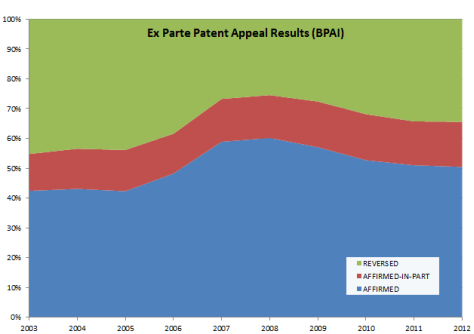
The chart above shows the results of ex parte appeals grouped by the fiscal year of the appeal decision. In the data, I eliminated administrative dismissals and other non-merits actions from consideration. At this point, I don't have a good explanation for the gradual shift in outcomes. It may be driven by the underlying patentability of the claims; the selection of cases for appeal; shifts in the law; and also changes in Board decisionmaking. 2012 figures presented here are only through July 2012.
Today, the USPTO’s board of administrative patent judges changes its name from the Board of Patent Appeals and Interferences (BPAI) to the Patent Trial and Appeal Board (PTAB). This transformation is required by the America Invents Act (AIA) and represents a further step in implementation of the new post-grant review trials as well as (eventual) elimination of intereference proceedings.
I received a few e-mails from parties concerned about the how the transformation impacts already pending appeals. The new name has no direct impact on the thousands of ex parte appeals pending before the Board. For these cases, the transformation really is simply a name change and there is no need for applicants to take any responsive action.
This is an important administrative patent law case holding that when the Board of Patent Appeals (BPAI) affirms a rejection based upon a new factual finding, it must identify the holding as a new ground for rejection. This holding benefits patent applicants because it creates a right to either reopen prosecution or request a rehearing based upon the new ground.
Here, the examiner rejected Stepan's claims as anticipated and obvious. Stepan had submitted a Rule 1.131 affidavit claiming a prior invention date in order to antedate one of the references. However, the examiner gave the affidavit no legal effect based upon the judgment that a prior public use of a portion of the invention qualified as 102(b) prior art because it occurred more than one year before the application filing date.
In the administrative appeal, the Board ruled that the applicant could claim priority to an earlier application and that, therefore the the prior art was no longer 102(b) prior art. However, the Board affirmed the rejection after holding that the prior use was still 102(a) prior art because the content of the Rule 1.131 affidavit was insufficient to prove Stepan's prior invention rights.
Writing for the Court of Appeals for the Federal Circuit, Judge Prost vacated the Board's decision — holding that the Board's factual finding on the sufficiency of the content of the affidavit was a new factual finding that was not a basis of the examiner's rejection being reviewed and, therefore, that the Board must identify the affirmed rejection as a new ground of rejection.
Notice does not focus on the applicant’s arguments divorced from the examiner’s rejections of record that are actually appealed to the Board. Instead, it focuses on the “adverse decisions of examiners” during prosecution which form the basis of the Board’s scope of review. 35 U.S.C. § 6(b). Because Stepan did not have prior notice of the Board’s intent to craft and rely on new findings of fact to support a §§ 102(a)/103(a) rejection and because it failed to identify this rejection as a new ground, Stepan’s notice rights were violated. 5 U.S.C. § 554(b)(3); 35 U.S.C. § 6(b). Had the Board labeled its rejection as a new ground of rejection, Stepan could have reopened prosecution to address the newly-alleged deficiencies in its Declaration with the examiner.
Note: Although this case involves an ex parte reexamination, the principles here apply equally with ordinary ex parte examination. However, the decision will not apply to the new post grant review proceedings under the Leahy-Smith AIA because the review goes directly to the Board (the newly named Patent Trial and Appeal Board or PTAB) rather than an examiner.
For one summer during college, I worked in a meat packing plant. In one hand, I wielded a power-operated knife while the other, gloved in chain-mail, held thawing pork-bellies. This case involves litigation over a hand-held rotary blade used in the commercial food processing industries. As is now common, after Bettcher filed its infringement lawsuit, Bunzl, the defendant, requested the patent undergo inter partes reexamination at the USPTO. Bunzl asserted the same prior art in both its reexamination request and in its invalidity defense before the district court.
The issue on appeal is the timing of the estoppel provision associated with inter partes reexamination under 35 U.S.C. § 315(c). Under the statute,
"[a] third-party requester whose request for an inter partes reexamination results in a[ reexamination] order … is estopped from asserting at a later time, in any civil action [related to patent law] … the invalidity of any claim finally determined to be valid and patentable on any ground which the third-party requester raised or could have raised during the inter partes reexamination proceedings.
As I read the statute, a reexamination requester is blocked from making particular invalidity arguments in court if certain conditions are met. These conditions include: (1) a final determination that the reexamined claim is valid; and (2) a finding that the invalidity argument is based on grounds that were or could-have-been raised by the requester during the inter partes reexamination.
In the case at hand, the USPTO had granted Bunzl's reexamination request, but the reexamination examiner had rejected Bunzl's position and issued a right-to-appeal-notice to Bunzl. Bunzl appealed to the BPAI, and recently lost the appeal, but had now requested rehearing by the Board. If Bunzl loses at the BPAI, it has a right to further appeal the reexamination to the Court of Appeals for the Federal Circuit.
In summary, at this point, the USPTO Examiner has made a "final" decisions that the claim is valid, and the BPAI has made a "final" decision that the claim is valid. However, Bunzl still has a right to appeal. The question from those facts is whether the claim is "finally determined to be valid" under the statute.
Deciding the issue, the Federal Circuit held that a claim is not "finally determined to be valid" under Section 315 until all appeals are exhausted.
[T]his court agrees with Bunzl that the estoppel provision of § 315 is triggered not when examination is completed but only after all appeal rights have been exhausted.
On remand, the district court will need to determine whether a new trial is necessitated by the additional prior art made available by the lack of estoppel.
Judge Reyna dissented – arguing that the estoppel issue is moot because the claim is anticipated as a matter of law.
The plain meaning of the claim language of the '325 patent reads on Bettcher's own prior art products, which include all of the structural features required by the claims, and which possess the capability of satisfying the functional or intended use limitations.
. . . .
No reasonable jury could conclude that the claims of the '325 patent were novel over the pre-1998 blades because none of the dispositive facts were disputed and the law is clear. I would reverse the district court and enter judgment as a matter of law of anticipation.
In reaching his outcome, Judge Reyna is finding that, as a matter of law, the wrong conclusion was reached by the trial jury, the district court judge, the original patent examiner, the reexamination examiner, the BPAI, and the other two judges on the court.
Comments by Crouch: This case is in tension with the recent Federal Circuit decision of Marine Polymer Tech. v. Hemcon, Inc. In that case, the court held that non-final arguments made during reexamination created intervening rights that relieved an accused infringer from liability, and that the intervening rights were created at the point of the arguments even though the reexamination was ongoing.
The Federal Circuit has before it an unusual petition for rehearing en banc. It involves an issue that, to my knowledge, has never before been heard by this court, and it's one that hardly anyone who practices patent law even knows about. Indeed, the reason that this issue is arising now is the U.S. Patent and Trademark Office has made an extraordinary (and heretofore successful) effort to prevent inventors and the patent bar from understanding it.
For this reason, my nonprofit organization has filed an amicus briefasking the Court to uphold statutory rights that, until recently, possibly no patent lawyer knew how to defend. If the Court acts favorably, it can undo decades of rogue agency practice at the PTO.
In In re Lovin, the key issue is whether an examiner's failure to state a prima facie case of obviousness, as required by MPEP Chapter 2100, is sufficient ground for the Board of Patent Appeals and Interferences to vacate or reverse a rejection. Lovin's brief alleges that the Board abandoned its longstanding practice of vacating rejections when the examiner had not made this case, and instead required the appellant to make a substantive showing of patentability in their appeal brief—that is, to prove a negative. The amicus brief of CFPH, LLC, a business unit of Cantor Fitzgerald, offered a complementary explanation of why the Board's interpretation of PTO Rule 41.37 was incorrect.
Regulatory Checkbook, the nonprofit I manage, seeks leave to intervene because the PTO lacked any legal authority to compel Lovin to provide this information. In fact, until December 22, 2009, the PTO had no legal authority to require any appellant to comply with any of the material information collections contained in 37 C.F.R. Part 41.
How could that be? To understand why, let's take a short trip to the Office of Management and Budget, which occupies the tall red brick building across Lafayette Park from the tall red brick building housing the Court of Appeals for the Federal Circuit.
As Congress considers adding additional burden to the Board of Patent Appeals, the Board’s backlog of pending cases continues its dramatic rise. The process-flow of the Board appears to be fairly steady-state. Each month, the Board receives about 1,150 cases and disposes of (decides or remands) about half (575) of those cases. The other half goes to the backlog.
Operating at this rate, it will take 3 1/2 years for the BPAI to dispose of the cases already in its docket. Thus, assuming that the BPAI takes appeals in-turn, an appeal docketed today will not be decided until the year 2015.
A note on the data: The chart is compiled from the BPAI’s own reports that are available online. [Link] A case is only considered part of the BPAI backlog once it receives an “appeal number.” Appeal numbers are assigned only after briefing is complete. The large “jump” in the reported backlog in early 2009 is due largely to a clerical change that identified a large number of briefed appeals that had not been given appeal numbers.
Inquiry: Does anyone have a nice memo or chart that they use to help in choosing the best after-final practice? (dcrouch@gmail.com)
Summary: In a 6-2-1 en banc decision, the Federal Circuit has reversed its prior precedent and held that a patent applicant must be allowed to introduce new evidence in a Section 145 civil action filed to challenge a USPTO refusal to grant patent rights and that the issues implicated by the new facts must be considered de novo.
[W]e hold that the only limitations on the admissibility of evidence applicable to a § 145 proceeding are the limitations imposed by the Federal Rules of Evidence and Federal Rules of Civil Procedure. Therefore, we hold that the district court applied the wrong legal standard for the admissibility of evidence in a § 145 proceeding and abused its discretion when it excluded Mr. Hyatt's declaration. . . .
The particular significance of a § 145 civil action is that it affords an applicant the opportunity to introduce new evidence after the close of the administra-tive proceedings—and once an applicant introduces new evidence on an issue, the district court reviews that issue de novo.
However, the Court also wrote that an applicant may still be barred from presenting new "issues" in the civil action and that, when no new evidence is presented, that BPAI findings and rulings should be given deference under the Administrative Procedures Act.
Impact: This decision could be seen as relieving some pressure on applicants to ensure that their cases for patentability are exhaustively presented to the USPTO's internal Board of Patent Appeals and Interferences (BPAI). The decision is especially important in light of the growing role of BPAI appeals in the ordinary course of patent prosecution. In its argument, the USPTO suggests that a strategic applicant may now choose hold-back some evidence from the BPAI appeal in order to overcome the APA deference if the case goes to the District Court.
Statute in Question: 35 U.S.C. § 145 creates a right to a "civil action" in Federal District Court against the USPTO Director whenever an applicant is "dissatisfied with the decision of the Board of Patent Appeals and Interferences in an appeal under section 134(a)." In the alternative, an applicant may appeal directly to the Court of Appeals for the Federal Circuit.
Background: Gil Hyatt is a well-known inventor and successful patentee. Hyatt filed a civil action in 2003 after the BPAI sustained written description and enablement rejections for seventy-nine of Hyatt's claims. The examiner had issued "2546 separate rejections of Mr. Hyatt's 117 claims" based on the doctrines of inadequate "written description, lack of enablement, double patenting, anticipation, and obviousness." The Board reversed all of the examiner rejections except for the § 112 p1 arguments. Complicating this case is the fact that the application's claimed priority date is 1975. Hyatt has aggressively pushed the bounds of USPTO practice. This decision is one of more than a dozen Federal Circuit decisions focusing on Hyatt's patent rights. When California pursued Hyatt for tax revenue for his patent licenses, Hyatt took the case to the Supreme Court and eventually won a $388 million judgment against the state of California for invasion of privacy.
After the Board affirmed a set of written description and enablement rejections, Hyatt filed a Section 145 civil action and included a declaration offering new evidence of enablement and written description. The district court excluded that inventor-declaration from evidence based on Hyatt's "negligence" in failing to previously submit the information to the PTO. In a 2009 panel decision, the Federal Circuit held that the district court had properly excluded the new evidence – holding that the district court may properly exclude evidence that Hyatt should have produced to the PTO. That opinion was penned by former Chief Judge Michel and Joined by Judge Dyk. Judge Moore wrote a vigorous dissent that supported a patent applicant's right to a full civil action including the right to submit additional evidence when challenging a PTO decision.
Judge Moore wrote the en banc decision that was joined by Chief Judge Rader and Judges Lourie, Bryson, Linn, and Prost. Judge Dyk dissented and was joined by Judge Gajarsa. Judge Newman Concurred-in-Part – arguing that the civil action should not give deference to PTO factual determinations.
A key to the majority decision is the notion that a Section 145 civil action is not an appeal, but rather a new, separate lawsuit filed to force the PTO to act. In its analysis, the court began with a focus on the 150-year history of the civil action right (and its predecessor Bill in Equity) and the reality that new evidence has always a part of those remedies. See, e.g., Gandy v. Marble, 122 U.S. 432 (1887) (explaining that the [predecessor] § 4915 suit in equity was "not a technical appeal from the Patent Office, nor confined to the case as made in the record on that office"). The court then reviewed the current text of the statute, implications of the APA, and various policy arguments before reaching its conclusions.
In a 37-page dissent, Judge Dyk argued that the majority made an improper leap from (1) the correct premise that new evidence should be admissible in the civil action to (2) the incorrect conclusion that the law provides no meaningful limits on the introduction of new evidence regardless of what was presented at the BPAI.
Appellate specialist Aaron Panner argued the case on behalf of Hyatt. The USPTO's case was argued by Beth Brinkman of the DOJ. In the original panel, the late Ken Bass has argued for Hyatt and Bill Jenks for the Government. Michael L. Martinez represented Hyatt in the civil action.
The work of the Board must go on . . . . In several recent decisions, the Board of Patent Appeals (BPAI or Board) has continued to affirm rejections of claims on patentable subject matter eligibility grounds under 35 U.S.C. § 101.
In Ex parte Kelkar, App. No. 2009–004635 (BPAI, September 24 ,2010), the applicant had claimed a method of determining the similarity between two genetic profiles and a computer program stored on a recordable medium for accomplishing the method. The method involves the broad steps of iteratively matching gene expression profile pairs in clusters until a best match is found. Because the method neither recites any particular machinery nor transforms an article into a different state or thing, the Board held that it failed the machine-or-transformation test. Citing Flook (1978), the Board then held that the claim was improperly directed to an abstract algorithm because the underlying innovation was the unpatentable mathematical algorithm. Some of the method claims included a preamble statement that the method occurred “in a computer.” The Board found that limitation at most a “a field-of-use limitation that is insufficient to render the otherwise ineligible process . . . patent eligible.”
The Board went on to affirm the rejection of the computer program claims that were “stored on a recordable medium.” The Board agreed with the examiner that those the storage medium limitation was broad enough to encompass unpatentable “carrier wave storage.” (See Nuijten (Fed. Cir. 2007)). The Board wrote:
When the broadest reasonable interpretation of a claim covers a signal per se, the claim must be rejected under 35 U.S.C. § 101 as covering nonstatutory subject matter. See In re Nuijten, 500 F.3d 1346, 1356-57 (Fed. Cir. 2007) (transitory embodiments are not directed to statutory subject matter). See also, Subject Matter Eligibility of Computer Readable Media, 1351 Off. Gaz. Pat. Office 212 (Feb. 23, 2010).
In Ex parte MacKenzie, App. No. 2009–-7332 (BPAI, October 4, 2010), the Board issued a new grounds of rejection under Section 101 because the claimed method was directed to an abstract process under Bilski. MacKenzie's rejected claim 1 reads as follows:
1. A method for use in a device associated with a first party for performing a signature operation on a message substantially based on the digital signature algorithm (DSA), the method comprising the steps of:
generating in the first party device a first component associated with the signature operation based on assistance from a device associated with a second party, wherein the assistance from the second party device is received as a first message from the second party device;
transmitting the first component to the second party device;
generating in the first party device a second component associated with the signature operation based on further assistance from the second party device, wherein the further assistance from the second party device is received as a second message from the second party device, wherein the second message comprises results generated using the transmitted first component; and
outputting a form of the first component and the second component as a result of the DSA signature operation.
Although MacKenzie's claim does recite various devices, the Board saw these as “nominal” limitations to “generic devices.” The Board wrote:
As the unpatentability of abstract ideas was reaffirmed by the U.S. Supreme Court in Bilski (2010), clever claim drafting involving the nominal addition of generic structures cannot circumvent the principles articulated by the Court. That is, even when a claim appears to apply an idea or concept in combination with a nominal claim to generic structure(s), one must ensure that it does not in reality seek patent protection for that idea in the abstract.
In Ex parte Venkata, App. No. 2009–007302 (BPAI, October 5, 2010), the Board held that “the claim’s body recites nothing more than software [and therefore] lacks statutory subject matter.” Venkata's claim was directed to a “system” that included two “discovery agents” that operate either via a local network or via an Internet host.
Kelkar's patent application is owned by IBM and prosecuted by its in-house patent department. MacKenzie's patent application is owned by Lucent and prosecuted by the small firm of Ryan, Mason & Lewis. Venkata's patent application is owned by Nokia and prosecuted by the small firm of Hollingsworth & Funk.
Notes:
The USPTO's January 2010 guidance on the Subject Matter Eligibility of Computer Readable Media is repeated as follows. I would argue that the Nuijten decision – if read to categorically exclude transitory embodiments, is no longer good law post-Bilski.
The United States Patent and Trademark Office (USPTO) is obliged to give claims their broadest reasonable interpretation consistent with the specification during proceedings before the USPTO. See In re Zletz, 893 F.2d 319 (Fed. Cir. 1989) (during patent examination the pending claims must be interpreted as broadly as their terms reasonably allow). The broadest reasonable interpretation of a claim drawn to a computer readable medium (also called machine readable medium and other such variations) typically covers forms of non-transitory tangible media and transitory propagating signals per se in view of the ordinary and customary meaning of computer readable media, particularly when the specification is silent. See MPEP 2111.01. When the broadest reasonable interpretation of a claim covers a signal per se, the claim must be rejected under 35 U.S.C. § 101 as covering non-statutory subject matter. See In re Nuijten, 500 F.3d 1346, 1356-57 (Fed. Cir. 2007) (transitory embodiments are not directed to statutory subject matter) and Interim Examination Instructions for Evaluating Subject Matter Eligibility Under 35 U.S.C. § 101, Aug. 24, 2009; p. 2.
The USPTO recognizes that applicants may have claims directed to computer readable media that cover signals per se, which the USPTO must reject under 35 U.S.C. § 101 as covering both non-statutory subject matter and statutory subject matter. In an effort to assist the patent community in overcoming a rejection or potential rejection under 35 U.S.C. § 101 in this situation, the USPTO suggests the following approach. A claim drawn to such a computer readable medium that covers both transitory and non-transitory embodiments may be amended to narrow the claim to cover only statutory embodiments to avoid a rejection under 35 U.S.C. § 101 by adding the limitation "non-transitory" to the claim. Cf. Animals – Patentability, 1077 Off. Gaz. Pat. Office 24 (April 21, 1987) (suggesting that applicants add the limitation "non-human" to a claim covering a multi-cellular organism to avoid a rejection under 35 U.S.C. § 101). Such an amendment would typically not raise the issue of new matter, even when the specification is silent because the broadest reasonable interpretation relies on the ordinary and customary meaning that includes signals per se. The limited situations in which such an amendment could raise issues of new matter occur, for example, when the specification does not support a non-transitory embodiment because a signal per se is the only viable embodiment such that the amended claim is impermissibly broadened beyond the supporting disclosure. See, e.g., Gentry Gallery, Inc. v. Berkline Corp., 134 F.3d 1473 (Fed. Cir. 1998).
DAVID J. KAPPOS Under Secretary of Commerce for Intellectual Property and Director of the United States Patent and Trademark Office
The next Patent-Term-Adjustment (PTA) challenge appears to be simmering.
The ordinary term of a patent is twenty-years from the original patent application filing date. The first several years of that term are generally worthless because they are spent prosecuting the application. The Patent Act provides for a patent term adjustment in cases where the patent prosecution process is unduly slow. With the current USPTO backlog, about 80% of issued patent receive some term adjustment. The average PTA for recently issued patents is just shy of two years. Thus, any discussion of the US twenty-year patent term must consider the real impact of PTA. In Wyeth v. Kappos, 591 F.3d 1364 (Fed. Cir. 2010), the Federal Circuit held that the USPTO had been substantially under-calculating the PTO due to patentees. That change boosted the average calculated PTA by about six-months.
Now, a new PTA challenge appears to be brewing in relation the dramatic increase in the number of appeals to the Board of Patent Appeals & Interferences (BPAI). There is typically a fairly long delay between (1) the point that a patent applicant files a notice of appeal and (2) the point that the appeal is docketed at the BPAI. That delay is due to a lengthy briefing and review period. The patent examiner maintains control over the case during that entire briefing period. It turns out that the majority of appeals never actually reach the BPAI. Rather, the most common occurrence is that at some point during the briefing-period the patent examiner withdraws the appealed rejection and subsequently either issues (1) a notice of allowance or else (2) a new rejection.
The brewing patent term adjustment issue involves how to account for the prosecution delay when a patent applicant appeals a rejection that is later withdrawn prior to a BPAI decision . The delay from notice-to-appeal to withdrawal-of-rejection is often around eight months.
PTA calculations are somewhat complex. 35 U.S.C. 154(b)(1) divides the "patent term guarantee" into three parts: (A) adjustments for delayed USPTO office responses; (B) adjustments for application pendency of more than three years; and (C) adjustments for delays due to appeals, interferences, and secrecy orders. Each Part considers aspects of appeals to the BPAI: Part (A) accounts for any USPTO delay that is more than four-months in responding to "an appeal taken under section 134" or to a decision by the BPAI where allowable claims remain; Part (B) states that the three-year pendency guarantee does not include "any time consumed by appellate review by the Board of Patent Appeals and Interferences or by a Federal court;" while Part (C) accounts for time in appellate review, but only if "the patent was issued under a decision in the review reversing an adverse determination of patentability."
In recent papers, the USPTO petitions office has rejected any PTA for the situation discussed above – where the applicant files a notice of appeal and appeal brief but then the examiner withdraws the rejection, so long as the withdrawal occurs within four-months of the appeal brief filing date. Running through the three-parts, the PTO argues that: Part (A) does not apply because the response to the appeal occurred within four months of the appeal brief. (37 U.S.C. §1.703 specifically interprets "appeal taken" to mean filing of the appeal brief rather than notice of appeal.) Part (B) does not apply because the USPTO interprets every day subsequent to the notice of appeal as being "consumed by appellate review." Finally, Part (C) does not apply because the board did not reach a decision.
Wrong Interpretation: The PTO's interpretation of the statute is not clearly right and is probably wrong because of the inconsistency in how the Office interprets the timing of BPAI review and because the current interpretation frustrates the "guarantees" provided in the statute. In particular, for Part (A) the USPTO states that an appeal is "taken" (and PTA counting-started) only after the applicant files the appeal brief while for Part (B) the USPTO states that time is being consumed by appellate review (and PTA counting-delayed) as soon as a notice of appeal is filed. The better interpretation is that "appellate review by the Board" for Part (B) does not begin until after the examiner answer. Certainly, until that point, the case-file remains under the examiner's control and not under review by the Board.
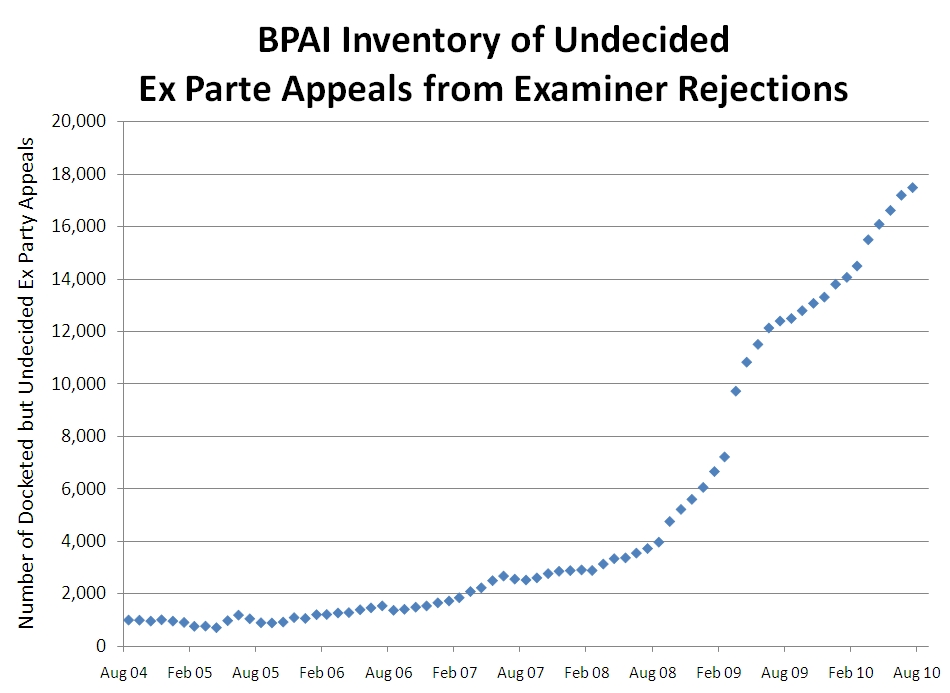
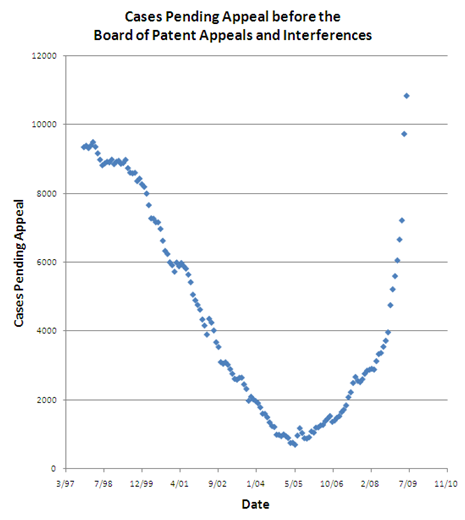
Although the Board of Patent Appeals (BPAI) is working harder than ever, its backlog continues to rise. The first chart below shows the BPAI’s inventory of undecided appeals in ex parte cases. This only includes fully-briefed appeals whose dockets have been transferred to the BPAI and does not include the thousands of other applications where awaiting briefing. The average timing from notice-of-appeal to appellate decision is 29 months.
I spoke with BPAI officials who identified the jump in early 2009 as a one-time issue involving the bulk transfer of cases that had been previously delayed.
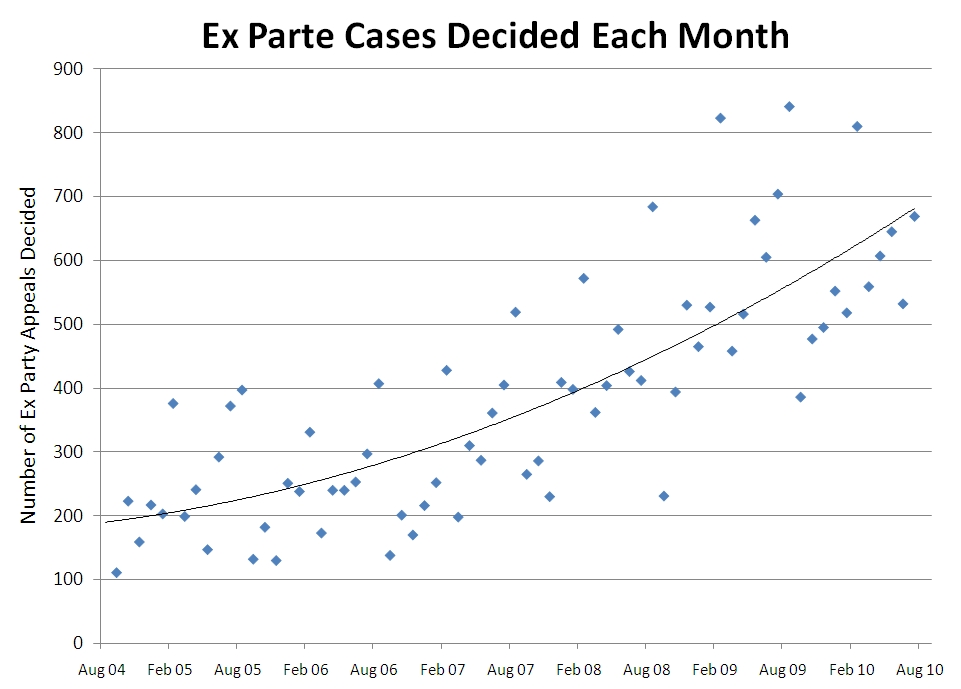
The next chart shows the number of Ex Parte cases decided each month. The average number of cases being decided each month continues to rise. However, the chart also reveals a high month-to-month variability. That variability is explained by the BPAI judge quota system. BPAI judge performance is primarily judged two times per year, and that process is reflected in a systematic incentive for the judges to do more work in Feburary and August and then less work in March and September.
Although the BPAI is deciding more cases than ever, inventory continues to rise because more appeals are being filed than ever.
In only its second precedential opinion of 2010, the Board of Patent Appeals and Interferences (BPAI) has further developed its procedures for its review of obviousness rejections and consideration of evidence of nonobviousness.
On Board review, if the appellant raises the issue as to whether the examiner’s conclusion of obviousness was in error, based in part on the proffered evidence of secondary considerations, the panel must consider if the examiner erred in determining patentability, based upon the totality of the record. In such instances, the Board panel must consider anew all the relevant evidence of obviousness, both for and against, in view of the argument on the issue. One such instance requiring a reweighing is seen in the present appeal – if the Appellants argue that the Examiner erred in determining that the weight of the evidence supports a conclusion of obviousness, the Board must review that conclusion of obviousness anew to see if the preponderance of relevant evidence properly before the Office supports that conclusion.
This decision should be seen as a continuation of the Ex parte Frye (BPAI 2010) holding that the Board must review "the particular finding(s) contested by an appellant anew in light of all the evidence and argument on that issue.”
Despite taking a fresh look at the evidence and conclusions, the BPAI held that the examiner had been correct in determining that the claimed "process for the manufacturing of decorative boards with an abrasion resistant surface and edges" was indeed obvious.
Over 85% of BPAI appeals focus on obviousness. The BPAI has a current backlog of over 16,000 cases. At its current rate of disposal, this figure represents a 29-month backlog.
This morning I created a dataset of prosecution information for 462 randomly selected utility patent applications filed in December 2004 and January 2005 to get a sense of where those applications stand after 4 ½ years of prosecution. Overall, 48% of the applications have issued as patents; 26% have been abandoned; and 26% are still pending. (Note – I excluded the 12% of cases from my sample that were never published as applications because data is not available for most of them).
Table 1 below shows the detailed status for each case as provided by the USPTO’s PAIR system. All but two of the pending cases have received at least an initial examination. The two still-unexamined cases are both software-related applications.
High-Level Status
Status
Percent of Cases
Patented
Patented Case
47.8%
Abandoned
Abandoned — Failure to Respond to an Office Action
25.2%
Abandoned
Abandoned — Failure to Pay Issue Fee
0.7%
Abandoned
Expressly Abandoned — During Examination
0.2%
Pending
Non Final Action Mailed
8.9%
Pending
Final Rejection Mailed
6.4%
Pending
Response to Non-Final Office Action Entered and Forwarded to Examiner
5.0%
Pending
On Appeal — Awaiting Decision by the Board of Appeals
1.0%
Pending
Notice of Allowance Mailed — Application Received in Office of Publications
1.0%
Pending
Notice of Appeal Filed
0.7%
Pending
Publications — Issue Fee Payment Verified
0.5%
Pending
Examiner’s Answer to Appeal Brief Mailed
0.5%
Pending
Docketed New Case – Ready for Examination
0.5%
Pending
Appeal Awaiting BPAI Docketing
0.5%
Pending
Withdrawn Abandonment awaiting examiner action
0.2%
Pending
Response after Final Action Forwarded to Examiner
0.2%
Pending
Appeal Brief (or Supplemental Brief) Entered and Forwarded to Examiner
0.2%
Pending
Advisory Action Mailed
0.2%
Table 1
An often frustrating aspect of application pendency is that abandoned cases can be kept alive by filing a continuation application. Of those cases that have been either patented or abandoned, 25% have one or more descendents in the form continuation or CIP applications. (I have not determined whether those continuations are themselves still pending.)
Of the cases already completed (no longer pending), the median patent took 2.6 years to issue while the median abandonment did not occur until 3.1 years into prosecution. Along this line, the longer a case was pending, the greater the likelihood that the case was abandoned. Thus, 71% of cases that were pending for fewer than three years were allowed while only 29% of cases that were pending for three to four and a half years were allowed.
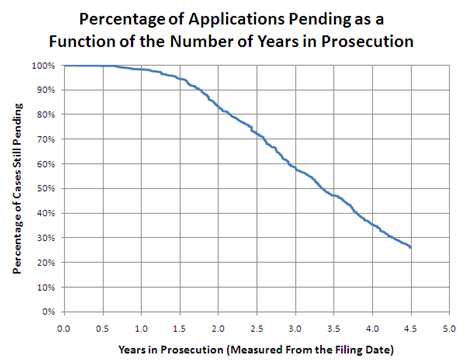
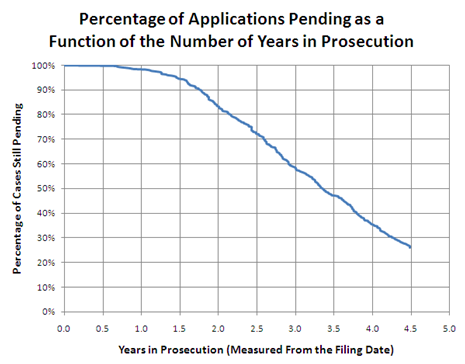
The chart below shows the percentage of applications pending as a function of the number of years in prosecution. Although the average time in prosecution for this cohort cannot be calculated yet (because so many cases are still pending), the median time in prosecution – as seen in the chart – is 3.3 years.
The patent office examination corps is divided into various technology centers. In my sample, TC 2800 (Semiconductors, Electrical and Optical Systems and Components) had allowed the highest percentage of cases (70%) and had the lowest rate of applications still-pending after 4 ½ years (3%). TC 1600 (Biotechnology and Organic Chemistry) has the highest abandonment rate (36%) while TC 2600 has the highest percentage of cases still pending (48%).
This morning I created a dataset of prosecution information for 462 randomly selected utility patent applications filed in December 2004 and January 2005 to get a sense of where those applications stand after 4 ½ years of prosecution. Overall, 48% of the applications have issued as patents; 26% have been abandoned; and 26% are still pending. (Note – I excluded the 12% of cases from my sample that were never published as applications because data is not available for most of them).
Table 1 below shows the detailed status for each case as provided by the USPTO’s PAIR system. All but two of the pending cases have received at least an initial examination. The two still-unexamined cases are both software-related applications.
High-Level Status
Status
Percent of Cases
Patented
Patented Case
47.8%
Abandoned
Abandoned — Failure to Respond to an Office Action
25.2%
Abandoned
Abandoned — Failure to Pay Issue Fee
0.7%
Abandoned
Expressly Abandoned — During Examination
0.2%
Pending
Non Final Action Mailed
8.9%
Pending
Final Rejection Mailed
6.4%
Pending
Response to Non-Final Office Action Entered and Forwarded to Examiner
5.0%
Pending
On Appeal — Awaiting Decision by the Board of Appeals
1.0%
Pending
Notice of Allowance Mailed — Application Received in Office of Publications
1.0%
Pending
Notice of Appeal Filed
0.7%
Pending
Publications — Issue Fee Payment Verified
0.5%
Pending
Examiner’s Answer to Appeal Brief Mailed
0.5%
Pending
Docketed New Case – Ready for Examination
0.5%
Pending
Appeal Awaiting BPAI Docketing
0.5%
Pending
Withdrawn Abandonment awaiting examiner action
0.2%
Pending
Response after Final Action Forwarded to Examiner
0.2%
Pending
Appeal Brief (or Supplemental Brief) Entered and Forwarded to Examiner
0.2%
Pending
Advisory Action Mailed
0.2%
Table 1
An often frustrating aspect of application pendency is that abandoned cases can be kept alive by filing a continuation application. Of those cases that have been either patented or abandoned, 25% have one or more descendents in the form continuation or CIP applications. (I have not determined whether those continuations are themselves still pending.)
Of the cases already completed (no longer pending), the median patent took 2.6 years to issue while the median abandonment did not occur until 3.1 years into prosecution. Along this line, the longer a case was pending, the greater the likelihood that the case was abandoned. Thus, 71% of cases that were pending for fewer than three years were allowed while only 29% of cases that were pending for three to four and a half years were allowed.
The chart below shows the percentage of applications pending as a function of the number of years in prosecution. Although the average time in prosecution for this cohort cannot be calculated yet (because so many cases are still pending), the median time in prosecution – as seen in the chart – is 3.3 years.
The patent office examination corps is divided into various technology centers. In my sample, TC 2800 (Semiconductors, Electrical and Optical Systems and Components) had allowed the highest percentage of cases (70%) and had the lowest rate of applications still-pending after 4 ½ years (3%). TC 1600 (Biotechnology and Organic Chemistry) has the highest abandonment rate (36%) while TC 2600 has the highest percentage of cases still pending (48%).
This morning I created a dataset of prosecution information for 462 randomly selected utility patent applications filed in December 2004 and January 2005 to get a sense of where those applications stand after 4 ½ years of prosecution. Overall, 48% of the applications have issued as patents; 26% have been abandoned; and 26% are still pending. (Note – I excluded the 12% of cases from my sample that were never published as applications because data is not available for most of them).
Table 1 below shows the detailed status for each case as provided by the USPTO’s PAIR system. All but two of the pending cases have received at least an initial examination. The two still-unexamined cases are both software-related applications.
High-Level Status
Status
Percent of Cases
Patented
Patented Case
47.8%
Abandoned
Abandoned — Failure to Respond to an Office Action
25.2%
Abandoned
Abandoned — Failure to Pay Issue Fee
0.7%
Abandoned
Expressly Abandoned — During Examination
0.2%
Pending
Non Final Action Mailed
8.9%
Pending
Final Rejection Mailed
6.4%
Pending
Response to Non-Final Office Action Entered and Forwarded to Examiner
5.0%
Pending
On Appeal — Awaiting Decision by the Board of Appeals
1.0%
Pending
Notice of Allowance Mailed — Application Received in Office of Publications
1.0%
Pending
Notice of Appeal Filed
0.7%
Pending
Publications — Issue Fee Payment Verified
0.5%
Pending
Examiner’s Answer to Appeal Brief Mailed
0.5%
Pending
Docketed New Case – Ready for Examination
0.5%
Pending
Appeal Awaiting BPAI Docketing
0.5%
Pending
Withdrawn Abandonment awaiting examiner action
0.2%
Pending
Response after Final Action Forwarded to Examiner
0.2%
Pending
Appeal Brief (or Supplemental Brief) Entered and Forwarded to Examiner
0.2%
Pending
Advisory Action Mailed
0.2%
Table 1
An often frustrating aspect of application pendency is that abandoned cases can be kept alive by filing a continuation application. Of those cases that have been either patented or abandoned, 25% have one or more descendents in the form continuation or CIP applications. (I have not determined whether those continuations are themselves still pending.)
Of the cases already completed (no longer pending), the median patent took 2.6 years to issue while the median abandonment did not occur until 3.1 years into prosecution. Along this line, the longer a case was pending, the greater the likelihood that the case was abandoned. Thus, 71% of cases that were pending for fewer than three years were allowed while only 29% of cases that were pending for three to four and a half years were allowed.
The chart below shows the percentage of applications pending as a function of the number of years in prosecution. Although the average time in prosecution for this cohort cannot be calculated yet (because so many cases are still pending), the median time in prosecution – as seen in the chart – is 3.3 years.
The patent office examination corps is divided into various technology centers. In my sample, TC 2800 (Semiconductors, Electrical and Optical Systems and Components) had allowed the highest percentage of cases (70%) and had the lowest rate of applications still-pending after 4 ½ years (3%). TC 1600 (Biotechnology and Organic Chemistry) has the highest abandonment rate (36%) while TC 2600 has the highest percentage of cases still pending (48%).
I used data reported by the Board of Patent Appeals and Interferences (BPAI) to compile the chart above. The chart reports the number of pending appeals each month from October 1997 – May 2009.
This study provides an issue-by-issue analysis of decisions on ex parte appeals by the Board of Patent Appeals and Interferences (BPAI) of the United States Patent and Trademark Office (USPTO). All the cases in this study were appealed to the BPAI after one or more of the pending claims were rejected by a patent examiner.
In the study, I report that most BPAI appeals focus on two or more issues. Of those, the majority of issues (61%) are affirmed and the remainder reversed. When more issues are presented, the case as a whole becomes more likely to be affirmed-in-part. In addition, I find that the likelihood that a case is affirmed has increased over time (Jan 2008 – May 2009).
By far, the most common issue on appeal is obviousness. I find that 87% – 90% of ex parte BPAI decisions decide an issue of obviousness. Only 4% of appeals consider neither obviousness nor novelty. The major aberration of this trend is for cases involving biotechnology and organic chemistry (TC 1600). 18% of BPAI decisions arising from TC 1600 focus on issues other than obviousness and novelty.
In comparing results by issue, I find that obviousness rejections are more likely to be affirmed than are other types of rejections. Most cases (74%) that discuss neither obviousness nor novelty are reversed.
The BPAI is becoming increasingly important. Over the past several years, the BPAI has seen a dramatic rise in the number of appeals being filed. In addition every recent patent reform legislative proposal has included an increased role for the Board.
Every proposed patent reform measure includes an expanded role for the US Patent & Trademark Office’s administrative patent court – known today as the Board of Patent Appeals and Interferences, the BPAI, or simply the Board. Even without legislation, the role of the BPAI has expanded greatly in the past few years. The number of ex parte appeals in FY2009 is expected to at least double the record-filing of 6,400 appeals in FY2008. I suggest that two factors have led to this short term dramatic rise in appeals: (1) an increase in rejection-rate by patent examiners; and (2) attempts by the PTO to limit non-appeal avenues for achieving full claim scope. These limits include the PTO’s proposed rules that would curtail the applicant’s ability to file multiple requests for continued examination (RCEs), continuation applications, and a multitude of claims. Although these rules have only been threatened, they impact appeal practice because they may apply to already-pending applications. Although more gradual, two additional influences on the rise in appeals include: (1) the continued perceived value of patent rights and (2) the continued rise in the number of patent application filed each year.
During patent prosecution, an applicant has a right to appeal to the Board after its application is twice rejected. 35 U.S.C. 134. In this short article, I look at how the Board responds to those rejections on appeal. Many appeals involve multiple rejections each of which may be affirmed or reversed. In addition, the Board occasionally introduces a new ground for rejection even after reversing an examiner decision. This analysis opens-up these decisions and provides data issue-by-issue.
My data comes from two primary sources. First, using Westlaw, I downloaded copies of the approximately 6,000 ex parte BPAI decisions issued between January 2008 and May 2009. Using an automated script, I extracted data from each of those appeals, including the holding and the extent of discussion of various issues. (i.e., how often “obviousness” or “enablement” is discussed in the opinion.) In addition, just under 200 ex parte decisions from 2009 were randomly selected and scored by hand to determine how the BPAI decided individual issues within the appeals. Board decisions typically identify a series of issues and then decide each issue. In Ex Parte Cypher, 2009 WL 1162435, 2008-4722, (Bd. Pat. App. Inter. 2009), for instance, the Board identified two issues: “(1) Claims 1-4 … are rejected under 35 U.S.C. § 103(a) as being unpatentable over Loh in view of McFarling. (2) Claims 9-11 … are rejected under 35 U.S.C. § 103(a) as being unpatentable over Loh and McFarling in view of Yeh.” In Cypher, both issues were affirmed. As a consequence, the data for this case reflects that two obviousness issues were raised, both of which were affirmed.
Results:
In the hand-scored sample, the average Board decision considered 2.1 issues (median of two issues). Approximately 61% of decided issues are affirmed on appeal and 39% are reversed. (In this study, fewer than 1% of issues were expressly not decided.) The issue-by-issue analysis fits with the overall holdings for cases on appeal. In the hand-scored sample, 59% of the cases were affirmed as a whole, 12% were affirmed-in-part, and 29% were reversed. (This sample parallels the Board’s own statistics for FY2009 which indicate that 60% of its decisions on the merits are affirmances, 15% affirmance in part, and 25% reversals). Table 1 shows the issue-by-issue results alongside the overall case-holding for the hand-scored sample.
Issue-by-Issue Results
Case-by-Case results
Affirmed
61% of issues affirmed
59% of cases affirmed
Affirmed-in-Part
N/A
12% of cases affirmed-in-part
Reversed
39% of issues reversed
29% of cases reversed
Table 1
As you might expect, when there is a strong correlation between the overall case holding of an appeal and the holdings on individual issues at issue in the appeal. When the overall case-holding is affirmed, the vast majority of issues are also affirmed. However, in the hand-scored sample, about 10% of cases that were affirmed included some individual issues that were reversed. Often, the reversed issues were rejections argued by the examiner in the alternative. In Ex Parte Mcquiston, 2009 WL 598537, 2008-3224 (Bd. Pat. App. Inter. 2009), for instance, applicant’s claim 1 had been rejected as (1) anticipated by Golds; (2) obvious over Golds; (3) anticipated by Simso; and (4) obvious over Simso. The Board rejected the first three of these rejections, but the claim remained unpatentable as obvious over Simso and the examiner’s decision affirmed as a whole.
Table 2 compares the case-holding with the issue-by-issue analysis based on our hand-scored sample of 200 BPAI decisions. As seen in Table 2, when a case is affirmed-in-part, roughly half (on average) of the issues are affirmed and half are reversed. In cases that were reversed, every issue was also reversed. (?2 P<.01).
Case Holding
Percent of Issued Affirmed
Percent of Issues Reversed
Affirmed
92%
8%
Affirmed-in-Part
51%
49%
Reversed
0%
100%
Table 2
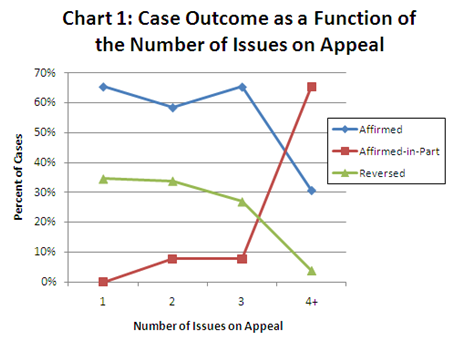
Number of Issues on Appeal: In Mcquiston, the applicant needed to address each alternate reason for rejection in order to win on appeal. In most cases, however, each claim is rejected for only a single reason – usually obviousness. See infra. The applicant can then choose how to group issues on appeal. If, for instance, claims 1-10 are each rejected as obvious, the applicant could choose to argue each claim separately or cluster the claims into one or more groups that are then argued as a unit. Chart 1 uses the hand-scored data to presents the likelihood of a particular case-holding as a function of the number of issues on appeal.
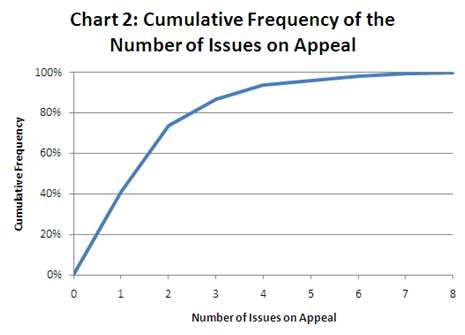
When only one issue is presented, the result in the case tracks the result of that issue. As more issues are presented, the likelihood of a split affirmed-in-part decision rises dramatically while the likelihood of either complete affirmance or complete reversal drops. Chart 2 is a cumulative frequency for the number of issues presented on appeal. In our sample, the number of claims ranged from 1 to 8. The median was 2 claims and the mode 1 claim. About 94% of decisions discussed four or fewer issues.
The Board is authorized to offer new grounds for rejection, and did-so in about 4% of the cases in the hand-scored study. The most common new ground was for obviousness.
Obviousness: Obviousness is the bread and butter of patent examinations. In this study, I also show that it is the mainstay of BPAI ex parte appeals. 90% of appeals in my hand-scored study included at least one obviousness issue that was decided on appeal. More than half of the appeals (54%) focused only on obviousness. The closest runner-up issue – anticipation – was an issue in 37% of the appeals. Other issues on appeal (each with a frequency of < 5%) included in descending frequency: written description requirement; indefiniteness, patentable subject matter, obviousness-type double patenting, and enablement.
For applicants, the fact that the majority of issues involve obviousness spells trouble for applicants. In the hand-scored data, the Board affirmed obviousness findings much more often it did for other grounds of rejection. Specifically, the Board affirmed 65% of the appealed obviousness issues, but affirmed only 52% of the appeal issues made on grounds other than obviousness. Table 3 compares these results for the hand-scored sample of 200 cases. (?2 P<.05).
Issue Holding
Obviousness Rejection
Other Grounds of Rejection
Affirmed
65%
52%
Reversed
35%
48%
Table 3
The pervasiveness of obviousness issues is further confirmed by the larger sample of 6,000 ex parte decisions issued between January 2008 and May 2009. Using a parsing script, I looked for discussions of obviousness issues by counting the number of times that the terms such as “obvious” and “35 U.S.C. § 103(a)” appeared in each opinion. In that sample, 87% of the decisions discussion obviousness while only 13% do not discuss obviousness. Table 4 shows the roughly parallel results.
Hand-Scored Sample
Automatically Parsed Sample
(n ˜ 200)
(n ˜ 6,000)
Obviousness at Issue
90% of cases decide an obviousness issue
87% of cases discuss either obviousness or Section 103(a)
No Obviousness Issue
10% of cases do not decide any obviousness issue
13% of cases do not discuss obviousness or Section 103(a)
Table 4
In order to ensure that I was picking up an actual obviousness issue, I created a script that looked for cases where obviousness was more intensely discussed, i.e., where obviousness terms were mentioned at least three times. In those cases where obviousness was intensely discussed, the Board affirmed the examiner’s rejections decisions 59% of the time. In cases where obviousness was not discussed at all, the examiner was affirmed in only 37% of cases. Table 5 compares these results for the automatically-parsed sample of 6000 cases. (?2 P<.01).
Case Holding
Obviousness Intensely Discussed
No Discussion of Obviousness
No Discussion of Obviousness or Novelty
Affirmed
59%
37%
22%
Affirmed-in-Part
15%
10%
4%
Reversed
26%
47%
74%
Table 5
The far right column of Table 5 provides a compelling statistic. 358 cases in the sample had no discussion of either obviousness or novelty. Of those cases, 74% were reversed on appeal.
Technology Center Specific Results: Patent examination is divided amongst various technology centers. Although the substantive patent laws do not vary across technology lines, patent practice can vary greatly. The BPAI regularly updates a statistical breakdown of its opinions by tech center. [Link]. Table 6 is derived directly from the BPAI statistics for FY2009 through May 2009 and shows the percentage of decisions on the merits from each tech center that arrive affirm, affirm-in-part, or reverse, respectively.
Technology Center
Affirmed
Affirmed-In-Part
Reversed
1600 Biotechnology and Organic Chemistry
59%
15%
27%
1700 Chemical and Materials Engineering
69%
11%
20%
2100 Computer Architecture, Software, and Information Security
63%
13%
24%
2600 Communications
64%
14%
21%
2800 Semiconductors, Electrical and Optical Systems and Components
Focusing in on obviousness again, it is interesting to see that appeals from Tech Center 1600 (Biotechnology and Organic Chemistry) are the least likely to discuss obviousness. The most appeal decisions emerge from Tech Center 1700 (Chemical and Materials Engineering), and those appeals are the most likely to include a discussion of obviousness. In particular, a discussion of obviousness is found in 92% of TC 1700 appeals but only 76% of TC 1600 appeals. (?2 P<.01). The difference is partially explained by TC 1600’s more rigorous application of the Section 112 issues of written description, enablement and indefiniteness. Table 6 is again derived from the automatically-parsed sample of 6,000 Board decisions. For each tech center, Table 7 indicates the percent of cases that discuss obviousness; both obviousness and novelty; novelty; and neither obviousness nor novelty. This table again highlights (1) the focus of the PTO on obviousness issues (and to a lesser extent novelty issues) and (2) the differences of TC 1600 from the rest of patent practice.
Percent of Cases Issue on Appeal
Technology Center
Obviousness+
Obviousness and Novelty
Novelty+
Neither Obviousness Nor Novelty
All
87%
31%
40%
4%
1600 Biotechnology and Organic Chemistry
76%
20%
26%
18%
1700 Chemical and Materials Engineering
92%
29%
34%
3%
2100 Computer Architecture, Software, and Information Security
82%
29%
43%
3%
2600 Communications
89%
31%
39%
3%
2800 Semiconductors, Electrical and Optical Systems and Components
The Board rejected Bagget's patent claims as obvious. On appeal, the Federal Circuit largely affirmed – holding that the the administrative body's factual findings were supported by the requisite "substantial evidence" and that the Board had properly “articulated [its] reasoning with some rational underpinning to support the legal conclusion of obviousness" as required by KSR. (Quoting KSR Int’l Co. v. Teleflex Inc., 550 U.S. 398, 418 (2007)).
The only portion vacated involves an error interpreting the term "memoization." The Board had initially misinterpreted the term as memorization. After a petition for rehearing, the Board corrected its mistake – but only as to one of the four claims containing the term. On appeal, PTO Solicitor Chen explained that Baggett had only addressed the one claim in the petition for rehearing, but offered that a remand would still be appropriate.
Notes:
This case may serve to emphasize the difficulty in appealing an obviousness decision from the Board of Patent Appeals & Interferences. The "substantial evidence" standard is low, i.e., "more than a mere scintilla of evidence." Likewise, the legal conclusion of obviousness now looks merely for "some rational underpinning."
In a note, Hal Wegner identifies four Federal Circuit appeals up for review that may focus on obviousness: In re Applied Materials Israel Ltd., Fed. Cir. No. 2009-1083 (argument July 7, 2009); In re Mettke, Fed. Cir. No. 2009-1125; In re Roth, Fed. Cir. No. 2009-1223; and In re Rivera, Fed. Cir. No. 2009-1123.
Although it may have been amended during prosecution, the original claim 1 reads as follows: 1. A method of producing constructed fares that includes an arbitrary added to a published fare, said method executed in a computer system, the method comprising: determining interior cities that appear with gateway cities in arbitraries for the airline; searching for gateway cities corresponding to the determined interior cities appearing in the arbitraries; and applying an arbitrary corresponding to one of the interior cities to a published fare involving one of the gateway cities to produce the constructed fare.
In January 2009, I reported on a dramatic rise of BPAI Appeals and the associated backlog. Since then, the backlog has almost doubled to over 10,000 pending appeals. This is the largest backlog on record and tends to explain why the Board is attempting to implement procedures to streamline the process.
At the Board’s average rate of 500 disposals per month, the backlog would take over 20 months to eliminate. However, that result requires the counterfactual assumption that no additional appeals will be filed during that period. Rather, though four months remain in FY2009, the number of ex parte appeals filed this year will likely more than double the record-filing of 6400 ex parte appeals in FY2008. Thus, appeals are being filed at a rate about 2 1/2 times faster than the Board’s usual work flow rate. In May 2009, for instance, the Board disposed of 523 appeals, but received 1641 new appeals to decide.
My keen research assistant Patrick Barnacle pulled up records on 56 ex parte patent appeals that have been decided by the Court of Appeals for the Federal Circuit since March 2005. All of these cases arise from rejections sustained by the USPTO’s internal Board of Patent Appeals and Interferences (BPAI). We are working to create a more complete database. In the meantime, I wanted to report some preliminary results on timing.
The median ex parte appeal took just over fifteen months to complete as measured from the date of the BPAI decision until the date of the Federal Circuit decision. As measured from the filing of the CAFC Notice of Appeal, the median appeal took exactly one year (365 days). Some appeals took longer: Comiskey, Ferguson, and Bilski each took more than two years from the NOA, but they were all tied to en banc decisions. About 25% of the appeals took less than ten months from the NOA.
Once oral arguments (if any) are complete, the Federal Circuit is rather quick at issuing an opinion. The median decision was issued 47 days after the oral arguments. (Again, a skewed average of 86 days is driven by the handful of en banc decisions) 30% of the decisions came within one week of oral arguments – most of those took one to two days.
We have not yet analyzed the correlation between delay and results, but it appears that especially quick decisions tend to favor the PTO over the applicant. As you might expect, delays in judgment correlate with longer opinions; opinions marked precedential; dissenting opinions; and opinions with Judge Newman on the panel.
 In re Stepan Co. (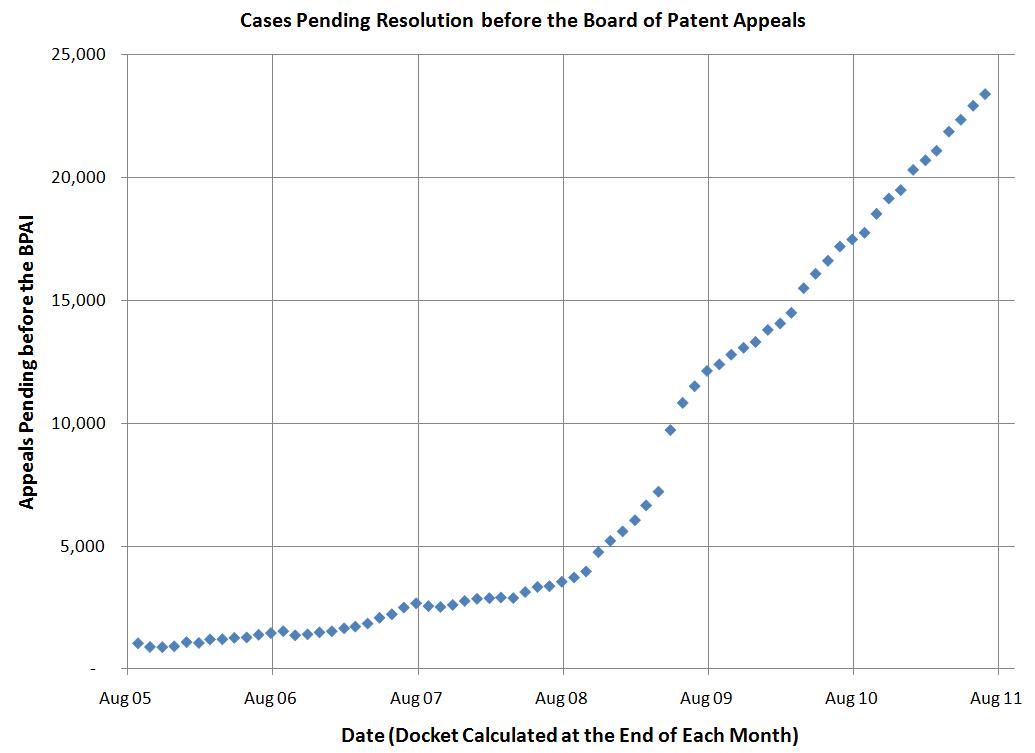
![6a00d8341c588553ef0115704a8ff5970c-pi[1]](https://cdn.patentlyo.com/media/images/2009/06/6a00d8341c588553ef0115713fac74970b-pi.png)