Terms of Use & Disclaimer

  • Terms of Use

  • Patently-O on Facebook
    Connect with Patently-O readers.

Jan 17, 2008

Patent Reform and the Ethos of the American Inventor

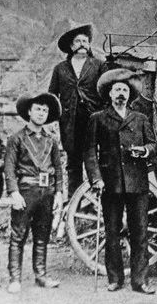
PatentLawPic138Although I understand the reality that most patent prosecution is handled on behalf of corporate assignees, I still hold a special place in my heart for the maverick American inventor.  Some might understand the slight pangs I felt when reading the inventorship section of the Senate report on patent reform.  The report suggests eliminating from the law “the antiquated notion that it is the inventor who files the application, not the company-assignee.” Perhaps it is time my thoughts of the American inventor to go the way of the Wild West and horse drawn carriages.
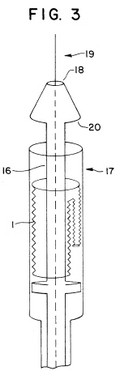
The Bill (S.1145) is intended to fix an understandable problem — that of inventors who fail to fulfill their contractual obligation to assign patent rights to the Corporate owner.  This is a serious problem as shown by the current issue of IPToday which includes a full-length article describing the complex set of hoops currently required to overcome these so called “problem inventors.” [LINK]

Beyond the sound-bites, the specific reform provisions are not so bad. The revised statute would allow an “obligated assignee” to file the patent application on its own behalf. An inventor’s oath is still required unless the “obligated inventor” is either unable or unwilling to sign. Under the provision, a patent cannot be challenged as invalid or unenforceable based on a corporations mistaken claim that the inventor had an obligation to assign.  The savings clause appears to also include protection against mistakes in correctly naming inventors in the application.

Aug 08, 2007

Priority to Foreign Application Requires "Inventor's Knowledge or Consent" at the Time the Foreign Application was Filed

PatentLawPic009Boston Scientific SciMed v. Medtronic Vascular (Fed. Cir. 2007).
SciMed’s patent application was originally filed by a European company (MinTec) in February 1994 as an European Patent Application. At that time, however, the inventors (Cragg & Dake) had not yet assigned rights to MinTec. Cragg assigned his rights a few months later. Dake did not assign his rights until 1996.

Medtronic has a US priority filing date of June 1994 on the same invention. In the interference, the question is whether a US patent applicant claim priority to a foreign application filed by an entity that was not acting on behalf of the US applicant at the time of filing? CAFC Answer: No priority unless foreign application was filed on behalf of the US applicant.

Under the court’s ruling here, 35 USC 119(a) provides a personal right to the inventor. Consequently, there must be a “nexus…between the inventor and the foreign applicant at the time the foreign application was filed.” That nexus requires at least “knowledge or consent” of the inventor.

“Indeed, as a matter of pure logic, an entity could not have filed a foreign application “on behalf of” an inventor without the inventor’s knowledge or consent; that the foreign application may have been filed in accordance with the laws of the country in which it was filed has no bearing here.”

Holding:

“[A] foreign application may only form the basis for priority under section 119(a) if that application was filed by either the U.S. applicant himself, or by someone acting on his behalf at the time the foreign application was filed.” (emphasis in original)

Notes:

  • This decision [LINK]: Scimed Life Sys., Inc. v. Medtronic Vascular, Inc., — F.3d — (Fed. Cir. 2007).
  • Final BPAI Decision: Patent Interference No. 104,192, Paper No. 187, 2001 WL 1339890 (B.P.A.I. July 21, 2001).
  • Trial Court Decision: Scimed Life Sys., Inc. v. Medtronic Vascular, Inc., 486 F. Supp. 2d 60 (D.D.C. 2006).


Dec 21, 2006

Women as Patentees

Patents are intended to lure potential inventors into the business of innovation.  The truth is, however, that very little is known about how patents really drive innovation.

Historically, only a very small number of women have obtained patents. Data from historic studies:

  • 1790 – 1895: About 1% were granted to women;
  • 1905 – 1921: About 1.4% were granted to women;
  • 1954: 1.5% of issued patents included women inventors;
  • 1977: 2.6% listed one or more women as inventors;
  • 1996: 9.2% listed one or more women as inventors.

Since patentees do not list their sex, all of these studies rely upon segregating inventors according to traditional first-names.

2006: In my own recent study, I looked at a sample of 150,000+ patents issued between 1999 and 2006.  I then made a list-ranking of first-names of first-listed inventors. Can anyone guess how many of of the top-100 inventor-names were traditionally female names???

Continue reading "Women as Patentees" »

Mar 08, 2006

Patently-O TidBits -- King of the Submarine.

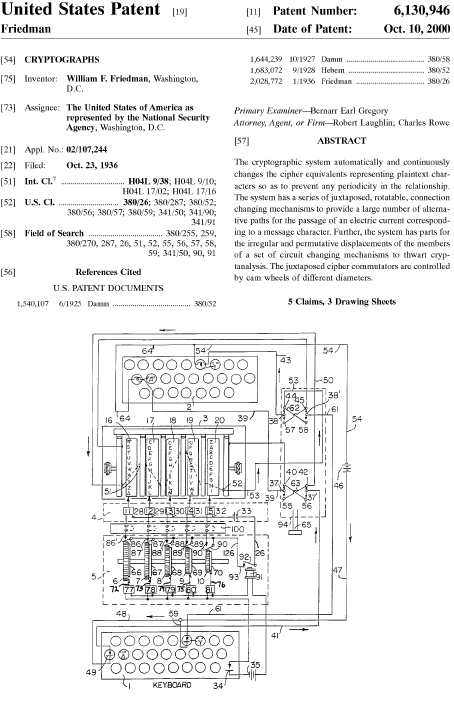
Bill Friedman filed his patent application on October 23, 1936 on a new cryptographic system. The patent finally issued some 64 years later as U.S. Patent No. 6,130,946. Can you find any currently viable patent with an earlier filing date?

AIPLATalk161 

* This tidbit came from the great discussion ongoing at the Patent Information User's Group about record-holding patents (longest pending, most claims, etc.). 

UPDATE: A reader found Patent No. 6,097812 by the same inventor.  It is still viable, but the filing date was July 25, 1933!

Feb 21, 2006

President's Day Patent

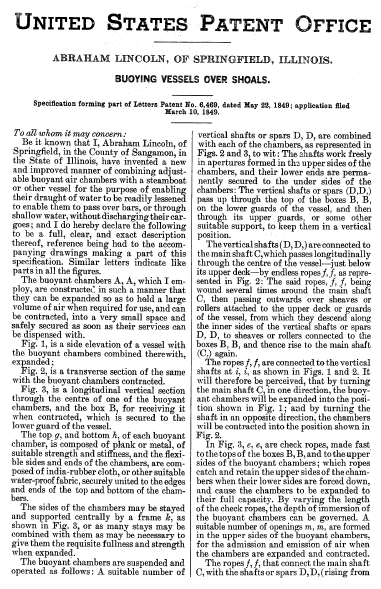
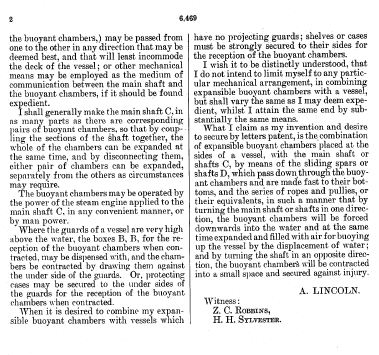
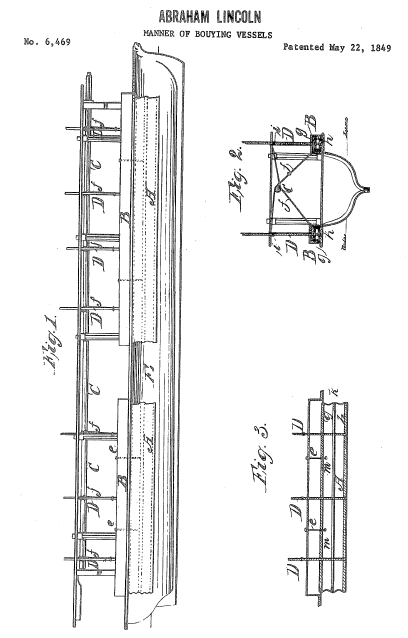
Abraham Lincoln is the only U.S. President to have received a patent.  His invention involved inflatable air chambers on a boat to help float the boat through low water or over sandbars.

AIPLATalk068

AIPLATalk069

AIPLATalk067

Feb 19, 2006

PTO Requests Model of Warp Drive Invention

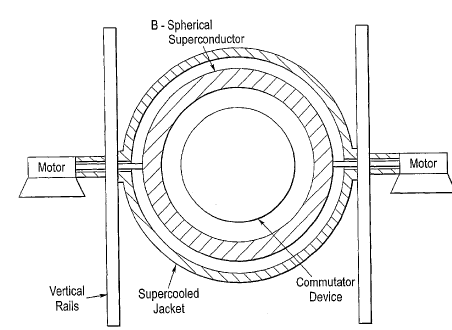
The Worsley-Twist warp drive does not depend upon traditional emissions of matter to create thrust.  Rather, the drive creates a change in the curvature of the space-time continuum — thus allowing travel by warping space-time.  Worsley & Twist patent application recently suffered another setback. The Examiner has now requested a working model:

Applicant is required to furnish a model of the instant invention. 35 U.S.C. 114. See Also 37 C.F.R. 1.91.

Among other rejections, the Examiner has asserted a rejection under 35 U.S.C. 101 for lack of utility — finding that the invention is inoperable.

PatentlyO066

Links:

More Interesting Patent Applications (From Keith Nagel)

  • U.S. Pub. No. / Title
  • 2005-110500 DEVICE FOR EXCHANGING TRANSMISSION AND RECEPTION OF FUTURE INFORMATION OF MULTI-WORLD IN-BETWEEN PAST
  • 2005-102494 GRAVITY CONTROL TIME MACHINE UTILIZING ACCELERATED MOTION TO WHICH GENERAL THEORY OF RELATIVITY IS APPLIED
  • 2005-101509 ULSI COMPRISING BINARY-NOTATION-SYSTEM ELEMENT FOR RETURNING ELEMENTARY PARTICLE OR ATOM TO PAST
  • 2004-197727 GENERATOR USING CASIMIR POWER SUCH THAT TWO METAL PLATES PARALLELLY PLACED IN SLIGHTLY SPACED RELATION IN VACUUM ATTRACT EACH OTHER
  • 2004-135253 APPARATUS FOR IRRADIATING EXCESS DIMENSION WITH GRAVITATIONAL WAVE USING BRANEWORLD THEORY IN BINARY NUMBER SYSTEM, TRANSMITTING-RECEIVING AND DECODING INFORMATION THEREFROM
  • 2004-080981 APPARATUS FOR RAPIDLY ROTATING SMALL-SIZED ROD WITH ACCELERATOR TO FORM SINGULAR POINT, TO GENERATE CTL, TO PLACE FUTURE INFORMATION OBJECT THEREON AND TO SEND IT TO PAST
  • 2004-032821 TRANSMITTER/RECEIVER TO PAST BY BINARY NOTATION SCALE OF FUTURE INFORMATION USING QUANTUM MECHANICS FOR RETURNING ELEMENTAL PARTICLE TO THE PAST
  • 2003-198642 DEVICE FOR TRANSMITTING FUTURE INFORMATION TO PAST BY INTEGRATING LEFT ELECTRON INTO MORSE SIGNAL SYSTEM BY USING INFORMATION TRANSMITTING SPEED ZERO SECOND OF SPIN OF ELECTRON BLEW OFF RIGHT AND LEFT
  • 2001-326969 FUTURE INFORMATION PAST TRANSMISSION/RECEPTION DOCUMENTING MACHINE UTILIZING LASER PULSE

Feb 01, 2006

Hamlet, on filing a response with the USPTO

Angela Horne is a patent agent at Quine IP Law Group.  As can be seen from her prose below, she is also a talented Shakespearean.  In this Scene, young Hamlet is debating his next course of action:

To file, or not to file (today): that is the question
Whether 'tis easier on the budget to file
The current draft without further extension;
Or instead, to take more time to review,
And by reviewing, further revise the arguments...
To file, to wait for the Examiner to review
At last; and by calling before two months is up, forestall
The heart-ache and the thousand muttered curses
That a Final Office Action is heir to. 'Tis a consummation
Devoutly to be wish'd.
To file the response, to follow up with a call;
To call, perchance to get the case allowed: aye, there's the rub;
For in that Notice of Allowance, what claims to next pursue
When we have the current claim set allowed, 
Must give us pause...

Ms. Horne’s prose also reminds me of the Roach Trap patent application that was filed in the mid 1800’s by D. Breed of Washington DC.

To all those whom it may concern:
By this description, you may learn
That I, D. Breed, a District man,
Have made invention of a plan,
Both new and useful, of a trap
For catching roaches while you nap.

In setting forth my new invention,
Of first importance I would mention
My trap's a novel earthen cup
Outside of which the roach creeps up
And, jumping in to eat molasses,
The well glazed mouth he ne'er repasses.

In drawings, figures one and two
Show simple forms, yet something new;
The first has rough outside or way;
The next, an inclined path at A.
The central stem (in dots you see),
Is crowned with bowl like half a pea,

To hold molasses, say a drop,
And smoothly glazed from base to top.
But this is no essential thing:
Without it, the roaches spring.
If in the bottom of the cup
You place the sweet whereon they sup.

The figure three shows a form unique
Of which in highest praise I speak;
'Tis glaze on in and outer sides,
Except between the handle strides
Where creep the roachies up a track
Without fear of sliding back.

In figure four, at B, a spout
Is made, to wash dead roaches out;
This form is glazed entire within,
also the mouth up to the brim
but on the outer side, all round,
No trace of glazing can be found.

In five and six, a septum, C,
Cuts full two thirds the cup from three,
The smaller part has open door
At letter D, close to the floor,
And inclined way to top of cup
Where Mr. Roach with cane walked up;

Nor needs his wife or child his hand
To reach the highest brink and stand,
A little trip is balance hung
May o'er the mouth of cup be swung;
But that, an almost useless thing,
To save expense, away I fling.

Of varied traps, with spiral walk
And sundry forms, I yet might talk --
Of clay or other mortar made
To suit the fancy or the trade:
Forms now conceived, yet not revealed,
That sleeping lie to fancy's field.

From this description,you may make
Whatever form you choose to take,
From figure one to six, made part
Of this to aid the potter's art,
I recommend said figure three
Of porcelain, like cup for tea.

Claim

As manufacture new, I claim
Said pottery trap, or porcelain.


Nov 23, 2005

A day of thanks

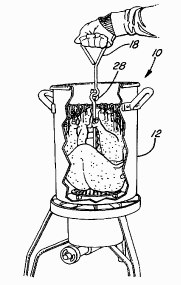
I hope that everyone has a happy Thanksgiving. Even if you are not in the U.S., I suggest that you take the day off to celebrate.  Although I love turkey, I hope that you don't deep-fry yours.

The U.S. Patent and Trademark Office Joins in the Celebration of Thanksgiving
Recognizes patents and trademarks related to Thanksgiving

The Department of Commerce's United States Patent and Trademark Office joins in the celebration of Thanksgiving by recognizing some patents and trademarks associated with this festive holiday.

Food often takes center stage at Thanksgiving, and there are many well-known Thanksgiving-related products protected by patents and trademarks. One way to spend more time with family and less in the kitchen cleaning up is by using a disposable cooking pan (patent #5,628,427) or a cooking jacket (patent #4,942,809) for the turkey, ham or roast. One non-traditional, but increasingly popular, way to cook a turkey is deep-frying, and one type of equipment used in this preparation is protected by patent # 5,758,569.

Some well-known trademarks associated with turkey and dressing, must-haves at many Thanksgiving tables, are Butterball (registration #1151836) for turkey products and Stove Top (registration #0949459) for stuffing. What holiday feast would be complete without cranberry sauce such as Ocean Spray (registration #2150919)? Desserts are always the final complement to a Thanksgiving feast. For those that do not bake their own, Sara Lee's slogan for its pies and cakes, "Nobody Doesn't Like Sara Lee," is protected by trademark registration #1885156.

These patents and trademarks, as well as the more than six million patents issued since the first in 1790 and the 2.3 million trademarks registered since 1870, can be seen on the Department of Commerce's U.S. Patent and Trademark Office web site at www.uspto.gov.

Patentable Subject Matter?

ScreenShot009

If you are already looking for a Christmas present, you might find a good one for your brother in U.S. Patent No. 6,966,840. The patent is titled “Amusement device that senses odorous gases in a bathroom.”

With all this question of patentable subject matter — perhaps this would have been a candidate for rejection. . . . Proposed revision to Diamond v. Diehr: “anything under the sun made by man [excluding bathroom related novelty devices].”


Sep 29, 2005

Patent Glossary

Learning the Law: The patent law firm of Brown & Michaels has created a nice, short patent glossary that covers many of the terms of art that patent attorneys use on a daily basis.  The patent glossary is a great place to start if you are a new lawyer, agent, or paralegal trying to learn the trade. 

Link:

Jun 15, 2005

Branding-Energy of the Volkswagen Beetle

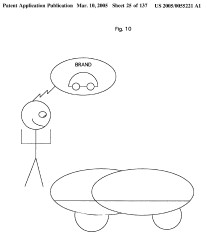
ScreenShot012I have been planning a post about U.S. published application No. 2005–0055221 for ages, but I just could not find any words to describe my emotions.

The abstract reads:

A branding-energy amplifier for amplifying the branding-energy of the Volkswagen Beetle. Branding-Energy Amplifier established upon the principle of Node Plurality.

As explained in the specification:

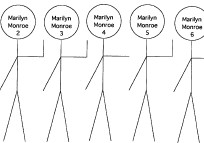
Branding EnergyIf you were to see a singular Marilyn Monroe walking down the street, you probably would notice.  If, however, you were to see 88 Identical Marilyn Monroes's single filing fashionably in parade-dress parade, you would likely stop whatever you were doing and stare in exasperated amazement wondering all the while what in the world was going on. . . . By extension then, a Volkswagen beetle limousine with 88 humps, does not look the same, does not function the same, and is, in fact, not the same, as a Volkswagen beetle with 1 hump because they do not share identical Automotive DNA.

View the patent: DOWNLOAD.  The warp-drive has nothing on this one.

Apr 07, 2005

Federal Circuit Judge Admits that Family Member is Infringing PBJ Claims

PB&JIP Law Bulletin has a nice follow-up article on Smuckers’ Peanut Butter & Jelly patent appeal at the Federal Circuit.  According to their report, the judges on the panel were somewhat hostile to the applicant:

Judge Arthur Gajarsa noted that his wife often squeezes together the sides of their child's peanut butter and jelly sandwiches to keep the filling from oozing out. "I'm afraid she might be infringing on your patent!" he said.

Smuckers is appealing the USPTO’s rejection of its patent application on its crustless sandwich making process.  Smuckers already holds one patent on the technology, but is hoping to capture a broader claim-set with this appeal.

A decision is expected within about four months.

Links:

Apr 01, 2005

Welcome to April!

PatentlyOImage008

A Mr. G. Aharonian holds the patent on a holiday boardgame that includes the fine American holidays of April Fool’s Day, Tax Day and Arbor Day. (U.S. Patent No. 4,915,391).

Abstract: A board game whose gameboard design is composed of an endless path of purchasable blocks representing the major national American holidays. . .

I wonder if the inventor has any relation to the famous G. Aharonian?

In other April First news, the IPO, as expected, has called for “more patents and fewer courts.”  From the press release:

Today IPO announced its 2005 legislative program. Key objectives are to quadruple the number of U.S. patents granted each year and to automatically enforce all patents without costly litigation. To this end, IPO called for eliminating the jobs of the 5,000 patent examiners at the USPTO and abolishing all PatentlyOImage009federal courts that have offended IPO members by denying or refusing to enforce patents. Money saved by cutting these unnecessary government jobs can be used to create a federal program to subsidize businesses known at "patent trolls," in order to increase patent licensing income and strengthen the U.S. economy.  (IPO April 1 Special Report).

Just to be clear — this press release is a joke.

Mar 24, 2005

Patents, String Theory, Anti-Aging, and the Warp Drive

PatentlyO065

I was discussing string theory with a buddy on the way to work this morning.  It turns out that the practical applications of string theory have not yet been fully realized — at least as far as patented technology is concerned.  Only eight issued patents and eight published applications refer to string theory in any way.  Of these, the two most interesting include Jerry Jacobson’s patented method for ameliorating the aging process by using electro-magnetic energy.  (U.S. Patent No. 6,004,257).

Although not yet issued, UK scientists Andrew Worsley and Peter Twist have applied for their patent on specifications for warp drive technology based on the theoretical underpinnings of both general relativity and string theory. (U.S. Pub. No. 2003–0114313). The Worsley-Twist warp drive does not depend upon traditional emissions of matter to create thrust.  Rather, the drive creates a change in the curvature of the space-time continuum — thus allowing travel by warping space-time.  Worsley & Twist recently responded to a rejection under Section 101 of the patent act.  The patent examiner raised concerns over the possibility of the claimed terms “graviton” and “warp drive.”  In their response, the applicants pointed out that the warp drive does not necessarily require superluminal (faster than light) travel.

PatentlyO066


Mar 08, 2005

Trial Lawyers Beware: The Mock Jury Has Been Patented

Mock Jury Patent

To put everyone on notice: The method of conducting a mock trial has been patented.  The patent, No. 6,607,389, claims priority to a 2001 provisional filing date.  The novel portion of the claim appears to be that both the stricken and not-stricken members of the jury pool hear the case.  Claim 1 reads as follows: 

1. A method of conducting a mock trial exercise . . . comprising:

  • assembling an initial pool of potential mock jurors;
  • questioning members of the initial pool . . .;
  • striking members of the initial pool for cause . . .;
  • permitting the attorney[s]to make a number of peremptory strikes of members of the initial pool . . .;
  • assembling a probable jury comprising members of the initial pool not struck;
  • assembling a stricken jury comprising members of the initial pool struck;
  • presenting [at least a summary of the case] to both the probable jury and the stricken jury.

The patent was awarded to Dr. Louis Genevie, founder of Litigation Strategies, a New York jury research and consulting firm.  Thanks to Dan Ravicher at PubPat for showing me this one. 

Feb 17, 2005

You don't see drawings like this anymore

IP Funny is written by a group of anonymous intellectual property attorneys.  In a recent post, they uncovered Nelson Waterbury's 1968 patent on a bulletproof buoyant combat uniform.  I have no idea whether the invention was valuable, but the drawings are great!

Links:

Feb 09, 2005

USPTO Issues Design Patent Number 500,000 for Chrysler Convertible

Patentlyo014

The USPTO announced a ceremony to commemortate issuance of design patent number 500,000.  The patent, issued to DaimlerChrysler(R) for the design of the Chrysler Crossfire(R) will be awarded by the new Secretary of Commerce Carlos M. Gutierrez and Under Secretary of Commerce for Intellectual Property Jon Dudas.

Design patents are granted for new, original, ornamental designs for articles of manufacture. The first design patent was issued in 1842 to George Bruce of New York City for printing types. Design patents provide exclusive rights to their owners for a term of 14 years from the date of issuance. [LINK]

Long out of favor, design patents are seeing a rebirth.  Earlier this week in Junker v. Eddings, the Federal Circuit upheld an $800,000 verdict in a design patent case.  According to Philip Mann, unlike in prior cases, "the Federal Circuit did not go out of its way to find the design patent invalid and/or not infringed."

Logistics:

Friday, February 11, 2005, 11:00 a.m.
Lobby, U.S. Department of Commerce
Main Entrance, 14th Street, N.W.
NOTE: I just received word from the PTO that the ceremony is NOT open to the public.

Feb 03, 2005

Patent TRIVIA CONTEST: Fluid-Filled Lens (WINNER FOUND)

The trivia contest posted last week generated lots of interest.  Thanks for everyone who tried their hand at searching.  The contest goal was to find a seminal U.S. patent that teaches a fluid lens.  The question included the clues that the lens was patented prior to WWII, had no cited prior art, 14 independent claims, and no dependent claims. A small non-monetary prize was promised to the winner.

However -- there will be no prize, because the winner is one of our fine USPTO Patent Examiners (Examiner-H) who was able to find U.S. Patent No. 2,062,468.  Ethical rules bar us from sending him a prize, and Examiner-H would prefer to remain anonymous.  Greg Aharonian would be proud.

About the patent: This "optical device" was patented by Charles H. Matz in 1936 teaches a "fluid lens." The strength of the lens can be altered by varying the curvature of the surface of the liquid.  Interestingly, Matz introduces the concept of varying the surface curvature (surface tension) by varying the voltage across the fluid lens.

NOTES:

  • Download The Patent
  • We're making the contest a bi-annual event (every 6 months). Feel free to send me suggestions for contest. (patent law blogger -- Dennis Crouch).
  • LINK: Paul Schwander from the EPO regularly provides a similar quiz in the IPR-helpdesk newsletter to help searchers build up their skills. FYI: IPR = Intellectual Property Rights.

Jan 30, 2005

Patent TRIVIA CONTEST: Fluid-Filled Lens

One of our loyal readers sent in a TRIVIA question about camera lens technology.  Before going to law school, I spent some time as a consultant for a major lens manufacturer, so this topic is also of interest to me.

Both Philips Electronics and Varioptic have patents on fluid-filled camera lenses. The IP dispute between these two companies will likely become quite hot in the near future. [link, link].

However, neither company has made any public reference to a seminal U.S. Patent that teaches a fluid lens that was patented before World War II (WWII).  This patent has no prior art cited against it, has 14 independent claims and no dependent claims. 

Contest: Can you find that seminal patent? A quite small non-monetary prize for the first correct answer.

Jan 06, 2005

eBay infringement decision expected

There is an interesting article in the Post (free subscription) about Thomas Woolston, creator of the MercExchange and Patently-O Reader.  Woolston won a $35 million patent infringement suit against eBay that is now on appeal.  According to the article he and I have the same schedule:

Every morning at 11, Woolston stops whatever he's doing, sits at his computer and clicks "refresh" on the Federal Circuit Court of Appeals Web site.

Woolston checks the Federal Circuit's website because the court is expected to release its decision in the eBay case within the next few weeks.  I check the website so that I can provide the most up-to-date news on patent cases.

Jan 01, 2005

Happy New Year!

Here's to a happy new year! I'll be back at work on Monday morning, and you should see a return of quality posts at that time.

We usually shoot fireworks at new-years. Jake's Fireworks is the big dealer in my childhood hometown of Pittsburg Kansas. Their latest patent is on a new way to package fireworks. (U.S. Design Patent No. D-499,638).

Nov 02, 2004

Election 2004: Paper Ballots Still Recieve A Majority of Votes

Portable Voting Booth Patent

Chicago still uses punch-cards for voting. Despite the risk of hanging chads or dimpled marks, the benefit of this system is the paper trail. Many voters, including myself, are reassured by the paper trail. Patent No. 4,445,731 (shown above) was invented by John Ahmann in the early 1980's. The patent covers the type of portable voting booths used in my precinct. Ahmann is still recognized as an expert in voting technology and testified in the Bush v. Gore controversy of 2000. According to the BBC, about 30% of U.S. voters will use electronic voting (e-voting) machines in today's election.

Problems and praise Opponents highlight the problems that have already occurred with the machines - pointing for instance to a congressional race in Ohio in which votes were incorrectly registered due to a problem with the memory cartridges.

At the same time however, Georgia's entirely electronic system appears to have few naysayers after two years in operation - although it is widely accepted that the presidential election will prove the greatest test.

The principal criticism remains the lack of paper audit trails. Nevada is the only state using machines which will provide voters with the kind of receipt which would, if necessary, allow for a manual recount.

But in order to accommodate some of the concerns, a number of states - including California - will give voters the opportunity to vote using electronic machines or a paper ballot form.

Here is a picture of my neighbor and senate hopeful Barak Obama and his daughter casting his vote.

Oct 27, 2004

iPod Receives Design Patent

Img178
Apple has received a design patent on its 3G iPod. The application was filed just days before the public release of the new iPods, and issued as a new patent on October 26. (U.S. Patent No. D497,618). Apple Insider and Steve Nipper have more information.

What is a Design Patent?
A design patent covers ornamental, non-functional characteristics of an article of manufacture. The Patent Act provides that a design patent should be issued for any new, original and ornamental design for an article of manufacture. As such, a design patent only protects the appearance of an article and not any structural or utilitarian elements. A design patent has a term of 14 years from the date of issuance.

LINK: The patent laws provide for the granting of design patents to any person who has invented any new and nonobvious ornamental design for an article of manufacture. The design patent protects only the appearance of an article, but not its structural or functional features. The proceedings relating to granting of design patents are the same as those relating to other patents with a few differences. See current fee schedule for the filing fee for a design application. A design patent has a term of 14 years from grant, and no fees are necessary to maintain a design patent in force. If on examination it is determined that an applicant is entitled to a design patent under the law, a notice of allowance will be sent to the applicant or applicant’s attorney, or agent, calling for the payment of an issue fee. The drawing of the design patent conforms to the same rules as other drawings, but no reference characters are allowed and the drawing should clearly depict the appearance, since the drawing defines the scope of patent protection. The specification of a design application is short and ordinarily follows a set form. Only one claim is permitted, following a set form.

Oct 23, 2004

BEvERage dispenser

You will not be surprised to learn that Randy Flann, the inventor of Patent No. 5,966,743 is from Milwaukee, Wisconsin.  In fact, you can buy real gear from Randy at his website www.rofoheadgear.com. The working old world barrel headgear runs just under $30.

Thanks to Mark Chael for the link.

Oct 15, 2004

The object of the invention is to create inventions

If only it were this easy to create inventions that actually work: The Prior-Art-O-Matic.

Oct 12, 2004

Patents for sale (not babies)

The Patent Offices publishes the Official Gazette (OG) in an online version every Tuesday. One section of the OG includes patents that are available for license or sale. Patentees can list patents they have available in a high-tech garage sale.

This week's patents for sale include a Caulking Gun (U.S. Patent 6,435,373), A credit card for apartment renters (the card always had enough credit in reserve to pay the monthly rental fee) (U.S. Patent 6,738,751), and a diaper restraint system. (U.S. Patent 6,755,198).  Contact information for the inventors is is available here.

Question: Is this type of listing ever successful? E-mail your story.

Sep 10, 2004

North Carolina Inventor Helps Eliminate Bug Problems

A few months ago, David Nelson of Asheville, North Carolina received a patent on his device for capturing insects.  (U.S. Patent No. 6,651,379).  Essentially, David has created a stack of extra sticky pads -- like Post-It® notes on steroids -- that can be used to capture flies and other bugs.

Each sheet has a region is coated with a mild compression adhesive material capable of trapping of an insect in response to the physical manipulation by a human being.... For increasing the maneuverability of the device, the device can be attached to an elongated rod such as a fly swatter's handle.  

Aug 30, 2004

LaundraPak Success

backback_laundry

In another solo-inventor success story, fellow tiger Jeremy Kestler has turned his invention into a successful business. The LaundraPak hangs over a door and can be carried on your back to the laundry room. (U.S. Patent No. 6,729,519). As students are returning to college and law school, I’m sure that sales will be booming. Jeremy has a 6-minute time-slot on QVC to get his message out. (Between 6:30 and 7:00 on Tuesday, August 31, CTD).

Aug 23, 2004

Method of Buying a House

house_patent
Brian Hastings recently received a patent for his real estate business method that would push the real-estate agent's commission to the home buyer. (U.S. Patent No. 6,751,596). His story is covered in this NYTimes article.

Aug 17, 2004

Online Inventor's Forum

The USPTO has released a transcript from its on-line chat.  Here are some Excerpts:

Inventor 
Can I use an invention promotion company to help me with my invention

USPTO Expert
Yes, however you should do a thorough search of what they offer including their costs and their success rate. Be sure and get references to ensure you are working with a reputable business. Also, registered patent practitioners are available to help you. For a list of questions to ask an invention promotion company go to our independent inventor link at our website.  http://www.uspto.gov/web/offices/com/iip/data.htm

Inventor
can drawings be revised after the original non-provisional application?

USPTO Expert
Drawings can be revised as long as no new matter (additional information supported by the original specification) is added by the revision. Revision of drawings is accomplished by filing replacement drawings.

Inventor
Is there a difference in preference/priority between individual patent applicants verses corporation applicants?

USPTO Expert
Although there are reduced fees for independent inventors and small businesses, the USPTO treats all applications in the same manner regardless of the fee paid.

Inventor
Can I market my provisional patent, after I mailed the application? If not, when?

USPTO Expert
Yes, you may market your invention at any time after your file the provisional. But you could lose your patent rights if you sell or offer to sell your invention more than one year before the effective filing date of your invention. The filing date of the provisional will be the effective filing date of a subsequent non-provisional as long as the disclosure of the provisional provides sufficient disclosure for the claims of the non-provisional, but you must file a non-provisional application in order to obtain a patent.

Inventor
What should I do if the (patent) examiner misunderstands the descriptions and benefits of the invention and compares it to prior art that has nothing to do with it?

USPTO Expert
In response to feedback from previous chat sessions, this month we have decided to answer more technical questions off-line in the written transcript of this chat which will be available in about a week on our website.  You can request an interview with the examiner. This interview can be in person or over the telephone. Give the examiner some advance notice of your request so that you both can agree on a convenient time. The interview could assist you in preparing your written response to the office action. An examiner has a burden to establish a basis for a conclusion of non-patentability. Section 2100 of the Manual of Patent Examining Procedure (MPEP) offers requirements to the examiner on developing a rejection. Probably MPEP 2111+ would be appropriate to your situation. From the MPEP sections, determine what rationale the examiner was required to use when drafting the rejection. If you can develop sound arguments why the examiner’s rejection failed to follow the MPEP guidance, then you may be successful in convincing the examiner to withdraw the rejection. http://www.uspto.gov/web/offices/pac/mpep/mpep_e8r2_2100_508.pdf

Inventor
I just want to say that the PTO is providing an excellent service to the public.


Aug 09, 2004

X-Patents

The U.S. Patent Office has almost seven million sequentially numbered patents electronically available through its online web interface. You might be surprised, however, that Patent Number 1 (Traction wheels for a locomotive) was not the first patent. The first 10,000 patents issued between 1790-1836 were not originally numbered and all records of them were lost in a fire at the patent office.

No copies of the patent descriptions and drawings were kept anywhere else, and only a copy of the official patent certificate was sent to the inventor. Patents were not numbered then; they were referred to only by name and issue date.
The patents that were recovered have been renumbered as x-patents. Thus, Samuel Hopkins' 1790 patent for potash manufacturing is U.S. Patent No. X-1. In today's NYTimes, Teresa Riordan has a nice article about the ongoing search for the lost patent documents.

Update: PHOSITA has a great post with more history on the Patent Office fire.

Jul 31, 2004

Patent Trivia

potash_patent
On this date in 1790, the very first U.S. patent was granted to Samuel Hopkins on a process for manufacturing potash. Potash can be any material containing potassium. However, potash is most commonly potassium carbonate derived from wood ashes. The term arises from the process of extracting lye from wood ashes in iron pots. Potash can be used in glass making:

Glass made with potash becomes rigid more quickly and becomes harder and more brilliant than soda glass.
www.guadalupeglass.com/Glossary.html

Jul 27, 2004

Segway Inventor to speak at Inventors Conference

dean_kamen
The USPTO has announced that

Dean Kamen, one of the world’s best known and most successful inventors, will be the keynote speaker at the opening session of the USPTO’s annual Independent Inventors Conference in Concord, N.H. on Friday, August 20.
Dean Kamen is Chairman of Segway LLC, an inventor and a physicist. "His inventions include a portable dialysis machine and the Segway™ Human Transporter."

Registration is available online.

Jul 24, 2004

Wheelchair Transfer Device

wheelchair_transfer_apparatus

Harry and Kathleen Cerne of Pittburg Kansas have recently been awarded a patent for their wheelchair transfer device. The device is designed to be secured to the wheelchair at more than one location in order to minimize the risk of slippage during use. In addition, the transfer device is operable with many different types of wheelchairs and is fairly inexpensive to construct. (U.S. Patent 6,748,612)

Jul 14, 2004

Post Office to honor R. Buckminster Fuller

img033
50 years ago, Buckminster Fuller patented the geodesic dome (or spherical icosahedron). Now, the post office has issued a stamp in his honor.

Jul 10, 2004

Bocce Weekend Update

Bocce
In 1966 J.M. Boulanger patented the rolling-ball game shown above. (U.S. Patent 3,231,278). Boulanger's game is very similar to Bocce. According to the rules:

Bocce originated in Italy and is one of the oldest of all lawn bowling games. It is now gaining popularity in the United States since it can be played by people of all ages and on a great variety of surfaces. Bocce is played between two players or two teams of up to four players on a team. Bocce is played with 8 large balls, 4 of one color, 4 of another color and one small target ball called the "Jack," or "Pallino." Players seek to place their Bocce Balls nearer to the target jack than their opponent or displace the opponent's Bocce Ball and so improve the position of their Bocce Ball in relation to the Jack, (Pallino). Bocce can be played in a variety of ways using various rules. LINK.

Jun 30, 2004

New Patent: Bicycle Passenger Seat

img028
Freddie Guynn of Laramie, Wyoming has patented a new type of child bicycle seat. (U.S. Patent 6,010,140). According to the Laramie Boomerang:

The bike seat sits on the bar directly behind the handlebars of the bike. Foot pegs are set above the brake and the child’s feet rest away from the spokes.
Ride safely!

Jun 18, 2004

Disc Golf Patents

disc_golf_target
In 1977 Ed Headrick patented this basket-target for disc (Frisbee) golf. (U.S. Patent 4,039,189) (PDF). After the patent had expired, Headrick's company (DGA) sued Champion Disc for trade dress infringement. The district court threw out the case, finding that the patented design was functional and thus could not retain trade dress protection. The holding was affirmed by Disc Golf Assoc., Inc. v. Champion Discs, Inc., 158 F.3d 1002 (9th Cir. 1998).

In addition to this patent, "Steady" Ed invented the modern Frisbee and the game of disc golf! Before he died in 2002, he made this remark.

"I felt the Frisbee had some kind of a spirit involved. It’s not just like playing catch with a ball. It’s the beautiful flight."
Find courses in your area. (Unfortunately for me, there are no courses in the city of Chicago).

Jun 17, 2004

Transcript of on line PTO help session

The USPTO has begun to hold regular on line "chat" sessions where independent inventors can ask questions. Sample Q&A:

Independent Inventor: In a utility patent, are you only granted protection for your claims?
USPTO Expert: Claims define your legal protection.
Independent Inventor: Is there such a thing as a Business Method Patent?
USPTO Expert: It is a utility patent. Utility patent applications may be filed for business methods. For additional information go here
Independent Inventor: Can applicants call in a speak with the examiner directly?
USPTO Expert: Yes, this is called an "interview" and is generally conducted after the first Office action has been mailed. Please see MPEP 713 for a detailed explanation of interview practice look here.
(Session Transcript)

May 27, 2004

EHarmony.com matchmaker patent

img019
What's love but a coupling satisfaction predictor? Eharmony recently received a patent on its matchmaking methodology. (U.S. Patent No. 6,735,568).

Claim 1 of the patent deacribes a method with four steps:

(i) generating, from empirical data, a number of factors ... relevant to relationship satisfaction;
(ii) approximating the satisfaction that a user ... has in the relationships that the user forms with others;
(iii) identifying ... candidates for a relationship with the user by [using] the approximated satisfaction and one or more of the factors; and
(iv) approximating the satisfaction that the user will have in a relationship with a particular candidate.
(Related AP Story by Rachel Konrad).

May 26, 2004

Even more American than Apple Pie

american_apple_pie
Pamela and Kevin Piston of Australia have patented this shape for a pastry. (U.S. Patent No. D467,404).

May 25, 2004

Independent Inventors Conference

USPTO Announcement:

The United States Patent and Trademark Office (USPTO) and the National Inventors Hall of Fame will hold the annual Independent Inventors Conference at the Franklin Pierce Law Center in Concord, New Hampshire August 20-21.

May 19, 2004

Ron Meritt Auction part III

There are only 24-hours remaining in Ron Meritt's eBay auction of his alternative fuel kit and associated intellectual property. The current price is $8,520. According to the disclosure:

The prototype motor currently runs approximately 99% pollution free, and is capable of operating on a variety of fuels.

Arnold O. Beckman

ScreenShot009
Arnold O. Beckman, inventor of the pH meter, died recently at age 104.

Beckman, a resident of Corona Del Mar, Calif., was born the son of a blacksmith on April 10, 1900 in Cullom, Ill., and became the friend of world leaders. Of all his scientific innovations, Beckman was perhaps best known for inventing the pH meter, an instrument that changed an industry and served as the foundation for the company that still bears his name. (Link)

May 10, 2004

Ron Meritt auction

Ron Meritt's Pollution-Free, Alternative Fuel Motor Conversion Kit intellectual property auction is available here.

Read more about it here.

Tribune Story

In today's Chicago Tribune, Laura Lane and Michael Koryta discuss some difficulties faced by individual inventors who hope to make a profit from their ideas.

Budding inventors might also want to check out the new movie Envy.

May 05, 2004

Voice Mail Inventor

ScreenShot004
Voice mail is 25 years old. (U.S. Patent No. 4,580,012)

Over lunch one day, Gordon Matthews took a restaurant napkin and scribbled an idea that would become an indispensable tool few can imagine the modern world without.
(Article).

Apr 30, 2004

Horse Training Method Inventor

Horse
This one is for my dad who is training his Missouri mules.

Wayne Schwartz of Spivey Kansas has recently patented this new method of controlling a horse. (U.S. Patent 6,725,810). Note: it does not shock the horse, it just remotely tugs on the reins.

Apr 27, 2004

Wood Panel Clamp Inventor


Lawrence Devers from Pittsburg, Kansas (my hometown) has recently patented a new hand-operated wood panel clamping tool. (U.S. Patent No. 6,726,192).

Wood panels for cabinet doors are typically constructed from a number of boards that are glued together edge-to-edge to form the complete panel. The panel may then be sanded or planed flat and milled out or routered to produce a design on the front face of the panel. Small cabinet-making shops typically lack a good way of forcing the boards into flat alignment with one another and holding them in such alignment while the panel is being squeezed from the sides by pipe clamps or the like until adhesive between edges of the boards sets up. Typically, cabinetmakers may have to use mallets to pound the boards into place while they adjust and readjust the pipe clamps at various locations along the length of the boards. It can be a slow, tedious, inexact, and sometimes frustrating procedure.
Devers' invention may work to solve this problem.

Poultry Researcher


Eldon John Strandine, 94, recently died. He held 17 patents for various aspects of the poultry industry and food safety. (Chicago Tribune)

Apr 22, 2004

Heart Bypass


Guidant is in the news, having turned a profit this quarter. Guidant’s IP portfolio includes many medical device patents including a device that allows the heart to beat while surgeons perform coronary bypass surgery. (U.S. Patent 6,019,722). The website xq23 has more info about innovations in cardiac surgery.

Apr 18, 2004

Golf Tee Inventor


Patently Absurd discusses several of Arthur Pedrick's inventions including the following:

UK Patent No. GB1251780. A practice golf tee. Photocells monitor the path of the club head. If they detect that the player is about to hook or slice the ball, a puff of compressed air passes along the conduit 1" and up the middle of the tee. This blows the ball off the tee so that the player misses it, and does not have to search for a lost ball.</