Forthwith, Part II: CIT Orders Refunds for All Importers, Not Just Litigants

by Dennis Crouch

Two weeks after the Supreme Court declared the IEEPA tariffs illegal, and two days after the Federal Circuit issued its mandates returning the case to the trial court, U.S. Customs and Border Protection was still liquidating import entries with the unlawful duties baked in. No refunds had been issued. White House controlled CBP Automated Commercial Environment system kept churning through previously filed entries as if Learning Resources, Inc. v. Trump, 607 U.S. ___ (2026), had never happened.

In Atmus Filtration, Inc. v. United States (Ct. Int’l Trade Mar. 4, 2026), Judge Richard Eaton issued an order that goes well beyond the individual case before him. Eaton declared that “all importers of record whose entries were subject to IEEPA duties are entitled to the benefit of the Learning Resources decision” and directed CBP to liquidate all unliquidated entries “without regard to the IEEPA duties.” For entries already liquidated but not yet final, CBP must reliquidate on the same terms. The order applies regardless of whether an importer has filed its own complaint. To hold otherwise, Judge Eaton wrote, “would be to thwart the efficient administration of justice and to deny those importers who have filed suit the efficient resolution of their claims, and to deny entirely importers who have not filed suit the benefit of the Learning Resources decision.” The CIT’s Chief Judge has designated Eaton as the sole judge for all IEEPA refund cases, and Eaton has scheduled a closed conference for March 6 at which the government must present a plan for administering refunds without requiring each of the thousands of affected importers to file individual complaints. (more…)

Guest Post: Design Patents at the ITC

By Sarah Fackrell, Professor of Law at Chicago-Kent College of Law

In the Matter of Certain Cameras, Camera Systems, and Accessories Used Therewith, No. 337-TA-1400 (ITC 2026).

Last week, the ITC issued a limited exclusion order in a dispute between GoPro, Inc. and Arashi Vision, Inc. (d/b/a Insta360). The order covered “certain cameras and camera systems” which, in the Commission’s view, infringed U.S. Patent No. D789,435.  In reaching this conclusion, the ITC appears to be requiring a much lower standard of visual similarity than the Federal Circuit does.

In deciding that the D’435 patent was infringed, the Commission affirmed—without  further discussion—the finding of infringement in the Initial Determination that was issued by ALJ Doris Johnson Hines on July 10, 2025. In that decision, Judge Hines seems to have been persuaded to not only require a lower overall level of similarity than the Federal Circuit currently requires, but to also effectively ignore several claimed design elements, disregarding them as visually “minor,” “trivial,” or otherwise unimportant.

It is true that there is a longstanding line of Federal Circuit cases saying that “minor differences between a patented design and an accused article’s design cannot, and shall not, prevent a finding of infringement.” See Litton Sys., Inc. v. Whirlpool Corp., 728 F.2d 1423, 1444 (Fed. Cir. 1984). But that doesn’t—and shouldn’t—mean that a judge (or a jury) can completely read claimed visual elements out of a design patent claim. (For more on how I’m using the word “element” here, see Intelligent Design & Egyptian Goddess, 68 Duke L.J. Online 94, 109 (2019)).

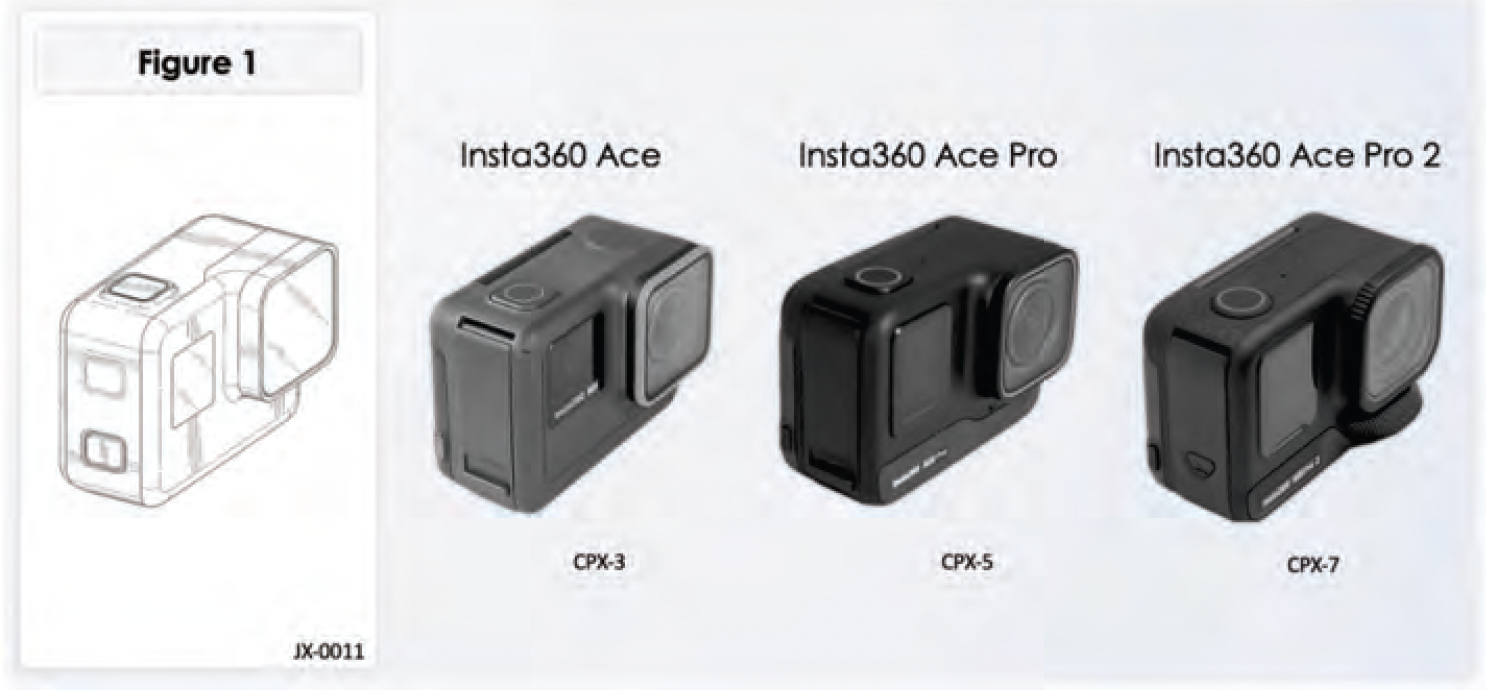
For example, consider this image (from GoPro’s expert report) that Judge Hines included in her decision:

(more…)