McDonnell Boehnen Hulbert & Berghoff LLP

Mar 10, 2009

Guest Post: Hot Topics in US Patent Reexamination

By Robert Greene Sterne. Rob Sterne is a founding director of the IP firm Sterne Kessler Goldstein & Fox. I asked him to write about current 'hot topics' in patent reexamination.

pic-11.jpg

The marked increase in the use of reexamination has naturally caused more frequent and closer evaluation and scrutiny of its unique procedures by involved parties and the courts. In FY2008, according to official USPTO (PTO) statistics, 168 inter partes reexams and 680 ex parte reexams were instituted. Compare this to FY2005, where 59 inter partes reexams and 524 ex parte reexams were instituted just three years ago. In short, it is becoming one of the faster developing areas of intellectual property law and, in the words of top PTO officials, it is a true "work in progress."

Developed in conjunction with the Sedona Patent Litigation Conference and a team of my colleagues (and incorporating feedback of dozens of sources including judges, senior officials from the PTO, patent litigators, patent prosecutors, academics, bloggers, and interested members of the public), a comprehensive and neutral white paper overview of this subject matter provides an in-depth review of hot issues currently confronting parties that find themselves in the "parallel universe" of patent reexamination and concurrent litigation in the district courts and USITC. The hot topics addressed include (A) impact of PTO decisions on stock price, (B) reexamination pendency, (C) substantial new questions of patentability, (D) real party in interest, (E) duty of disclosure, (F) protective orders, (G) stay of litigation in view of reexamination, (H) appeals from the Central Reexamination Unit to the Board of Patent Appeals and Interferences, (I) the impact of reexamination on settlement, and (J) page and time limits in reexamination proceedings.

Here is a closer look at three of these topics:

  • Litigation Stays: Reality or Myth – The percentage of reexams that are in the 'parallel universe' of district court or USITC patent litigation continues to climb. For example, in FY2008, 62% of current inter partes reexams and 30% of ex parte reexams were in parallel litigation. Judges have wide latitude in granting or denying stays and litigants must carefully evaluate prior stay decisions from their judge and the court they are in to effectively prognosticate how the judge will rule. Especially with respect to inter partes reexams, the grant of a stay can effectively be "game over" for the patent owner.
  • Stock Fluctuation: Impact of PTO and Court Decisions on Stock Price – The practical impact of reexam on patent owners can be enormous. There are recent celebrated examples of stocks dropping 40% in hours after the release of a non-final office action rejecting claims in a suit, even though this development is not controlling on a court case because the reexam is not final. Third party requestors engage in litigation in the press by issuing inflammatory press releases that spin the truth. Patent owners need to be prepared for this media battle to protect their stock price. Moreover, the PTO mails decisions to parties in the reexam, putting the patent owner at a real disadvantage in dealing with the potential reexam media war.
  • Reexamination Pendency: So How Long Does it Take? – The stated goal of the PTO CRU is 24 months from the time the reexam is instituted to a Final CRU office action or action closing prosecution. By statute, the CRU must handle reexams with “special dispatch.” However, there are no definitive statistics on how long it takes for a reexam to be handled to completion by the CRU and then through appeal at the BPAI. Our current best estimate is that it takes approximately two to four years for the CRU to complete a reexam, typically a little faster for ex parte reexams, and two to four years for the BPAI to complete a reexam appeal. Thus, the reexam process could take four to eight years before it arrives at the US Court of Appeals for the Federal Circuit on appeal. This is a significant amount of time and requires additional strategy and tactical decisions by the parties.

For additional insight into patent reexamination, download recent podcasts – "2008 Patent Reexamination Trends" (Episode #1) here and "The Parallel Universe of Patent Reexamination and Litigation" (Episode #2) here.Download the latest version of the Sedona Conference related paper referenced above here, where you can read in-depth about the full list of hot topics identified above.

Mar 08, 2009

Stays Pending Inter Partes Reexamination

In an earlier post I indicated my suprise that courts continue to “grant stays of litigation pending re-examination – especially inter partes reexaminations which tend to be incredibly slow.” In thumbing through Matthew Smith’s new book on Inter Partes Reexaminations, the following statements caught my attention and reaffirmed my conclusion that stays do not make sense here:

“A fully contested proceeding, therefore, could consume six to seven years. . . . [However t]here is as yet no reliable data available to estimate the total time of the proceeding. As of the end of 2008, the only cases with issued reexamination certificates were those in which technical mistakes were made, or in which at least one party chose not to contest the proceedings.”

The first request for inter partes reexamination was made in 2001 and still no contested inter partes reexamination has completed its course. Mr. Smith’s suggestion of “six to seven years” may well be optimistic.

Part of the Patent Reform Act of 2009 would be to take inter partes reexaminations out of the hands of the examination corps and put it under the direction of “an administrative patent judge.” Under the proposal, the PTO is given authority to spell out the actual procedures. Of course, the Board of administrative patent judges has been handling this sort of trial-in-the-first-instance for many years in the form of interference proceedings. The board already has a trial division that is ready to go. Although there are some outliers, interference proceedings are generally terminted within less than two years. For the Oct-Dec 2009 period, 13 interference proceedings were terminated with an average pendency of 9.5 months. 100% of those cases were terminated in less than two years. See 37 C.F.R 41.200(c) (“Patent interferences shall be administered such that pendency before the Board is normally no more than two years.”)

Notes:

Mar 03, 2009

Patent Reform Act of 2009

Patent reform legislation has now been introduced in both the House and the Senate. The provisions call for major reforms and mirror much of the proposed legislation from 2008. If anything, this is not a consensus Bill. File Attachment: SenateBill.pdf (116 KB) File Attachment: HouseBill.pdf (180 KB)

Proposed changes in the Senate Bill include:

  • First to File: Moving to a first-to-file system that credits invention based on the filing date of the patent application rather than on the date of actual invention.   The provision eliminates the one-year grace period for most cases. Thus, any independent third-party publication prior to filing is considered prior art regardless of the date of invention. Likewise, secret prior art (102(e)) cannot be 'sworn behind' based on prior invention. This provision obviously hurts folks who delay in filing patent applications.
  • Damages: Must look to the invention's "specific contribution over the prior art" to determine damages. There is an interesting provision that a reasonable royalty may be calculated as the price of licensing a "similar noninfringing substitute in the relative market." In some cases, this could push damages to zero if the noninfringing substitute is in the public domain. The provision also codifies that treble damages are limited to instances where a judge finds that an adjudged infringer recklessly continued to infringe after receiving particularly specified written notice sufficient to create declaratory judgment jurisdiction and without relying on reasonable advice of counsel.
  • Expanded Reexamination Proceedings: Reexaminations may be requested based on published prior art, or evidence of prior public use or sale in the US. Inter partes reexaminations would begin to look more like court cases and would be heard by administrative patent judges. The Bill would clarify that parties would be estopped from filing inter partes reexamination requests after a district court judgment.
  • Additional Post Grant Review: Within 12 months of issuance, a third party can file a cancellation petition based on any ground of invalidity (rather than simply prior art). The post grant reviews would also be conducted by the administrative patent judges.
  • Pre-Issuance Submissions: Third parties can submit prior art during examination of the patent as well as a statement regarding the relevance of the art. The art should be submitted the latter of (1) six months after publication or (2) before the first office action on the merits.
  • Patent Litigation Venue: "A party shall not manufacture venue by assignment, incorporation, or otherwise to invoke the venue of a specific district court." Venue is only proper were (a) defendant is incorporated; (b) defendant has its principle place of business; (c) where the defendant is permanently located and has committed substantial acts of infringement; or (d) where the plaintiff resides if the plaintiff is a nonprofit or individual inventor. The court should transfer venue to avoid evidentiary burdens when transfer can be accomplished without causing undue hardship to the plaintiff."
  • Interlocutory Appeals: The Federal Circuit will have jurisdiction over interlocutory appeals of claim construction when approved by the lower court.
  • Administrative Patent Judges: The BPAI would become the Patent Trial and Appeal Board (PTAB). Interferences would be gone, however they would be replaced by derivation proceedings as well as reexamination and post-grant trials.
  • PTO Powers: The PTO has power to set its fees, including reducing fees.
  • Oath: Easing the rules to more easily allow rights-holders to file patent applications on behalf of the inventor.
  • Federal Circuit Judges: Making legal it for a Federal Circuit judge to reside more than 50 miles from DC.

As you can see, this is very much the type of reform that companies like Google would like to see. Google is regularly faced with charges of patent infringement and rarely sues for infringement. Some of these changes will benefit the system as a whole, but it is clear that this is not "balanced" reform. The damages provision will almost certainly reduce patent awards. And, perhaps equally important, the damages provision provides adjudged infringers a real cause to appeal jury awards if they did not directly follow the expert testimony.

I believe that the expanded use of reexaminations and post grant review and prior art submissions will be beneficial, and I have faith that the administrative patent judges will be able to handle their newfound responsibilities. That said, these provisions provide challengers with new ways to attack patent rights.

The plaintiff bar in the Eastern District of Texas is quite good, and defendants are doing what they can to escape from their grasp. The venue provision moves in that direction and would thus weaken the value of patents.

The trick with the first to file system is to realize that it is not about some mythical race to invent between competitors. Rather, it is about keying the priority on the date of filing the application rather than the date of invention or even one year prior to filing. This provision weakens patent rights because more materials will be considered prior art. It is possible to switch to a first-to-file system without eliminating the grace period so dramatically – this legislation does not, however meet that standard.

The Bill is sponsored by both Senators Leahy (D-VT) and Hatch (R-UT). Representative Conyers (D-Mich) introduced parallel legislation in the House, the legislation is largely similar, but does contain some differences. (I have not reviewed the House version in detail). Some opposition has already formed. Reps Manzullo (R-IL) an Michaud (D-ME) issued a joint press release titled "New patent bill encourages IP theft, destroys American jobs." Their focus was on the damages provision.

There are some changes from the 2008 legislation.

  • The Bill does not require that all applications be published at 18 months.
  • Applicants would not be required to search prior art.
  • The 2009 Bill allows public use or sale in the US to be reasons for challenging patents.
  • CHECK 21 provisions are gone.
  • Fee Diversion is allowed in the 2009 Bill. (Oddly, Leahy explained that PTO Examiners perfer a system of fee diversion)
  • The 2009 Bill does not address inequitable conduct.

Links:

Mar 02, 2009

Patently-O Bits and Bytes

Upcoming Events

  • Northwestern Law School's Journal of Technology and Intellectual Property (NJTIP) is putting on a great event in Chicago on March 6, 2009 (Friday). Bob Irvine will be debating Bilski with Lauren Katznellenbogen. Irvine is a partner at my former firm, MBHB – He is amazingly smart and was my resource whenever I had difficulty understanding some complex technology. The debate is moderated by blogger R. David Donoghue. (The notice includes a disclaimer that the positions "are for advocacy purposes" and might not reflect the positions of the parties or their firms. Other speakers include Judge Holderman, Dr. Chris Singer (of Patent Docs and MBHB), Profs Seymore and Sag, and Mike Baniak (also of MBHB). [Symposium Website]
  • The IP Law Summit - March 17-19 - hosted by the marcus evans company will be a nice event in Ponte Vedra, Florida. I will be speaking there along with Marc Began (Novo), Manny Schecter (IBM), Bruce Schelkoph (Cummins), Scott Kief (Wash U), Bruce Pokras (Pfizer), Colin Raufer (Boeing), Mony Ghose (BD), Ken Collier (Medtronic), Scott Reid (Lenovo), Chris Turoski (Cargill), Hope Mehlman (Regions Financial), Tom Boshinski (Mead), Wendall Guffy (Nestle), Tim Wilson (SAS), Robert Renke (Flashpoint), John Parrish (Sanofi), Mike Jaro (Medtornic), and Phyllis Turner-Brim (Intermec).

Stays pending reexamination:

  • I continue to be surprised that courts grant stays of litigation pending re-examination – especially inter partes reexaminations which tend to be incredibly slow. In Wall Corp. v. BondDesk Group, LLC (D.Del. Feb. 24, 2009), district judge Gregory Sleet granted the defendant's motion to stay the litigation pending inter partes reexaminations. The fact that the reexamination was inter partes was especially important to the court since the potential "estoppel will resolve many of the invalidity issues and streamline the litigation." In a decision last week in Affinity Labs v. Dice Electronics, LLC, (E.D.Tex. February 20, 2009), the Texas-based Federal Court denied a stay pending ex parte reexam noting that the ex parte approach allows the "Defendant to lay behind the log, hoping for favorable developments with the passage of time. Instead of streamlining the process, Defendants' choice guarantees the imposition of additional costs … and indicates a lack of desire to resolve the issues in the case in a timely manner."

Late Patents:

Feb 05, 2009

Inter Partes Reexamination Estoppel and ITC Proceedings

One knock against the inter partes reexamination system is that it creates an estoppel. Under 35 USC 315(c), a third-party of requester is estopped from later asserting that a claim is invalid based on grounds that were "raised or could have been raised" during the reexamination. The 315(c) estoppel, however, is specifically limited to "civil action[s]" arising from 28 USC 1338 – i.e., those brought in district court. Similarly, under Section 371(b), an accused infringer cannot request an inter partes reexamination after losing a final decision in district court on any validity issues that the party "raised or could have raised" in the civil action.

In an e-mail earlier this week, Scott Kamholz of Foley Hoag raised the idea that the inter partes reexamination estoppel provisions do not apply to Section 337 investigations through the ITC. I believe Kamholz is correct. Thus, an ITC finding of validity does not estop the losing defendant from later requesting inter partes reexamination on the same grounds. Likewise, a defendant may raise invalidity issues in an ITC investigation that were previously addressed by an inter partes reexamination involving the same parties. Of course, the proceedings in the ITC and PTO are quite different and could readily lead to different outcomes. Perhaps most notably, patents are given a strong presumption of validity in ITC proceedings but are not presumed valid during reexamination.

Sep 15, 2008

In re Swanson: CAFC Allows Reexamination Based on Reference Previously Considered by PTO and Courts

In re Swanson (Fed. Cir. 2008)

Back in 1984, the patent examiner rejected Swanson's claim based on U.S. Patent No. 4,094,647 ("Deutsch"). The claims were then amended and the patent allowed. Later, in an infringement action involving the patent, the Federal Circuit affirmed a judgment that "Deutsch did not anticipate the asserted claims." Abbott v. Syntron, 334 F.3d 1343 (Fed. Cir. 2003). Surmodics is the patent owner, and the patent is licensed to Abbott.

After losing at the CAFC, Syntron filed for ex parte reexamination of the patent – asserting again that the claims were anticipated by Deutsch. As per usual, the PTO agreed to reexamine the patent – based on a "substantial new question of patentability." 35 USC §303. On appeal, Swanson argues that the Deutsch reference was considered in both the initial examination and the litigation – and thus cannot serve as the "new" basis for reexamination.

Third-party filed reexaminations provide a check on PTO power, but the SNQ requirement is designed to protect patentees from harassment.

This 'substantial new question' requirement would protect patentees from having to respond to, or participate in unjustified reexaminations. Further, it would act to bar reconsideration of any argument already decided by the Office, whether during the original examination or an earlier reexamination. House Report 96-1307, 96th Cong., 2d Sess. (1980).

In its 1997 Portola Packaging case, the CAFC gave teeth to the SNQ requirement – finding that a new question could not be presented by "prior art previously considered by the PTO in relation to the same or broader claims." Reacting to that decision, in 2002 Congress amended Section 303 and to ensure that a new question may be raised by prior art that was previously considered by the examiner:

35 USC §303 "The existence of a substantial new question of patentability is not precluded by the fact that a patent or printed publication was previously cited by or to the Office or considered by the Office."

Pointedly, the House Report accompanying the 2002 legislation found that "the Federal Circuit incorrectly interpreted Congress' original intent." According to the House Report, "the appropriate test to determine whether a 'substantial new question of patentability' exists should not merely look at the number of references or whether they were previously considered or cited but their combination in the appropriate context of a new light as it bears on the question of the validity of the patent."

SNQ = Reference Never Considered by the PTO for the Particular Purpose: Based on the statutory change, the appellate panel found that a substantial new question is simply one that has never been considered by the PTO. Here, the record shows that the original examiner relied upon Deutsch only as a secondary reference in an obviousness rejection of a broader claim.

"In light of the extremely limited purpose for which the examiner considered Deutsch in the initial examination, the Board is correct that the issue of whether Deutsch anticipates the method disclosed in claims 22, 23, and 25 was a substantial new question of patentability, never before addressed by the PTO"

SNQ Relation to Court Proceedings: In court, the parties had battled out the exact anticipation argument presented in the reexamination. On appeal, the CAFC panel found that "the determination of a substantial new question is unaffected by these court decisions." According to the court this makes sense because "the two forums [Courts and the PTO] take different approaches in determining validity and on the same evidence could quite correctly come to different conclusions" based on the burden of proof. Quoting Ethicon (Fed. Cir. 1988).

Affirmed

Notes:

  • Judges Gajarsa (Author), Lourie, & Bryson.
  • This opinion gives further strength to ex parte reexamination requests.
  • The CAFC has consistently required that a patent's presumption of validity be negated by "clear and convincing evidence." Here, the court made a minor slip by calling the standard 'statutory.'

"In civil litigation, a challenger who attacks the validity of patent claims must overcome the presumption of validity with clear and convincing evidence that the patent is invalid. 35 U.S.C. § 282. If this statutory burden is not met, "[c]ourts do not find patents 'valid,' only that the patent challenger did not carry the 'burden of establishing invalidity in the particular case before the court.'" Ethicon, 849 F.2d at n.3 (internal citations omitted) (emphasis in original)."

Thanks to Paul Morgan for noting this issue.

Aug 22, 2008

The Surprising Efficacy of Inter Partes Reexaminations

An Analysis of the Factors Responsible For Its 73% Patent Kill Rate And How To Properly Defend Against It

     By Andrew S. Baluch and Stephen B. Maebius, Foley & Lardner LLP[i]

INTRODUCTION

In creating inter partes reexamination, Congress hoped to provide a faster, cheaper alternative for resolving questions of patent validity in the U.S. Patent & Trademark Office (USPTO) rather than in the courts.  As a measure of the procedure’s growing popularity and availability, the rate of requests for inter partes reexamination has steadily increased each year, totaling over 308 since the procedure was created in November 1999.[ii]  But, while the pace of reexam requests continues to increase, the end results of completed proceedings have received relatively little attention.

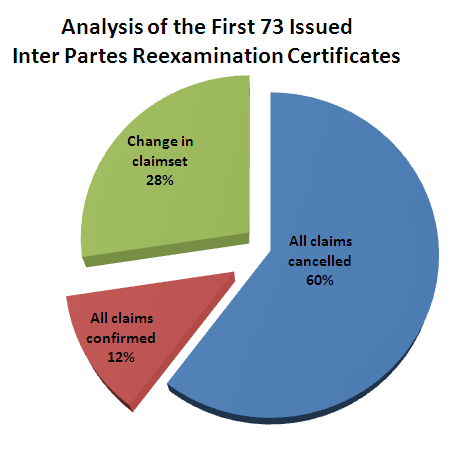
Here, we report the outcomes of all inter partes reexaminations completed as of August 2008.  Surprisingly, the proceedings displayed a high 73% “kill” rate (complete elimination of all claims targeted by the requesters) — a rate which is far above that in litigation (33%)[iii] and ex parte reexamination (12%)[iv]. 

Is the high kill rate explained by the fact that especially weak patents were targeted?  Did the patent owners simply give up because the patents were commercially unimportant?  Or is inter partes reexamination truly the best procedure for a party to use in the U.S. to invalidate a patent? 

For both requesters and patent owners, the present study highlights the factors and strategies favoring success in inter partes reexaminations.  Although the reported statistics appear to favor requesters, a patent owner has unique procedural tools at its disposal both in the courts and at the USPTO.

KEY FINDINGS

·         Requester’s Success Rate:  Third-party requesters succeeded in having all claims cancelled or disclaimed in 73% (22) of the first 30 completed inter partes proceedings in which a certificate issued.  These early certificates are likely skewed in favor of quick dispositions in which the patent owner simply failed to respond to a first Office action, which occurred in 43% (13) of the proceedings.  However, when the patent owner did respond to the first Office action, the requester’s success rate fell to 53% (9 out of 17).  In any event, the requester’s likelihood of a complete victory in inter partes reexams is substantially greater than that in ex parte cases during the same period: only 12% of all ex parte reexams since January 2000 resulted in all claims being cancelled.[v]

·         Pendency:  The inter partes proceedings had an average pendency (measured from request date to certificate issue date) of 33.3 months.  Like the requester’s success rate, the overall pendency is skewed by the numerous early cases in which the patent owner simply failed to defend its patent.  Eliminating these uncontested cases dramatically increases the average pendency up to 42.5 months.

·         Grounds of Rejection:  In a first Office action, obviousness was the sole ground of rejection in only 20% (6) of the proceedings, whereas anticipation was a ground of rejection in 73% (22) of the proceedings.  Nevertheless, obviousness-only rejections did not improve the patent owner’s chances of success: 83% (5 out of 6 obviousness-only cases) resulted in all claims being cancelled or disclaimed.

·         No Board Decisions:  None of the first 30 inter partes reexamination certificates was the product of a Board decision.  Only one party, a patent owner, filed a notice of appeal, but then dropped the appeal by declining to file an appeal brief.  In all cases where examiners found claims to be patentable, the third-party requesters did not bother to appeal the finding.

·         Litigation:  Five (17%) of the 30 inter partes reexaminations involved concurrent litigation between the patent owner and third-party requester.  The causes of action were split:  2 declaratory judgment (DJ) actions brought by the third-party requester, and 3 infringement suits brought by the patent owner.  The only still-pending cases involve reexaminations favoring the plaintiff:  one DJ action in which all reexamined claims were cancelled, and one infringement suit in which all reexamined claims were confirmed.

[READ THE FULL REPORT]


[i]  The authors are patent attorneys at Foley & Lardner LLP and further acknowledge their past and current involvement in both ex parte and inter partes reexaminations.  The views expressed herein are solely those of the authors and should not be attributed to their firm or any of its clients.  Comments may be directed to smaebius@foley.com.

[ii] USPTO Inter Partes Reexamination Filing Data (Sept. 30, 2007).

[iii] See Kimberly A. Moore, Judges, Juries, and Patent Cases – An Empirical Peek Inside the Black Box, 99 Mich. L. Rev. 365 (2000) (between 1983 and 1999, validity was upheld in 67% of cases — 64% of bench trials; 71% of jury trials).

[iv] See Dennis Crouch, Ex Parte Reexamination Statistics II, Patently-O, available at http://www.patentlyo.com/patent/2008/06/ex-parte-reexam.html (posted Jun. 25, 2008) (between January 2000 and June 2008, all claims were cancelled in 12% of proceedings).

[v] See Crouch, supra.  See also USPTO Ex Parte Reexamination Filing Data (Dec. 31, 2007) (reporting 12% cancellation rate for all ex parte reexams initiated by third-party requester).

Jun 25, 2008

Ex Parte Reexamination Statistics II

Patent.Law088To get some sense of the PTO’s current ex parte reexamination practice, I looked at the 2000+ reexamination certificates that have been published in the Official Gazette since January 2000.  There are three potential outcomes for any particular reexamined claim: validity affirmed; validity affirmed with an amendment; and cancelled. In addition, claims may be added. 

Outcomes: From my sample, 71% of the completed reexaminations resulted in claims that were either amended or cancelled while only the remaining 29% resulted in all claims being confirmed. A much smaller number – 12% – of the reexaminations resulted in all claims being cancelled. 

The middle ground: 59% had at least one independent claim confirmed while 50% included at least one amended claim.  For the 34 completed design patent reexaminations, the single claim was confirmed as valid 16 times and cancelled 18 times.

Timing: The reexamination certificates in my sample had an average pendency of 33.5 months (median 28.5 months).* The PTO's reported average and median are 24.0 months and 18.6 months respectively. The difference apparently comes from their inclusion of reexaminations from the 1980's and 1990's which had much lower pendency than more recent numbers. [PTO Data 1981-2007]. 

Outcome & Timing: Reexaminations that simply resulted in a confirmation that the the initial claims are valid were resolved more quickly (averaging 24 months) while those resulting in cancellation of all clams were much slower (averaging 45 months). Cases at the longer end of the spectrum often involved either BPAI appeals or lost files.

Patent.Law089

  • Thanks to several Patently-O readers for showing me how to find reexamination certificates. I was able to use the Westlaw database for this search. (Remember law school and the free academic access). The data can be compiled from the PTO OG, but that would be a larger job. The PTO does maintain a list of all the issued reexamination certificates here.
  • * I roughly calculated pendency by measuring the elapsed time from publication of a reexamination request to publication of the reexamination certificate.
  • Reexamination Statistics I

Jun 07, 2008

Patently-O Bits and Bytes No. 42: Two requests for help

  • What is the best way to search for reexamination certificates? Are these available through the PTO site?
  • Does anyone have a good process flowchart for a university tech-transfer operation?
  • Thanks! dcrouch@patentlyo.com

Jun 05, 2008

Ex Parte Reexamination Statistics I

PatentLawPic332Through its attorneys Microsoft requested ex parte reexamination almost thirty Avistar patents. In recent days, the PTO denied Microsoft’s request in 14 of those cases.

Standing alone, this denial does not appear to be big news — except for the fact that over 95% of requests for ex parte reexamination are granted. In FY 2003–07, for instance, the PTO reviewed 2389 requests for ex parte reexamination and only denied the request in 105 cases. (4.4%). (At this point, there is some possibility that the denials are procedural  as the documents are not yet available on PAIR).

To be granted, a reexamination request must present a “substantial new question of patentability” that affects at least one claim of a patent.  The request must be based on a prior art patent or publication.  Prior public use or sale are not admissible as evidence in an ex parte reexamination proceeding (although affidavits explaining the prior art publications is admissible).

In general, there has been a rise in requests for ex parte reexamination. As the chart below demonstrates, increase is entirely due to an increase in requests for reexamination that are filed by third parties.

PatentLawPic333

May 22, 2008

Patently-O Bits and Bytes No. 36

  • PatentLawPic304[Not a] Patent Race: IPO released its annualy survey of top utility patent assignees. IBM again leads the way with over 3,000 utility patents issued in 2007. The organization leads the report with the interesting statement: “IPO DOES NOT INTEND TO ENCOURAGE MORE PATENTING IN U.S.”. [LINK]
  • Tafas v. Dudas: On May 19, the CAFC released its notice of docketing in the case — starting a 60 day clock for the PTO to submit its opening brief. I expect that they will take the entire time.
  • Inter Partes Reexaminations: Joff Wild highlights a new report on PTO Inter Partes Reexaminations: “Without appeal, the average pendency period for inter partes re-exam is 43.5 months, much longer than the 28.5 months reported by the USPTO – a 95% confidence interval would put the pendency between 34 and 53 months….To date, there has never been a single inter partes re-examination that has gone through the entire re-examination process (including appeal) and made it to completion. Only three have ever received a decision by the Board of Patent Appeals and Interferences.” [LINK][Report][Zura comments]
  • MBHB Snippets: In the past, I have published several practice focused articles in MBHB’s Snippets publication. The newest edition is now online. Articles include:
    • Aaron Barkoff, Patent Litigation Under a Future Biosimilars Act
    • Kevin Noonan, Follow-on Biologic Drugs and Patent Law: A Potential Disconnect?
    • Jim McCarthy & Marcia Ireland Rosenfeld, It’s Not Easy Selling Green
    • Benjamin Huber, Seagate: Reports of the Death of Opinions of Counsel Have Been Greatly Exaggerated
    • [Read Snippets]

May 12, 2008

RIM v. NTP Continues to Trouble Patent Office

Although NTP v. RIM settled years ago, the PTO’s reexamination of NTP’s patents have continued to plod along. PatentlyOImage009In the background are allegations by NTP that PTO officials improperly (and covertly) met with RIM CEO Jim Balsillie and other RIM representatives regarding the ongoing (ex parte) reexaminations.

During ex parte reexaminatoin, third-party communications are strictly forbidden.  It is clear, however, that in the months leading up to the NTP settlement, the PTO was feeling a tremendous amount of political pressure from RIM as well as Congress and the Senate.

Now, Congressman Howard Berman has demanded information from the PTO regarding these meetings “hand-delivered” by “May 19, 2008.”

“Did this meeting [with Balsillie and counsel] take place? What was discussed at this meeting? What is the USPTO’s policy concerning ex parte communications between senior USPTO officials and parties who have an interest in the outcome of proceedings before the office? In what other instances, if any, did senior USPTO officials engage in similar ex parte communications with parties that had an interest in the outcome of a proceeding being conducted before the Office?”

Hopefully the Office will be able to provide Chairman Berman with a tidy set of evidence to clarify the rules and exactly what happened.

Documents:

Feb 04, 2008

PubPat: Proposed Post-Grant Review Cuts-Out Public Interest

RavicherThere is a possibility that a passed Patent Reform statute would eliminate third-party-requested reexaminations (ex parte and inter partes) and yet fail to create any substantive third-party initiated post-grant procedure to replace the current options.

In addition, the proposed post-grant review procedure would block a non-threatened party from challenging the validity of a patent more than a year after its issuance. In a letter sent today to the Senate reformers, Dan Ravicher of PubPat asks that third-party reexamination be preserved.  The non-profit groups such as PubPat and EFF have filed dozens of reexamination requests asking the PTO to invalidate “wrongfully issued” patents.

The Current Proposal Found in S.1145: The proposed system of post-grant review would have two windows for third-party filings:

  • First Window: Post-Grant oppositions filed by anyone within one year of issuance.  Patents reviewed in the first window would not be given any presumption of validity.
  • Second Window: Opposition must be filed by party who has a likelihood of feeling “significant economic harm” based on the patent. A presumption of validity would apply in reviews within the second window.

The PTO would be required to complete its review work within 18 months. Post grant reviews would be conducted by a three-member panel of administrative judges rather than by examiners. Parties to the review may settle the case.

  • PubPat Recent Successes:
    • Forgent Networks '672 "JPEG" patent: Broadest claims finally rejected;
      Patentee abandoned assertion of patent.
    • Columbia '275 Axel Cotransformation Patent: All claims finally
      rejected; Patentee abandoned assertion of patent.
    • Microsoft '517 FAT Patent: Patentee modifies claims, which are allowed.
    • Pfizer '156 Lipitor Patent: Patentee modifies claims, which are allowed.
    • WARF Stem Cell patents and Gilead Tenofovir (AIDS drug) patents have had all claims non-finally rejected, but are still pending. 

Aug 22, 2007

In Reexamination, PTO is Not Bound by District Court Claim Construction

In re Trans Texas Holding Corp. (Fed. Cir. 2007)

Trans Texas holds two patents directed to a system of insulating both deposits and loans from inflationary and short-term interest rate fluctuations. In earlier litigation, a Texas district court construed various claim terms. Now, in reexamination, the PTO has taken a fresh look and offered its own interpretation of the claims.

Issue Preclusion (AKA Collateral Estoppel) traditionally blocks the same parties from relitigating the same issue in a later proceeding. CAFC caselaw has identified four elements of issue preclusion:

  1. Identity of the issues in a prior proceeding;
  2. The issues were actually litigated;
  3. Determination of the issues was necessary for the prior judgment; and
  4. The party defending against preclusion had a “full and fair opportunity to litigate the issues.”

Ex Parte Proceeding: Although reexamination is an ex parte proceeding, the CAFC considers the PTO to be a “party” as any other outcome “simply makes no sense.”

The PTO is plainly a party to these appeal proceedings, and if it were not treated as a party, there would be no basis for even considering the application of issue preclusion in the first place.

Since the PTO did not have an opportunity to litigate the issue in the Texas district court, it cannot be bound by that decision.

[T]he PTO was not even a party to the earlier district court litigation and cannot be bound by its outcome.

Obviousness affirmed.

Search Patently-O


  • The Web Patent Blog

Patently-O Jobs

Subscribe


  • Patently-O is the most popular patent law blog and a daily read for over fifteen thousand patent law professionals from every major innovative corporation, IP Law Firm and world patent office. Click the link above to receive an automatic Patently-O e-mail each morning with the freshest posts.

Author

Terms of Use & Disclaimer

  • Terms of Use

  • Patently-O on Facebook
    Connect with Patently-O readers.

  •