On March 25, 2026, the House Judiciary Subcommittee on Courts, Intellectual Property, Artificial Intelligence, and the Internet held its first oversight hearing of the USPTO under Director John Squires. The hearing, which ran for several hours with Squires as the sole witness, covered an extraordinary range of topics: IPR institution policy (including the proposed NPRM), retroactive de-institution of trials, AI in patent examination, the application backlog, national security concerns about foreign petitioners, Section 101 reform, fee-setting authority, injunctive relief, employee morale, and a sustained exchange over Dir. Squires decision to file trademark applications for the Trump administration's "Board of Peace." Overall, there was substantial and bipartisan skepticism.
Several themes recurred throughout the hearing. Squires repeatedly invoked his "born strong" framework for patent quality and characterized the IPR changes as restoring "balance and fairness" to the AIA system. Members on both sides pushed back, questioning whether the Director's centralized control of institution decisions, combined with summary denial orders that provide no reasoning, is consistent with the AIA's design. The hearing also showcased Squires' rhetorical style: the "Central Bank of Innovation" metaphor appeared in both his written and oral testimony, and he introduced a new characterization of the proposed estoppel rule as "one, join, and done" rather than the critics' shorthand of "one and done."
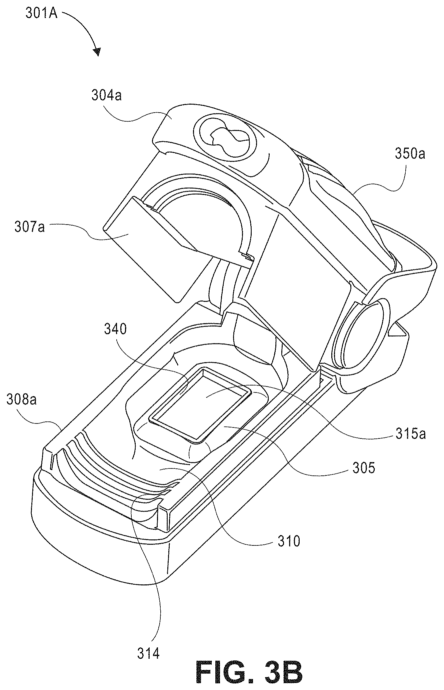
The Federal Circuit recently affirmed the US International Trade Commission's (ITC) limited exclusion order barring importation of certain Apple Watch models, bringing to a close (at least on this front) one chapter of the sprawling patent war between Masimo and Apple over blood oxygen measurement technology in wearable devices. Apple Inc. v. ITC, No. 24-1285 (Fed. Cir. Mar. 19, 2026).
The Federal Circuit's decision rejected every argument Apple raised on appeal - with the most interesting issues focused on (1) the domestic industry requirement and (2) prosecution laches.
The ITC's Domestic Industry Requirement: Section 337 of the Tariff Act makes it unlawful to import articles that infringe a valid U.S. patent, but the agency can take action only if "an industry in the United States, relating to the articles protected by the patent . . . exists or is in the process of being established." 19 U.S.C. § 1337(a)(2). This domestic industry requirement has two prongs. The "technical prong" asks whether an actual article exists that practices at least one claim of the asserted patent. The "economic prong" asks whether there is significant domestic investment in that article through plant and equipment, labor or capital, or research and development. Both prongs must be satisfied as of the date the complaint is filed.
The requirement reflects the reality that the ITC is designed particularly to protect US industry against unfair foreign competition, not to serve as a general patent court.
Voluntary dismissal: Under Rule 41(a), a plaintiff can walk away from a lawsuit before the defendant answers or moves for summary judgment, no questions asked, no permission required. The tactic gets used strategically all the time: to avoid an unfavorable ruling, to refile in a better forum, etc. Courts have generally tolerated this practice, recognizing that voluntary dismissals serve important functions in managing litigation. But, there has always been some concern about strategic over-use. In Ascendis Pharma A/S v. BioMarin Pharmaceutical Inc., No. 26-1026 (Fed. Cir. Mar. 26, 2026), the Federal Circuit drew a line, holding that a party cannot use voluntary dismissal to restart a statutory deadline it already missed. The court affirmed the district court's denial of a mandatory stay under 28 U.S.C. § 1659(a)(2), holding that Ascendis's dismiss-and-refile maneuver could not revive the 30-day window for requesting that the district court halt proceedings pending a parallel ITC investigation.
The case arises from a pharmaceutical patent dispute between two drug manufacturers developing treatments for achondroplasia (ACH), a genetic condition that causes short-limbed dwarfism. BioMarin sells Voxzogo, an FDA-approved ACH treatment covered by U.S. Patent No. RE48,267. Ascendis filed a New Drug Application for its competing product, TransCon CNP, on March 31, 2025. The very next day, BioMarin filed a complaint with the U.S. International Trade Commission alleging that Ascendis's importation of TransCon CNP infringed the '267 patent. Ten days later, on April 11, 2025, Ascendis filed a declaratory judgment action in the Northern District of California seeking a declaration of non-infringement with the argument that its imports were within the 35 U.S.C. § 271(e)(1) safe harbor - i.e., for reasons directly related to obtaining FDA approval.
This setup with parallel ITC and district court proceedings sets up a discussion of the mandatory stay provision of 28 U.S.C. § 1659(a). That section provides that the district court shall stay proceedings with respect to any claim involving the same issues, at the request of a party that is also a respondent in the ITC proceeding. But, the stay mandate is only required if requested within 30 days after the district court action is filed.
In our case, Ascendis had waited more than 30 days to request a stay - it then voluntarily dismissed its DJ action without prejudice and immediately refiled a nearly identical complaint the same day for the express purposes of resetting the clock. Apparently Ascendis realized the DJ action created a problem: once the FDA approved the drug, BioMarin could use the pending district court case as a vehicle to seek a preliminary injunction. A mandatory stay under § 1659 would protect against that occurrence.
The Supreme Court today reversed the billion-dollar copyright verdict against Cox Communications, holding that an internet service provider (ISP) cannot be held contributorily liable for its users' copyright infringement simply because it knows about the infringement and continues providing service. Cox Communications, Inc. v. Sony Music Entertainment, No. 24-171 (U.S. Mar. 25, 2026). Justice Thomas wrote the opinion for seven justices; Justice Sotomayor, joined by Justice Jackson, concurring in the judgment.
Unlike patent law, the copyright statute does not include a particular statutory framework for contributory infringement. For decades, however, the Supreme Court has attempted to treat the two doctrines in parallel - with copyright often borrowing elements from patent's statutory treatment of 35 U.S.C. 271(b) and 271(c). In Cox, the court continued this approach and solidified contributory copyright liability to just two pathways: inducement and providing a service "tailored to infringement." Because Cox did neither, its continued provision of internet service to subscribers flagged as past and future infringers did not make it an infringer. This case will now sit along side the court's prior key decisions in Metro-Goldwyn-Mayer Studios Inc. v. Grokster, Ltd., 545 U.S. 913 (2005), and Sony Corp. of America v. Universal City Studios, Inc., 464 U.S. 417 (1984).
With oral arguments in Hikma Pharmaceuticals v. Amarin Pharma, No. 24-889, set for April 29, the Court's insistence that knowledge of infringement is not enough for secondary liability is a troubling signal for the branded pharmaceutical company trying to hold a generic manufacturer liable for induced patent infringement.
Short post today because I’m surfing in Puerto Rico on Spring Break. Speaking of breaks – Some legal deadlines bend. Others break you.
In Brown v. United States, No. 26-1179 (Fed. Cir. Mar. 23, 2026), the Federal Circuit dismissed an appeal because the notice of appeal arrived outside the 60-day statutory window. The court reaffirmed that this deadline is mandatory and jurisdictional, meaning no court has authority to forgive a late filing. Marandola v. United States, 518 F.3d 913 (Fed. Cir. 2008). Mr. Brown was apparently incarcerated when he filed his notice, but he did not submit any declaration establishing timely deposit in the prison mail system under Fed. R. App. P. 4(c). The “mailbox rule” can help, but only with proper certification.
As a reminder, the deadline for filing a notice of appeal from a district court judgment is just 30 days under 28 U.S.C. § 2107(a), while parties appealing a PTAB final written decision in an IPR have 63 days under 37 C.F.R. § 90.3(a)(1).
One of the topics I teach in my internet law course is the steady erosion of the boundary between digital and physical privacy. For years, privacy debates centered on what we do online: how we scroll, what we buy, who we email. But location tracking has collapsed that distinction. Your phone knows where you sleep, which doctor you visit, and whether you attended a protest. And because that data is collected continuously, stored indefinitely, and held by private companies, it is available to law enforcement with the right legal process. The question the Supreme Court will take up in April is just how much process the Fourth Amendment requires.
In Chatrie v. United States, No. 25-112, the Court is hearing its first case addressing the constitutionality of geofence warrants. A geofence warrant works differently from a traditional warrant. Instead of identifying a suspect and then seeking evidence, law enforcement identifies a location and a time window and then asks a technology company to hand over data on every device that was nearby. In this case, a detective investigating a 2019 bank robbery in Midlothian, Virginia, obtained a warrant directing Google to search its Sensorvault database, which at the time held continuous location records for over 500 million users of Google's Location History service. The warrant defined a geofence with a 150-meter radius centered on the bank and a one-hour window around the robbery.
Google's initial search returned anonymized location data for 19 devices in the zone. What followed was a three-step process designed by Google. The detective, without returning to a judge, selected nine of the 19 accounts for expanded tracking over a two-hour window with no geographic limits. He then asked Google to de-anonymize three of those accounts, again without judicial approval. One belonged to Okello Chatrie.
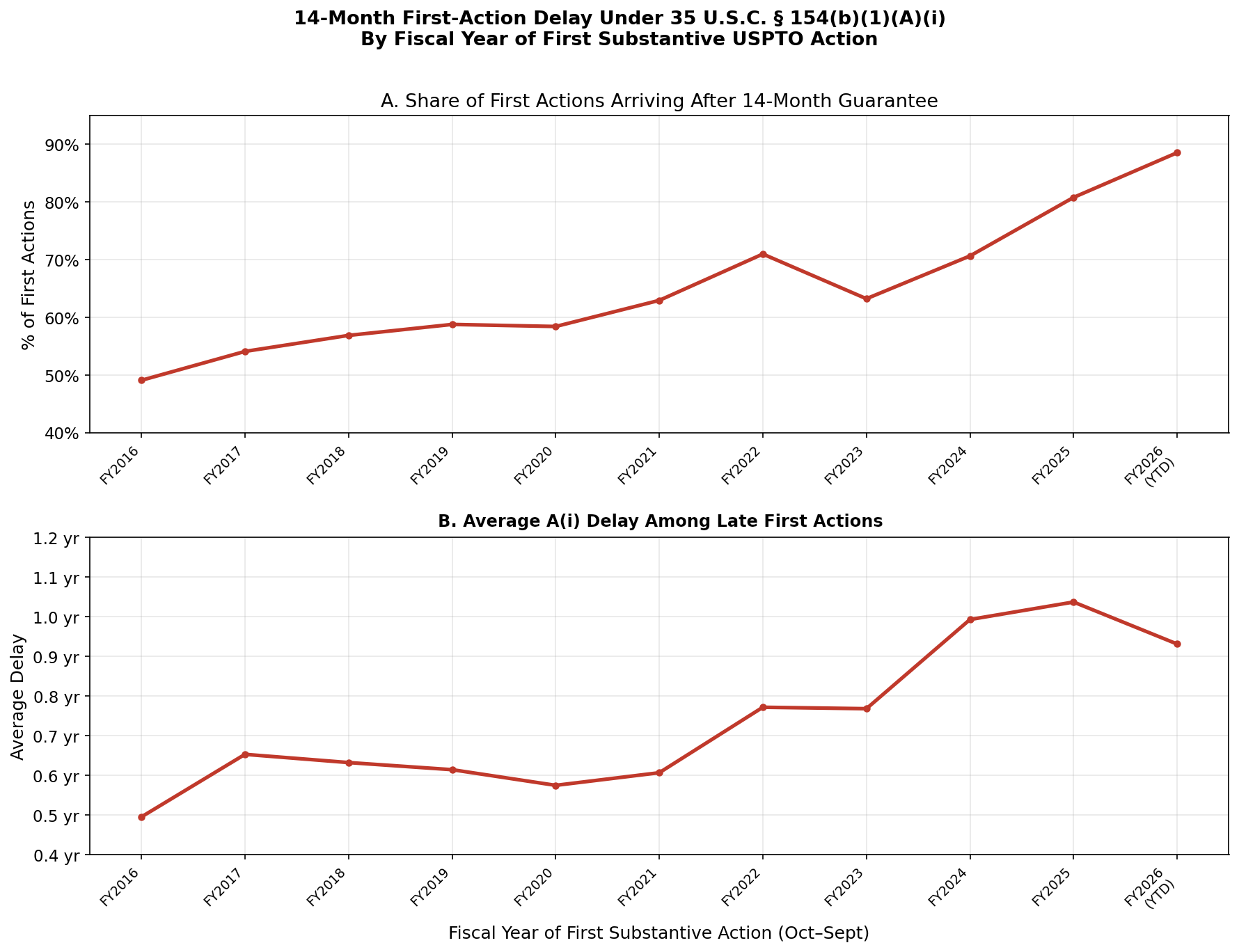
The Patent Term Adjustment statute guarantees that USPTO delays will not unduly shorten patent term. 35 U.S.C. § 154(b). The first guarantee an applicant encounters is the 14-month clock: the USPTO must issue a First Office Action on the Merits (FAOM) or a Notice of Allowance (NOA) within 14 months of filing. When the agency misses that mark, the applicant earns day-for-day patent term adjustment under what we call "A delay" or "(A)(i) delay." § 154(b)(1)(A)(i). The chart above shows how well the USPTO has been hitting that target, broken down by the fiscal year of the first substantive examiner action.
In Hikma v. Amarin, No. 24-889, the Supreme Court is focusing on the question of when does a generic manufacturer’s decision to sell a cheaper version of a drug cross the line into actively inducing infringement of the brand’s method-of-use patent? I have posted a new working paper to SSRN that proposes a framework for answering that question. Dennis Crouch, The Tinderbox: Market Structure, Skinny Labels, and Induced Patent Infringement (2026). The essay responds to, and builds on, Professors Jacob Sherkow and Paul Gugliuzza’s recent critique of the Federal Circuit’s approach. Jacob S. Sherkow & Paul R. Gugliuzza, Infringement by Drug Label, 78 Stan. L. Rev. 131 (2026). (more…)
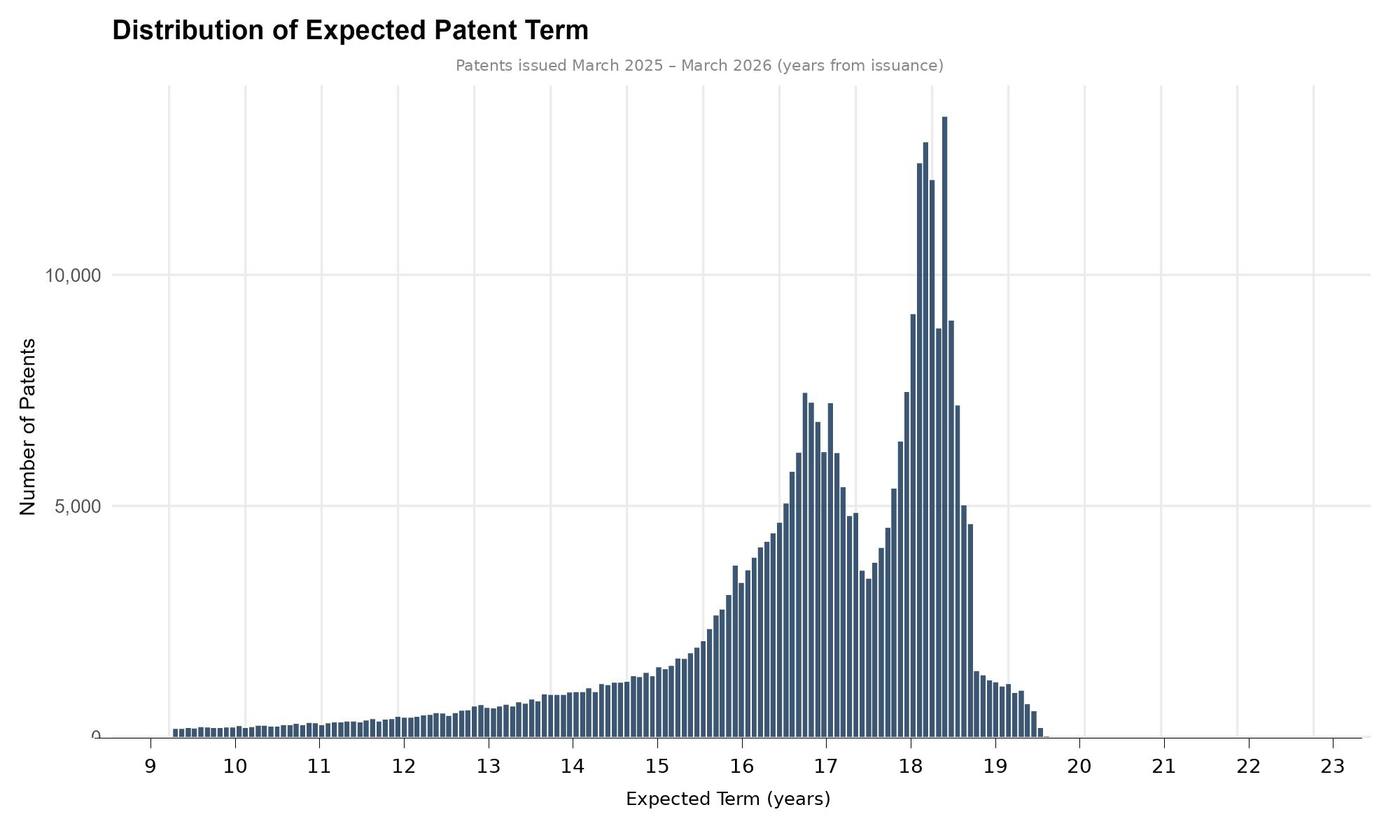
Congress set the patent term at twenty years from the earliest effective filing date. 35 U.S.C. § 154(a)(2) (not counting provisional or foreign national filing). But that statutory baseline is just the starting point. But, the actual term is shaped by a series of prosecution decisions, USPTO delays, terminal disclaimers, and patent family structure. The chart below shows the distribution of expected remaining patent term (measured from issuance) for utility patents issued between March 2025 and March 2026. The calculation accounts for patent term adjustment (PTA) and terminal disclaimers, though the latter relies on a heuristics and so is not perfectly precise. Still, the overall shape tells a vivid story about what the patent system actually delivers.The most striking feature is
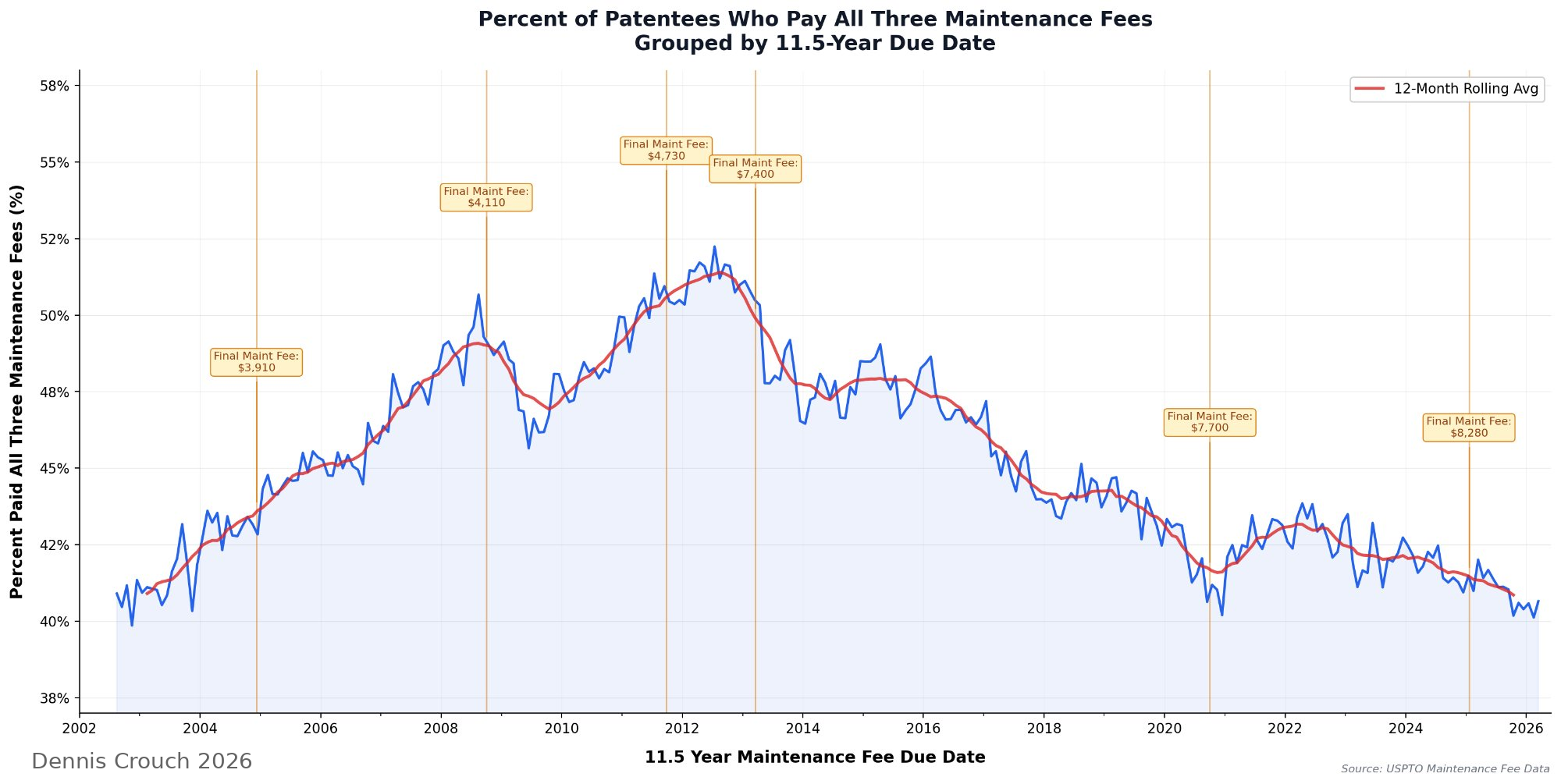
Congress set the patent term at 20 years from filing. But the effective term for most U.S. patents is considerably shorter - but these are self-selected patents. USPTO's maintenance fee records shows that roughly 60% of all patentees now abandon their patents before the full term expires, choosing not to pay the escalating series of post-issuance maintenance fees required to keep a patent in force. The rate of full-term patent maintenance has fallen to approximately 40%, approaching the lowest levels recorded in the past two decades, and the trajectory suggests further decline.
Under 35 U.S.C. § 41(b), patent holders must pay maintenance fees at three intervals after issuance: 3.5 years, 7.5 years, and 11.5 years. Failure to pay (including during a six-month grace period with surcharge) results in expiration of the patent. The chart below tracks the percentage of patentees who paid all three maintenance fees, grouped by the month their final (11.5-year) fee came due. The data reveals a striking arc: a steady rise from about 41% in 2002 to a peak of roughly 52% around 2012-2013, followed by a sustained decline back to approximately 40% today. The 11.5-year maintenance fee for large entities has nearly tripled during this period, from $3,100 in 2001 to $8,280 as of January 2025, well above the rate of inflation for this period. The question is whether this fee escalation is the primary driver of the decline, or whether other forces are at work.
I recently spoke by phone with Judge Pauline Newman. At 98 years old, she seemed sharp, engaged, and fully conversant -- particularly regarding the legal questions swirling around her case (and its impact on the patent system). She turns 99 in June.
Judge Newman has been barred from exercising any function of her judicial office since late 2023, when she issued her last opinion. She remains, in name, an active-service judge on the United States Court of Appeals for the Federal Circuit. But, in every practical respect, she has been removed from the bench by her colleagues, without impeachment, without an actual finding of disability, and without any court ever reaching the merits of her constitutional claims. This week, her attorneys filed a petition for certiorari asking the Supreme Court to consider her case.
Newman v. Moore, No. 25-___ (U.S. Mar. 12, 2026), presents two questions about the Judicial Conduct and Disability Act of 1980 (28 U.S.C. § 357(c)) that bars judicial review of judicial council "orders and determinations."
Whether that bar extends to ultra vires acts that exceed the council's statutory and constitutional authority.
Whether the bar forecloses claims seeking prospective injunctive relief against future unlawful orders.
Both questions arise against a factual backdrop that the D.C. Circuit itself described as raising "important and serious questions" about due process and judicial independence, while holding that its hands were tied by 25-year-old circuit precedent.
Guest post by Sapna Kumar. Prof. Kumar is the Henry J. Fletcher Professor of Law at the University of Minnesota Law School.
USPTO Director John Squires recently issued a memorandum regarding a new policy for instituting IPR and PGR proceedings. The memo argues that manufacturing moving overseas is causing “significant economic and national security damage” and claims that [t]hese developments bear directly” on the Director’s “statutory obligation to consider the effect of institution standards on the economy and the integrity of the patent system.” It further notes that large companies lacking “significant” U.S. manufacturing are the “most frequent users of IPR and PGR proceedings.” Based on these findings, the memo states that in determining whether to institute IPR and PGR proceedings, the Director will consider to what extent accused infringing products at issue in a parallel proceeding are U.S. manufactured or relate to U.S. manufacturing operations and to what extent the patent owner’s competing products are U.S. manufactured.
The United States is a member of the World Trade Organization (WTO) and a signatory to the WTO-administered Agreement on Trade-Related Aspects of Intellectual Property (TRIPS). The USPTO has acknowledged that “TRIPS applies basic international trade principles to member states regarding intellectual property including national treatment.” As Article 3 states, “[e]ach Member shall accord to the nationals of other Members treatment no less favourable than that it accords to its own nationals” for IP protection. With regard to nondiscriminatory practices, Article 27 further specifies that “patents shall be available and patent rights enjoyable without discrimination as to the place of invention, the field of technology and whether products are imported or locally produced.”
Based on memo’s language, the USPTO will be more likely to institute an IPR or a PGR against a patent holder whose competing products are not manufactured in the United States, and will be less likely to do so against a patent holder that domestically manufactures its competing products. This means that the strength of U.S. patent rights will now vary based on whether patented products are produced in the United States or abroad. This appears to violate Article 27, given it limits enjoyable patent rights based on where products are being produced. (more…)
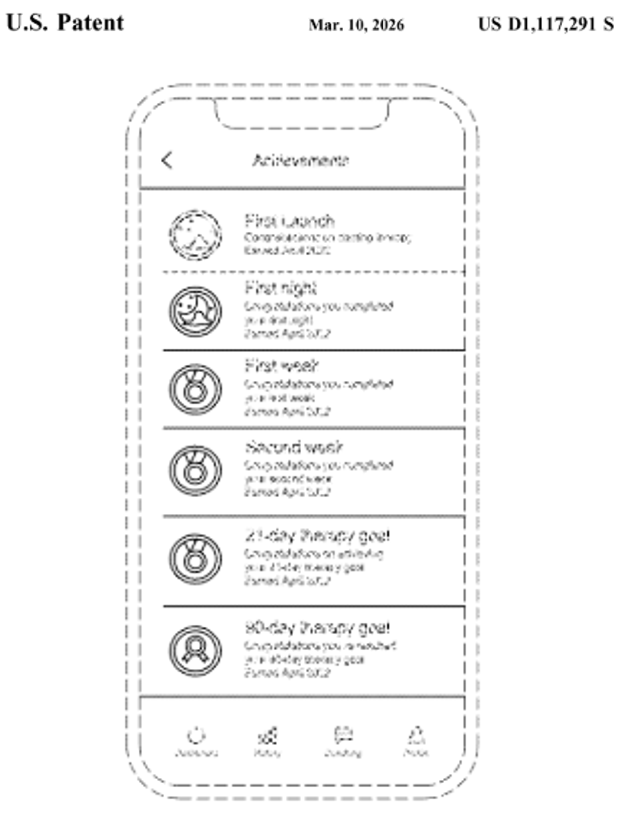
The USPTO today published new examination guidance that relaxes the rules for obtaining design patents on computer-generated interfaces and icons, completing a policy arc that began with a 2020 request for public comment on the meaning of "article of manufacture" in 35 U.S.C. § 171. Supplemental Guidance for Examination of Design Patent Applications Related to Computer-Generated Interfaces and Icons, Docket No. PTO-P-2026-0133 (Mar. 13, 2026). The guidance makes three practical changes that design patent prosecutors should take note of immediately.
First, it removes the longstanding requirement in MPEP § 1504.01(a) that drawings depict a display panel or portion thereof in solid or broken lines for applications directed to computer-generated interfaces or icons, so long as the title and claim properly identify an article of manufacture.
Second, it reverses the 2023 position on claim language, now holding that titles and claims using the preposition "for" (such as "icon for display screen" or "projected interface for computer") adequately describe a design for an article of manufacture under § 171.
Third, it extends design patent eligibility to projected and holographic interfaces and to virtual and augmented reality designs for computers and computer systems.
Under the old practice, the claim put the article of manufacture first and described the GUI as being "with" or "on" it: "The ornamental design for a display screen or a portion thereof with a graphical user interface, as shown and described." And the drawings had to include a broken-line border showing the display panel. Under the new guidance, applicants now have the option to flip the grammar so the design element leads and the article follows the word "for": "The ornamental design for a graphical user interface for a display screen, as shown and described." Or broader still: "The ornamental design for a graphical user interface for a computer, as shown and described." The guidance also accepts "computer icon" standing alone as adequate claim language, since the word "computer" in that compound term is treated as identifying the article of manufacture.
GUI Design Patents Are Growing — But So Is Everything Else
U.S. design patents issued for graphical user interfaces, icons & display screens (2011–2025)
Source: USPTO Patent Public Search (calendar year grant dates)GUI patents classified in USPC D14/485–495
PATENTLY-O
27,660
Total GUI Patents2011–25
2,787
2025GUI Patents
3,111
Peak Year2016
5%
2025GUI Share
(function(){
var container=document.getElementById('gui-chart-container');
var cvs=document.createElement('canvas');
cvs.id='gui-chart-canvas';
cvs.style.width='100%';
cvs.style.height='380px';
container.appendChild(cvs);
var btnDiv=document.getElementById('gui-chart-buttons');
var btnC=document.createElement('button');
btnC.id='btn-count';
btnC.textContent='Count + Share';
btnC.style.cssText='padding:5px 14px;font-size:11.5px;font-weight:700;background:#1a1a1a;color:#fff;border:1px solid #ccc;border-radius:3px 0 0 3px;cursor:pointer;font-family:inherit;';
var btnT=document.createElement('button');
btnT.id='btn-totals';
btnT.textContent='GUI vs. Total';
btnT.style.cssText='padding:5px 14px;font-size:11.5px;font-weight:400;background:#fafafa;color:#555;border:1px solid #ccc;border-left:none;border-radius:0 3px 3px 0;cursor:pointer;font-family:inherit;';
btnDiv.appendChild(btnC);
btnDiv.appendChild(btnT);
btnC.addEventListener('click',function(){showChart('count');});
btnT.addEventListener('click',function(){showChart('totals');});
var labels=[2011,2012,2013,2014,2015,2016,2017,2018,2019,2020,2021,2022,2023,2024,2025];
var gui=[367,540,975,1082,1488,3111,2132,1729,1800,1877,2170,2121,1468,2003,2787];
var total=[21356,21951,23468,23657,25986,28873,30870,30497,34808,34906,33167,34174,35189,46966,51652];
var pct=[2,2,4,5,6,11,7,6,5,5,7,6,4,4,5];
var ctx=cvs.getContext('2d');
var currentChart=null;
window.showChart=function(view){
if(currentChart)currentChart.destroy();
if(view==='count'){
btnC.style.background='#1a1a1a';btnC.style.color='#fff';btnC.style.fontWeight='700';
btnT.style.background='#fafafa';btnT.style.color='#555';btnT.style.fontWeight='400';
currentChart=new Chart(ctx,{
type:'bar',
data:{labels:labels,datasets:[
{label:'GUI Design Patents',data:gui,backgroundColor:'rgba(194,54,22,0.85)',borderRadius:2,barPercentage:0.7,yAxisID:'y',order:2},
{label:'% of All Design Patents',data:pct,type:'line',borderColor:'#2980b9',backgroundColor:'#2980b9',borderWidth:2.5,pointRadius:4,pointBackgroundColor:'#2980b9',pointBorderColor:'#fff',pointBorderWidth:2,tension:0.25,yAxisID:'y1',order:1}
]},
options:{responsive:true,maintainAspectRatio:false,interaction:{mode:'index',intersect:false},
plugins:{legend:{display:true,position:'bottom',labels:{font:{size:11},boxWidth:12,padding:16}},
tooltip:{backgroundColor:'#fff',titleColor:'#1a1a1a',bodyColor:'#333',borderColor:'#ddd',borderWidth:1,titleFont:{weight:'bold',size:13},bodyFont:{size:12},padding:10,
callbacks:{label:function(c){return c.dataset.yAxisID==='y1'?' GUI Share: '+c.parsed.y+'%':' GUI Patents: '+c.parsed.y.toLocaleString();}}}},
scales:{x:{grid:{display:false},ticks:{font:{size:11}}},
y:{position:'left',grid:{color:'#eee'},ticks:{font:{size:10.5},callback:function(v){return v.toLocaleString();}},title:{display:true,text:'GUI Design Patents Issued',font:{size:11},color:'#888'}},
y1:{position:'right',grid:{drawOnChartArea:false},ticks:{font:{size:10.5,color:'#2980b9'},callback:function(v){return v+'%';}},title:{display:true,text:'Share of All Design Patents',font:{size:11},color:'#2980b9'},min:0,max:14}}}
});
} else {
btnT.style.background='#1a1a1a';btnT.style.color='#fff';btnT.style.fontWeight='700';
btnC.style.background='#fafafa';btnC.style.color='#555';btnC.style.fontWeight='400';
currentChart=new Chart(ctx,{
type:'bar',
data:{labels:labels,datasets:[
{label:'Total Design Patents',data:total,type:'line',borderColor:'#aaa',backgroundColor:'rgba(200,200,200,0.3)',borderWidth:1.5,pointRadius:3,pointBackgroundColor:'#aaa',fill:true,tension:0.25,order:1},
{label:'GUI Design Patents',data:gui,backgroundColor:'rgba(194,54,22,0.88)',borderRadius:2,barPercentage:0.65,order:2}
]},
options:{responsive:true,maintainAspectRatio:false,interaction:{mode:'index',intersect:false},
plugins:{legend:{display:true,position:'bottom',labels:{font:{size:11},boxWidth:12,padding:16}},
tooltip:{backgroundColor:'#fff',titleColor:'#1a1a1a',bodyColor:'#333',borderColor:'#ddd',borderWidth:1,titleFont:{weight:'bold',size:13},bodyFont:{size:12},padding:10,
callbacks:{label:function(c){return ' '+c.dataset.label+': '+c.parsed.y.toLocaleString();}}}},
scales:{x:{grid:{display:false},ticks:{font:{size:11}}},
y:{grid:{color:'#eee'},ticks:{font:{size:10.5},callback:function(v){return v>=1000?(v/1000)+'k':v;}},title:{display:true,text:'Design Patents Issued',font:{size:11},color:'#888'}}}}
});
}
};
showChart('count');
})();
This new guidance gives applicants (at least) two additional degrees of freedom.
The International Trade Commission conditions patent relief on a showing that the patent holder maintains a "domestic industry" in the United States. 19 U.S.C. § 1337(a)(2)-(3). That statutory requirement is derived from ITC's trade-protection mission: the agency exists to guard American industry from unfair imports, not to serve as a general-purpose patent court. Until now, no other patent forum has imposed anything comparable.
USPTO Director John Squires issued a memorandum on March 11, 2026, announcing three new discretionary factors for IPR and PGR institution decisions, all organized around U.S. manufacturing and small business status. When deciding whether to institute review, the Director will now consider:
The extent to which products accused of infringement in parallel litigation are manufactured in the United States or relate to investments in American manufacturing operations;
The extent to which competing products made, sold, or licensed by the patent owner are manufactured in the United States; and
Whether the petitioner is a small business sued for infringement of the patent at issue.
The memo applies immediately to all pending IPRs and PGRs where the patent owner's discretionary brief deadline has not yet passed.
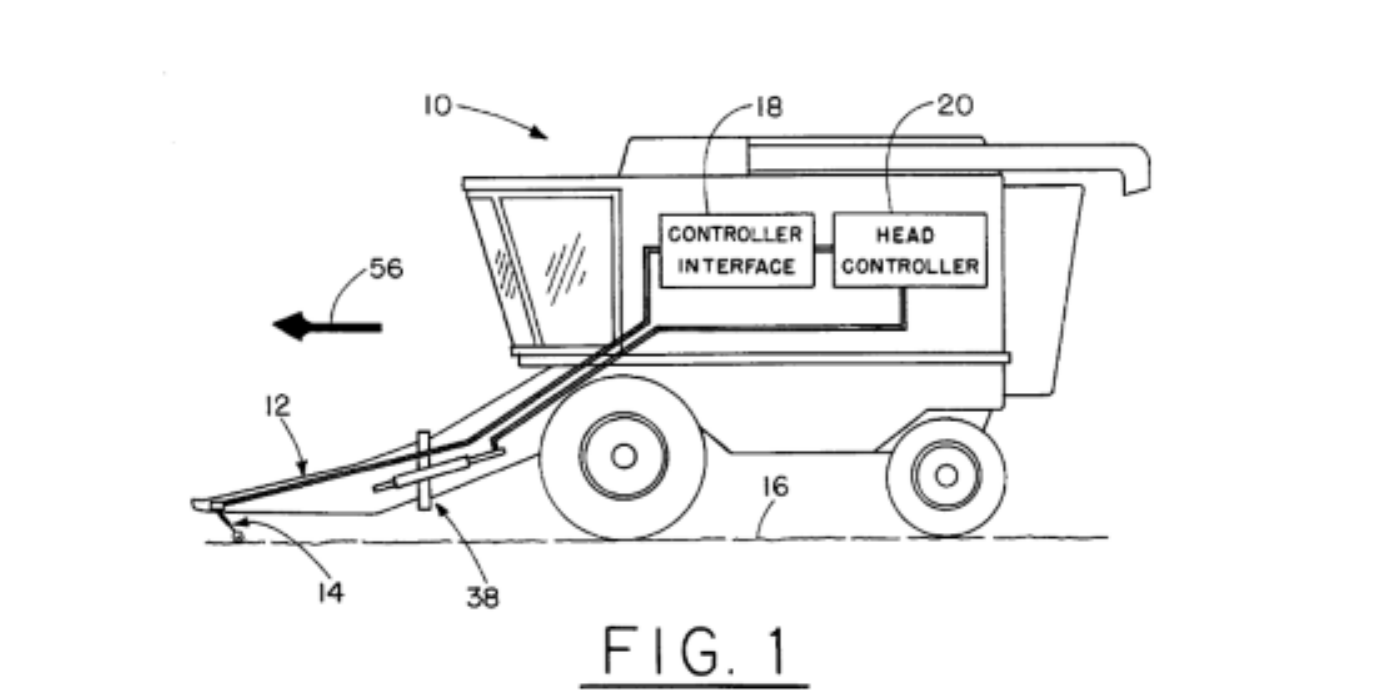
by Dennis Crouch Patent attorneys will recognize the case name Graham v. John Deere Co., 383 U.S. 1 (1966), as the Supreme Court's foundational statement on obviousness under 35 U.S.C. § 103. Sixty years later, a new case with nearly the same name has arrived at the Federal Circuit, though this one is spelled with two m's. Gramm v. Deere & Company, No. 2024-1598 (Fed. Cir. Mar. 11, 2026), involves neither obviousness nor the Graham factors. Instead, it offers an illustration of means-plus-function claiming under § 112(f) and the doctrinal hazards. The Federal Circuit, in a unanimous opinion by Judge Reyna joined by Judges Lourie and Cunningham, reversed the district court's indefiniteness finding and remanded for further proceedings.
The American Intellectual Property Law Association has filed an amicus brief urging the Supreme Court to grant certiorari in United Services Automobile Association v. PNC Bank N.A., No. 25-853 (U.S. filed Mar. 2, 2026). The AIPLA brief does not focus on the particular merits of USAA's mobile check deposit patents. Instead, it frames the case as an opportunity for the Court to correct what the brief calls a historical regression: the Federal Circuit's application of the Alice/Mayo eligibility framework has revived the same subjective "inventive concept" inquiry that the Patent Act of 1952 was specifically designed to eliminate. The brief, filed by Barbara Fiacco and Valerie Orellana of Foley Hoag on behalf of AIPLA, traces this argument through more than a century of patent law, from the commingled eligibility/obviousness/definiteness standards of the 19th century through the 1952 reforms and back to the present "confusion."
USAA's petition presents two questions:
Whether the Federal Circuit has wrongly extended the "abstract idea" prohibition to cover concrete technological processes; and
Whether it has improperly held that computer-implemented inventions are patent-eligible only if they improve the computer's own functionality.
In 2025, the Federal Circuit reversed a $218 million jury verdict for USAA, holding that its claims directed to mobile check deposit using a handheld device were ineligible. The Supreme Court has signaled some interest by issuing a "Response Requested" and PNC's response is now due April 8, 2026, following an extension. See Dennis Crouch, USAA Petitions SCOTUS: Is Mobile Check Deposit Just an "Abstract Idea"?, Patently-O (Jan. 19, 2026).
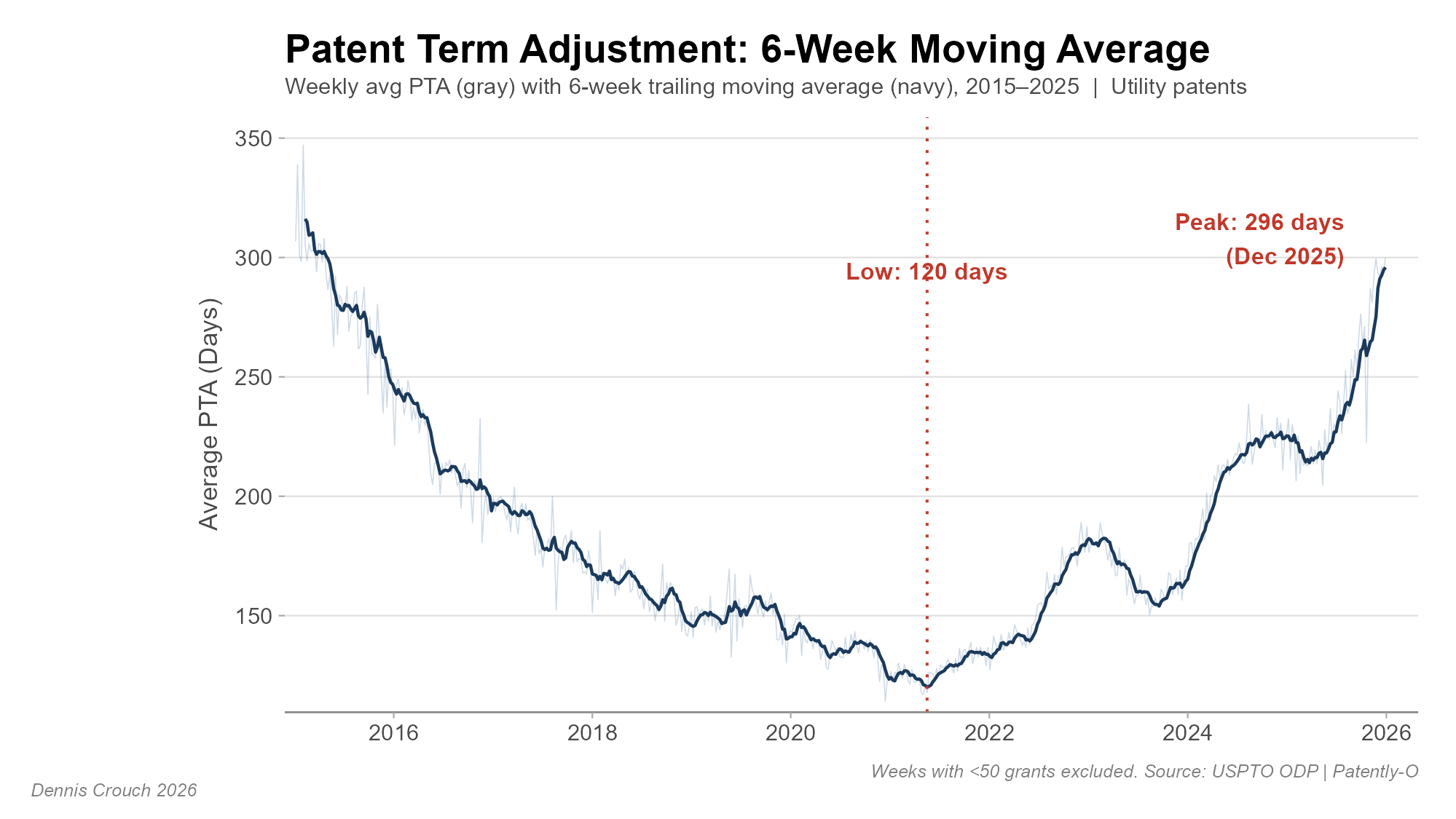
Patent Term Adjustment (PTA) offers one of the most revealing windows into the USPTO's examination backlog. Under 35 U.S.C. § 154(b), the USPTO guarantees certain examination timelines: a first action within 14 months of filing, responses to applicant submissions within four months, and total prosecution wrapped up within three years. When the Office misses these marks, the patent term is extended day-for-day. The result is that average PTA across newly issued patents serves as a rough measure of how well the agency is keeping up with its own workload.
The chart above tracks the average PTA for utility patents issued each week from 2015 into early 2026, smoothed with a six-week moving average. The pattern is striking. In 2015, the average PTA hovered around 320 days, reflecting the agency's long struggle with a massive examination backlog. Over the next six years, the Office steadily ground that number down, reaching a low of approximately 120 days in mid-2021 as part of the COVID slow-down in filing. That progress has now fully reversed. Average PTA climbed back to 296 days by December 2025, approaching the decade-earlier peak. The agency spent years working down the backlog and has now given back nearly all of that progress.
Section 256 of the Patent Act is a remarkable statutory provision. It declares that a patent "shall not be invalidated" on the grounds of incorrect inventorship so long as the error "can be corrected." 35 U.S.C. § 256(a). Unlike its neighboring provisions for correcting other types of patent errors, Section 256 operates retroactively, reaching back to the patent's original filing date. And the statute imposes no express timing requirement: it does not say "if corrected within X days" or "if diligently pursued." The statute simply says "if it can be corrected." In Implicit, LLC v. Sonos, Inc., No. 2020-1173 (Fed. Cir. Mar. 9, 2026), however, the Federal Circuit held that the absence of a statutory deadline does not immunize a patentee from the consequences of delay. Forfeiture principles, the court ruled, can prevent a patent owner from relying on a Section 256 correction to mount a new argument in an inter partes review that it failed to raise during the original proceeding.
The case involved two patents owned by Implicit that originally named Edward Balassanian and Scott Bradley as co-inventors. Both were employees of BeComm Corporation, Implicit's predecessor. A third engineer, Guy Carpenter, had written the source code and authored the document that became the provisional application, but was not a named inventor.
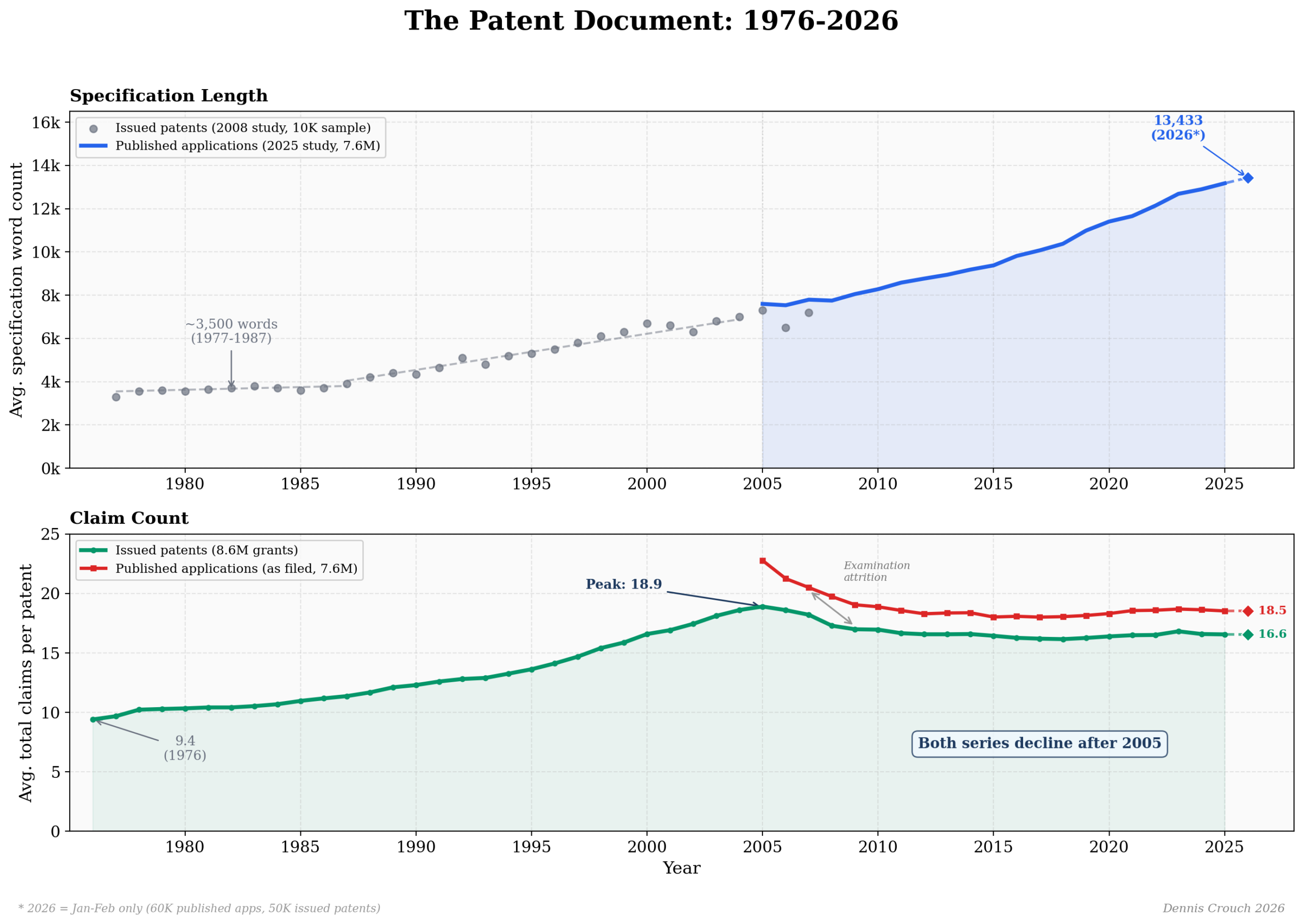
When I set out to update my 2008 study on patent document size, I had a specific hypothesis in mind. The Supreme Court's 2014 decision in Alice Corp. v. CLS Bank International, 573 U.S. 208 (2014), transformed how patent attorneys draft applications, particularly in the software and business method space. Practitioners responded to Alice's tightened eligibility standards by loading their specifications with technical detail, implementation examples, and hardware-integration language designed to demonstrate that an invention is more than an "abstract idea." If Alice changed drafting behavior, I expected to see a structural break in patent document metrics around 2014-2015. I found something different. Patent specifications have indeed gotten dramatically longer over the past twenty years, but the growth curve is smooth and monotonic. It was well underway before Alice was decided. Using the population of 7.6 million published patent applications from 2005 through early 2025, this study finds specifications nearly doubled, from about 7,600 words to over 13,000. But the growth in document length was not matched by growth in claims. Average claim count actually fell, reversing the upward trend I had documented back in 2008.
In 2008, I reported that patent documents were getting bigger in every dimension: longer specifications and more claims. Both trends moved in the same direction. The story was straightforward: patents were growing. The new data is a bit more complicated. Specifications continued their upward march, but claim counts peaked around 2005 and have been declining ever since.
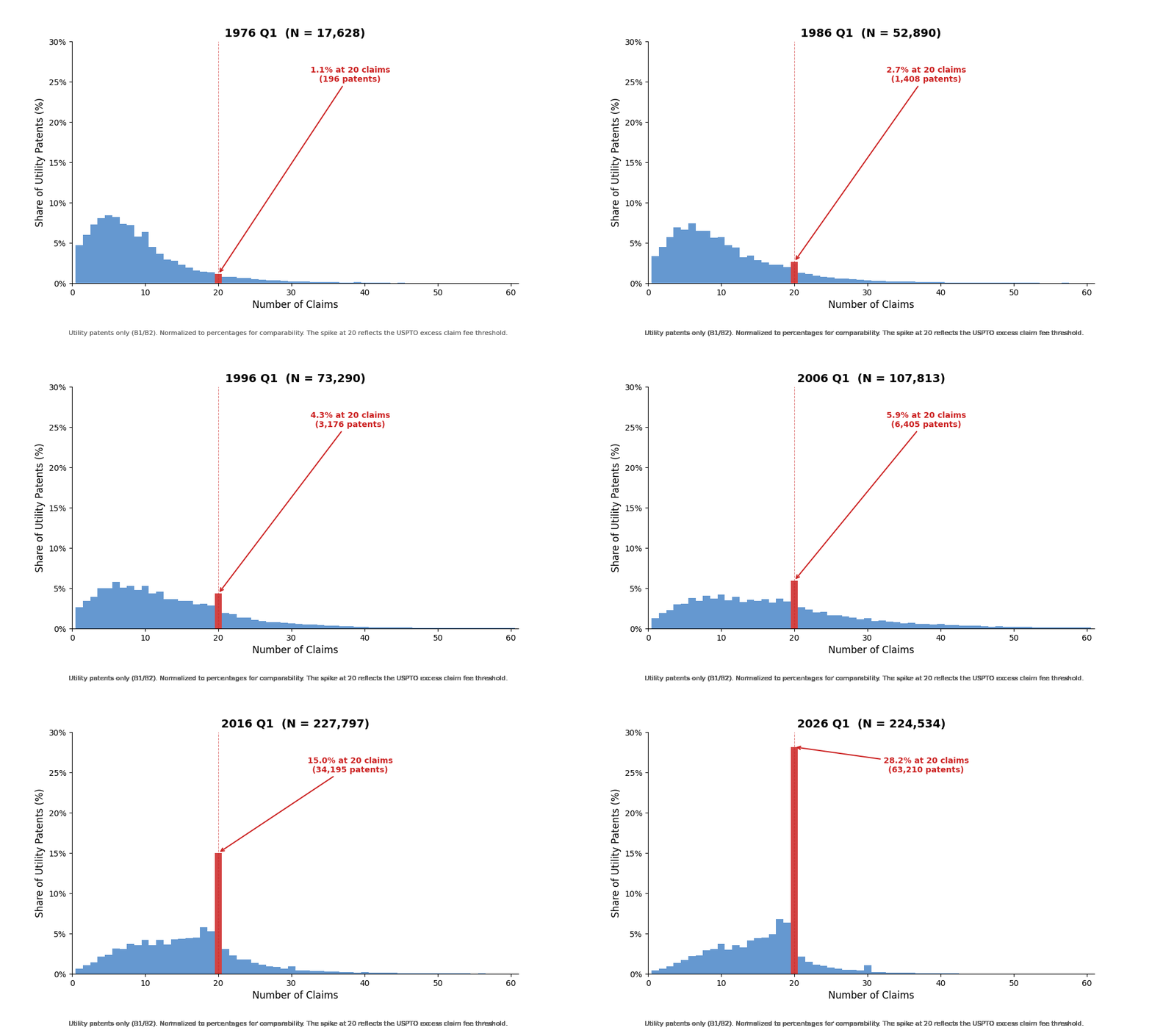
My recent post on the fee-driven collapse of claim count diversity compared 2005 and 2025 snapshots. But the transformation is better seen as a slow-motion process spanning decades. The animated chart below shows the distribution of claims per U.S. utility patent from 1976 through early 2026, quarter by quarter.
 The most striking feature is