- Two new IP Blogs — both from a growing set of solo patent attorneys.
- Effective IP: Longtime Blogger Matt Buchanan has started his own law firm and a new blog.
- Boswell IP: Former Perkins Coie attorney, Mason Boswell started his own firm and accompanying blog focusing on IP law for software & startups.
- Two new patent search & analytic tools:
- Sumo Brain: Full-text cross-collection searching of US & EP patents and applications.
- Espresso(TM): An “emerging technology information search engine.”
- We’ve already discussed PriorSmart.
- Design Patent “Town Hall Meeting” at the Patent Office June 16, 2008. The current debate is primarily over whether auto parts should be protectable under design patent law. Insurance companies and others argue that design patents unduly raise the cost of repair. File Attachment: design_town_hall.pdf (116 KB).
- Design Patent Top Ten: Top Ten Receipients of US Design Patents in 2007.
- Samsung
- Microsoft
- Sony
- Nike
- P&G
- LGE
- Wolverine
- Hon Hai Precision
- Honda
- Matsushita (Panasonic)
- Recent Patent Law Job Postings:
May 2008
USPTO Examiner Guidance on Business “Processes”
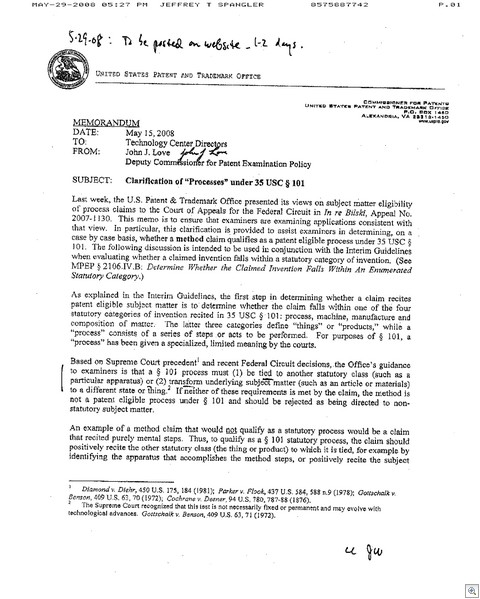
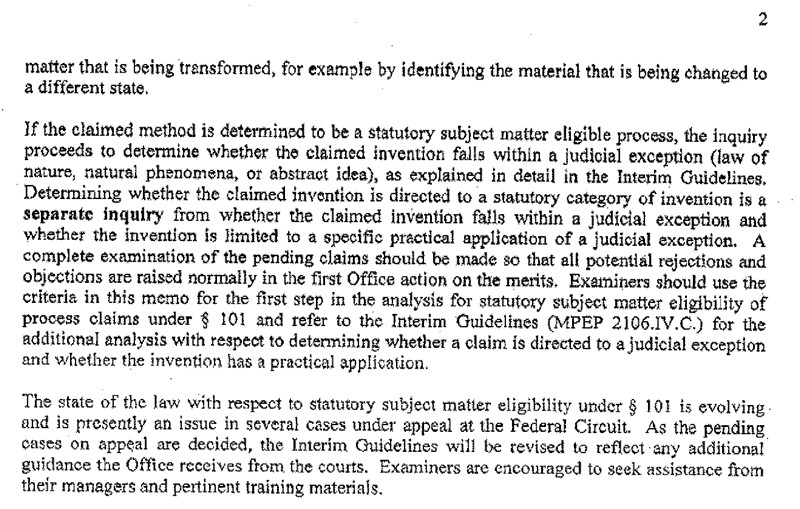
Patent Attorney Jeff Spangler recently attended the PTO’s business method partnership where he received a copy of the written clarification given to examiners to help them determine when a claimed business method is eligible for patent protection as a statutory process under 35 USC 101. According to the memo:
“Based on Supreme Court precedent and recent Federal Circuit decisions, the Offic’s guidance to examiners is that a Section 101 process must (1) be tied to another statutory class (such as a particular apparatus) or (2) transform underlying subject matter (such as an article or material) to adifferent thing. If neither of these requirements is met by the claim, the method is not a patent eligible process under Section 101 and should be rejected as being directed to non-statutory subject matter.
An example of a method claim that would not qualify as a statutory process would be a claim that recited purely mental steps. Thus, to qualify as a Section 101 statutory process, the claim should positively recite the other statutory class (the thing or product) to which it is tied, for example, by identifying the apparatus that accomplishes the method steps, or positively recite the subject matter being transformed, for example by identifying the material that is being changed to a different state.
Patently-O Bits and Bytes No. 37
- Design Patents En Banc: On June 2, the CAFC is hearing the en banc Egyptian Goddess case to consider the proper method for determining infringement of a design patent. That afternoon, the FCBA is hosting a post-argument discussion with a panel including attorneys for the parties as well as as several amicus. Participate either live or via Webex.
- Big Verdict: “Howrey Loses $250 Million IP Verdict in East Texas” [Medtronic wins over Boston Scientific]. This case may well be ongoing for some time through post-trial motions and appeal.
- Malpractice: “Morgan Lewis Faces Malpractice Suit Over Patent Application.” See also Patent Malpractice a Federal Issue.
The Multi-Factor Test for Declaratory Judgment Jurisdiction in Patent Cases
 Cat Tech LLC v. TubeMaster, Inc. (Fed. Cir. 2008)
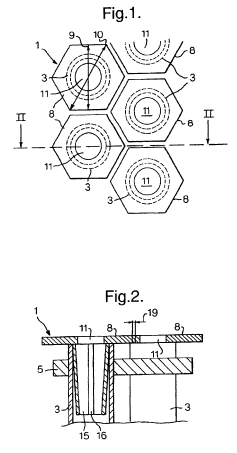
Cat sued TubeMaster — alleging infringement of its patent covering a method of using a catalyst loading devices to simultaneously load thousands of tube reactors. Cat’s infringement allegations were focused on one particular TubeMaster commercial configuration. During the litigation, TubeMaster filed a counterclaim for declaratory relief that its other three configurations did not infringe. On appeal, the CAFC first looked to see whether the district court had proper jurisdiction over the declaratory relief counterclaims.
In MedImmune, the Supreme Court rejected the Federal Circuit’s “rigid” two prong test for DJ jurisdiction that required that the DJ plaintiff (1) have a reasonable apprehension that the patentee will file suit and (2) conduct “meaningful preparation” to conduct potentially infringing activity. The MedImmune decision eliminated the first prong — finding the that the “reasonable apprehension” test excluded at least some actual “cases and controversies” under Article III of the U.S. Constitution.
New Multi-Factor Test for Declaratory Judgment Jurisdiction: In Cat Tech, the Federal Circuit found that the second prong of “meaningful preparation” is still intact — at least as a factor working to determine whether a dispute is immedate and real.
“[T]he issue of whether there has been meaningful preparation to conduct potentially infringing activity remains an important element in the totality of circumstances which must be considered in determining whether a declaratory judgment is appropriate. . . . If a declaratory judgment plaintiff has not taken significant, concrete steps to conduct infringing activity, the dispute is neither ‘immediate’ nor ‘real’ and the requirements for justiciability have not been met.”
From this decision by Judge Mayer, it appears that the new test for DJ jurisdiction has moved from two prongs to a broader “totality of the circumstances” under the umbrella of a “fundamental inquiry” of “whether the facts alleged, under all the circumstances, show that there is a substantial controversy, between parties having adverse legal interests, of sufficient immediacy and reality to warrant the issuance of a declaratory judgment.” (quoting MedImmune). Meaningful preparation toward potential infringing activity is important (but perhaps not a required element) in this fundamental inquiry because actual steps taken toward infringement are indicators of both “immediacy and reality.”
On the facts of this case, the CAFC found “meaningful preparation” toward each product was sufficiently shown by “AutoCAD drawings for each of its four configurations”; successful manufacture of one of the configurations; being ready to deliver products under any configuration “within a normal delivery schedule” after receiving an order; and because the company “does not expect to make substantial modifications to its loading device designs once production begins.”
Finally, although also a factor in the analysis, the fact that TubeMaster had not created any sales literature or begun advertising its alternate configurations did not negate the immediacy and reality of the controversy.
Affirmed.
Federal Circuit Contract Interpretation
 Lawler Mfg. v. Bradley Corp. (Fed. Cir. 2008)(nonprecedential)
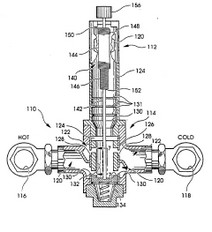
In 2001, Lawler and Bradley settled a patent infringement lawsuit and entered into a contractual license agreement. Bradley was given the right to practice Lawler’s plumbing valve patents in exchange for a 10% royalty. The license included a combination royalty provision. The royalty licensed parts sold in combination would be charged at a separate (likely lower) royalty rate.
The dispute on appeal was whether a set of example combinations included in the contract limited the “combination” royalty rate to only a limited set. The particular contract provision read as follows:
“If a Licensed Unit is invoiced or shipped in combination in another product such as an emergency shower or eyewash, [then the combination rate applies.]”
De Novo Construction: Looking much like a claim construction opinion, the CAFC reviewed the contract language de novo (following Indiana law) and reversed the lower court interpretation. In particular, the court found that the “such as” language of the contract limited the combination royalty to only a limited set of combinations. The CAFC found its interpretation necessary to give meaning to the such as clause. As with Federal Circuit claim construction law, Indiana contract law has a preference for giving meaning and effect to all written terms.
“The question before us is whether that term, read in the context of the agreement, is restrictive, as Lawler urges, or merely explanatory, as the court found. We find that it is restrictive. “Such as” refers to items similar to what are recited rather than indicating that the recited items are just examples of what is covered by that provision. . . . The parties’ inclusion of the “such as” phrase … must either have been intended to provide some guidance as to the limited types of combinations that the parties contemplated … or to provide meaningless surplusage. Indiana law constrains us from finding the latter.”
Reversed and remanded.
In dissent, Judge Mayer saw the “such as” language as merely providing examples in much the same way that embodiments provide example implementations of an invention. “[E]mergency eyewashes and showers are examples of combination products, but they are not the only combination products covered by section 3.1 of the licensing agreement.”
First Sale Doctrine: Copyright & Patent
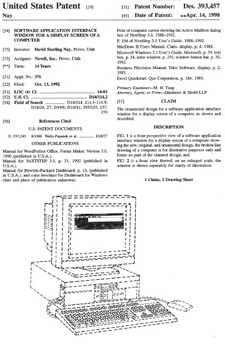 In some ways, the Supreme Court case of Quanta v. LGE is a symbol of the ongoing struggle between property law and contract law. With concepts like the first sale doctrine (and the rule against perpetuities), property law has typically operated to limit dead hand and downstream control over property rights. These limiting doctrines are largely ignored in a freedom of contract regime.
Vernor v. Autodesk (W.D. WA 2008)
A federal copyright case last week landed on the side of property & the first sale doctrine. The court denied summary judgment to Autodesk — finding instead that Vernor may well have a legitimate right to re-sell his copies of AutoCAD. Autodesk argues that he only holds a contractual license to use the software (via shrink-wrap license) and does not actually hold full property interests in the programs.
“[T]he transfer of AutoCAD packages from Autodesk to CTA was a sale with contractual restrictions on use and transfer of the software. Mr. Vernor may thus invoke the first sale doctrine, and his resale of the AutoCAD packages is not a copyright violation.”
In copyright law, the first sale doctrine is codified in statute — allowing the owner of a particular copy to resell that copy even if the owner had contractually agreed not to do so.
“[T]he owner of a particular copy or phonorecord lawfully made under this title … is entitled, without the authority of the copyright owner, to sell or otherwise dispose of the possession of that copy or phonorecord.” 17 USC 109.
In patent law, the first sale doctrine – also known as patent exhaustion – has no statutory support. Rather, like the doctrine of equivalents, patent exhaustion is grounded in common law principles. The Quanta case is fairly technical and could result in a narrow low-impact opinion. However, it is also quite possible that the Supreme Court will re-solidify the property concepts. Expect a decision within the next few weeks.
Notes:
-
Patry and InternetCases have more details on the Autodesk case.
-
More on Quanta v. LGE.
-
Comment on Chain of Title: M. Slonecker: “For the sake of factual accuracy, AutoDesk “sold” the software to CTA. At a later date CTA auctioned off its assets, and Mr. Vernor was the winning bidder for the software program discs. With copies in hand, Mr. Vernor placed the discs he purchased at the auction on sale at eBay. Apparently AutoDesk is not pleased with this state of affairs and has been engaged in a running battle with Mr. Vernor about his eBay activities.”
… and See What Sticks: Claim Construction Appeals

Rattler Tools v. Bilco Tools (Fed. Cir. 2008) (nonprecedential)
Rattler sued Bilco in the Eastern District of Louisiana — alleging that Bilco’s magnetic scrapper (used to clean out oil wells) infringed several patents. After a bench trial, the district court found the patents completely non-infringed. In particular,the district court held that the “accused products and methods did not meet any of the thirteen limitations ofthe ten asserted claims.”
Rattler appealed — asking for a new claim construction for each of those thirteen limitations. Without any detail analysis, the CAFC politely showed Rattler the door. “We have considered all of Rattler’s arguments. Having done so, we see no reason to disturb the careful and thorough post-trial decision of the district court.”
This case is unremarkable in its short analysis, but does serve as a reminder of the current state of patent appeals. The conventional wisdom that the CAFC re-writes a large percentage of claim construction decisions leads most losing parties to appeal on claim construction. At the same time, appellants are also including more claim construction arguments in each appeal.
CAFC: Failing to Submit Invention Inspiration OK; Failing to Submit Product Code of Preferred Input Not OK.
 TALtech v. Esquel Apparel (Fed. Cir. 2008) (nonprecedential)
Summary: (1) An applicant need not disclose its own prior work or inspiration for invention if merely cumulative of other references cited; (2) Failing to identify the brand of adhesive tape used in the invention was a best mode violation — resulting in claim invalidation; (3) There is no presumptive order of the steps in a process claim – unless the claim language “requires an ordering of steps” either implicitly or explicitly.
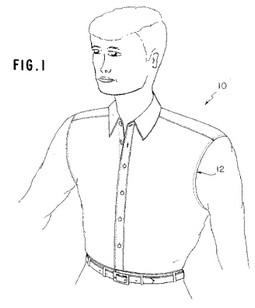
One of TAL’s employees – John Wong – was inspired by TAL’s use of heat-fusible adhesive tape in manufacture raincoats. Over a long process of trial and error, Wong figured out how to use a particular variety of adhesive tape to create a dress shirt that does not pucker after washing.
After receiving a US utility patent, TAL became embroiled an patent litigation with another Hong-Kong based manufacturer – Esquel Apparel. In that litigation, the district court found TAL’s patent unenforceable due to inequitable conduct during prosecution and invalid for failing to submit fulfill the “best mode” requirement of 35 U.S.C. 112 (inter alia). Based on the inequitable conduct, the court also awarded attorney fees to Esquel.
Inequitable Conduct: “In this case, the district court found TAL liable for inequitable conduct because inventor John Wong had not disclosed the raincoat seam that inspired his invention to the PTO.” On appeal, the CAFC first dispelled any notion that a patent applicant is required to disclose the inspiration for the invention. Although not stated by the court, 35 U.S.C. 103(a) arguably indicates that the inspiration is not relevant to the patentability inquiry: “Patentability shall not be negatived by the manner in which the invention was made.”
Here, the CAFC noted that TAL’s raincoat may well have been “merely cumulative” to a German patent application that was submitted during prosecution. “If the undisclosed raincoat seam was merely cumulative to [the German application], then no inequitable conduct lies in its nondisclosure.”
Best Mode: At the time of filing, Wong had settled upon a particular type of adhesive tape – known as Vilene SL33 – as the best way to form the seams. The patent application did not, however, disclose Vilene SL33. A patent may be invalidated for failing to submit a “best mode” if (1) the inventor possessed a best mode at the time of filing; and (2) the written description fails to disclose the best mode in a way to allow one reasonably skilled in the art to practice that mode.
Possession of the Best Mode: The evidence clearly showed that Wong “experimented with many adhesives but settled on a preference for one.” Thus, the court agreed that the first prong was met — the inventor did possess a best mode at the time of filing – i.e., Vilene SL33.On the second prong the CAFC disregarded the applicant’s argument that the PTO “prefers the use of generic names of products” and that there is no evidence that the Vilene brand products are actually better quality than other brands. Instead, the court honed-in on the result of the first prong – that Vilene SL33 was the best mode known to the inventor – and agreed that the best mode had not been disclosed. “TAL has not explained how the written description teaches one having reasonable skill in the art the way to practice the best mode as found in the analysis of the first prong – the use of Vilene SL33.”
Process Order: “Generally, there is no presumption of order, and so a claim with many steps can be infringed by an accused process performing the claimed steps in any order. However, we will find that the claim requires an ordering of steps when the claim language, as a matter of logic or grammar, requires that the steps be performed in the order written, or the specification directly or implicitly requires such a narrow construction.”
In this case, the claimed process implicitly requires a particular ordering. In particular, the bonding adhesive must be presented before a folding step because the folding step requires that the garment abut the bonding element.
Conclusion: The asserted claims were found invalid and not infringed. The remand appears only necessary to determine inequitable conduct and consequently potential attorney fees.
USPTOExaminers.com
According to the website, USPTO Examiners (www.usptoexaminers.com) “is a website designed for professionals to anonymously review, rank, and learn about a patent examiner or a trademark examining attorney who works at the United States Patent and Trademark Office (USPTO).” Law Firms are also reviewed. The site’s motto is “We Examine the Examiners.”
The owners of the site are anonymous. In addition, the comments are anonymous, but pointed. As an example, the following comment was recently published about a particular examiner (named on the site):
“The work I have reviewed from him plainly indicates his incompetence. I have had to appeal every case where he was the examiner. And I got him reversed at the Board every time. I think he falls into some kind of job protected category. That is the only reason I can think of why he has not been fired.”
You can also find positive comments about particular examiners, such as the following:
“I have called Primary Examiner Truong several times regarding my searches. Primary Examiner Truong is helpful and knowledgeable about the topic and the classification system. If you are trying to do a search, I recommend calling Primary Examiner Truong. If Primary Examiner Truong is not available I recommend calling Primary Examiner Mendoza in the same Group Art Unit.”
Although the owners of the site have not revealed their names, I sat down the other day and had a virtual conversation with UE.
|
Patently-O Bits and Bytes No. 36
 [Not a] Patent Race: IPO released its annualy survey of top utility patent assignees. IBM again leads the way with over 3,000 utility patents issued in 2007. The organization leads the report with the interesting statement: “IPO DOES NOT INTEND TO ENCOURAGE MORE PATENTING IN U.S.”. [LINK]
- Tafas v. Dudas: On May 19, the CAFC released its notice of docketing in the case — starting a 60 day clock for the PTO to submit its opening brief. I expect that they will take the entire time.
- Inter Partes Reexaminations: Joff Wild highlights a new report on PTO Inter Partes Reexaminations: “Without appeal, the average pendency period for inter partes re-exam is 43.5 months, much longer than the 28.5 months reported by the USPTO – a 95% confidence interval would put the pendency between 34 and 53 months….To date, there has never been a single inter partes re-examination that has gone through the entire re-examination process (including appeal) and made it to completion. Only three have ever received a decision by the Board of Patent Appeals and Interferences.” [LINK][Report][Zura comments]
- MBHB Snippets: In the past, I have published several practice focused articles in MBHB’s Snippets publication. The newest edition is now online. Articles include:
- Aaron Barkoff, Patent Litigation Under a Future Biosimilars Act
- Kevin Noonan, Follow-on Biologic Drugs and Patent Law: A Potential Disconnect?
- Jim McCarthy & Marcia Ireland Rosenfeld, It’s Not Easy Selling Green
- Benjamin Huber, Seagate: Reports of the Death of Opinions of Counsel Have Been Greatly Exaggerated
- [Read Snippets]
 [Not a] Patent Race: IPO released its annualy survey of top utility patent assignees. IBM again leads the way with over 3,000 utility patents issued in 2007. The organization leads the report with the interesting statement: “IPO DOES NOT INTEND TO ENCOURAGE MORE PATENTING IN U.S.”. [
Theory of Dependent Claims: Survey Results
Patent claims define the scope of an invention much like metes and bounds define real property boundaries or a statute delineates the difference between criminal and non-criminal activity. Often, patent applicants submit a series of claims all directed toward the same invention. Various independent claims allow an applicant to focus on various aspects of the invention. These broad aspects may be directed to various nodes of a larger system or regions of a compound, processes for creating or using various elements, etc. Dependent claims by definition add additional limitations. Thus, for instance disputed claim 1 and 2 from the recent Lovanex dispute reads as follows:
1. A heterogeneous intimate admixture of sulfated heparinic polysaccharides … consisting essentially of
from 9% to 20% of polysaccharide chains having a molecular weight less than 2,000 daltons
from 5% to 20% of polysaccharide chains having a molecular weight greater than 8,000 daltons, and
from 60-86% of polysaccharide chains having a molecular weight of between 2,000 and 8,000 daltons ….2. The heterogeneous polysaccharide admixture as defined by claim 1, comprising less than 2% of dermatan sulfate.
Claim 2 is interpreted to include all the limitations of claim 1 with the additional limitation of “less than 2% of dermatan sulfate.” See 37 CFR 1.71(c).
Earlier this week, I polled Patently-O readers on why they file dependent claims and received just over 1000 responses. (Listed below).
| Theory of Dependent Claims | ||||||
| Why do you file dependent claims? | ||||||
| Percent of Responses | ||||||
| Answer Options | Strongly Agree | Mostly Agree | Neither Agree nor Disagree | Mostly Disagree | Strongly Disagree | Rating Average |
| Dependent claims are backup in case the independent claim is rejected in prosecution. | 59% | 34% | 4% | 2% | 0% | 1.51 |
| Dependent claims are backup in case the independent claim is found invalid in litigation. | 59% | 31% | 6% | 3% | 1% | 1.56 |
| Claim Differentiation: The dependent claims expand or alter scope of other claims. | 47% | 37% | 8% | 6% | 3% | 1.82 |
| Dependent claims focus on particular commercial embodiments to make infringement easier to explain to a jury. | 29% | 44% | 21% | 4% | 2% | 2.07 |
| I primarily include dependent claims with nonobvious additional limitations. | 19% | 45% | 25% | 9% | 1% | 2.29 |
| I was taught to draft dependent claims. | 26% | 34% | 26% | 8% | 7% | 2.35 |
| USPTO fees: Patent office does not charge extra for first twenty-claims. | 26% | 34% | 24% | 9% | 7% | 2.36 |
| Dependent structure better supports foreign filing. | 7% | 19% | 58% | 11% | 3% | 2.84 |
| Dependent claims are easier to draft and manage than independent claims. | 6% | 23% | 37% | 23% | 11% | 3.08 |
| Client demands a certain number of claims. | 6% | 16% | 29% | 25% | 23% | 3.42 |
| Dependent claims help avoid restriction requirements. | 2% | 13% | 39% | 31% | 15% | 3.44 |
| A longer application is more valuable. | 2% | 13% | 29% | 34% | 22% | 3.60 |
| answered question | 1029 | |||||
| skipped question | 0 | |||||
Responses were also allowed to add additional reasons in the comment section. I have compiled a few of those individual responses below.
- Drafting Process: A few responses commented on the iterative process of drafting a patent. For some, drafting the dependent claims helps refocus and redefine potentially problematic terms from the independent claims. For many, the dependent claims also serve as a guide for fully drafting the specification.
- Prosecution Process: Some responses proposed that the dependent claims are helpful during prosecution for several reasons. First, there is a perception amongst patent practitioners that examiners read and consider the claim-set before looking at the actual specification. For that reason, the claims should be considered as a way to teach the examiner about the features and purpose of the invention. For some, obvious limitations in a dependent claim are useful in that regard to show the examiner an intended use (practical embodiment) of the invention. For those who see patent prosecution as a negotiation, a series of narrowing dependent claims speed up the the process — the applicant and examiner need only agree upon how narrow the claims need be. Some propose at least some dependent claims being “super narrow” to serve as a “foot in the door” to increase the likelihood that there is at least some patentable subject matter. Once you have agreed that a patent will issue, it may be easier to debate the scope of the eventual claims. On a practical note, the existence of dependent claims means that an applicant can get to a post-final rejection allowance without filing a request for continued examination. These practical concerns are important considering that the vast majority of patent applicants amend their claims during prosecution.
- Claim Differentiation: Most practitioners agreed that the claim differentiation benefit of dependent claims is important. The doctrine encourages courts to consider that each claimed element covers something different than the others. Pushing that line, a typical reasoning is that two or more dependent claims providing alternative implementations of a term from an independent claim will help ensure that the independent claim element is not limited to a single embodiment. Some folks quibbled with my statements regarding dependent claims “expanding scope” of other claims and instead used a more PC version of “aiding construction.” It is important to realize that the originally filed dependent claims also form part of the specification and can thus help overcome enablement and written description hurdles.
- Appeasing Clients: Many inventors see their invention narrowly — as their particular embodiment. Dependent claims provide an easy way to satisfy the inventor’s desire to claim their invention without limiting legal rights. On this “politics” side — dependent claims also give reason to add joint inventors, which may be good for office politics. “An invention may only warrant one independent claim embodiment, but many clients like to see many claims. They believe the more claims they have the stronger the patent and that they are getting value for there money.So you add them, e.g., a blue widget, a red widget. It is like chicken soup for a cold, it can’t hurt.”
- Ease of Analysis: “Filing dependent claims rather than only independent claims makes it much easier for several parties (attorneys prosecuting the application, examiners and the BPAI examining the patent, attorneys analyzing the issued patent, courts analyzing the issued patent) to more readily evaluate the differences and similarities of claims.” Others noted that it is also useful as a way for potential licensees to know that the proposed product is literally and explicitly covered. For some patent owners, this “ease of analysis” is actually a negative. (Try to read NTP’s $600,000,000 claims). A long claim-set makes it more likely that a potential defendant will easily cave rather than pursue an expensive invalidity / noninfringement study.
- Capture “minor inventions”: Dependent claims allow an applicant “to capture improvements to the invention that are not important enough to justify a separate application, but that one would want to avoid having a competitor step in and patent something similar.”
- Tradition: There is nothing wrong with tradition and custom. It helps ensure that we’re all on the same page. For many the 3/17 rule of independent/dependent claims serves as a default rule that can be adapted for unique circumstances.
- International: Internationally, patents use fewer independent claims than in the US. One European attorney made the following comment: “Multiple independent claims in the US style cause major headaches and costs in Europe, so one good independent, with well gradated dependents, is the best solution for me.”
- I will attach the full comments once reformatted.
New Counsel On Appeal Does Not Overcome Waiver of Novelty Argument
 Golden Bridge Tech. v. Nokia and Lucent Tech. (Fed. Cir. 2008)
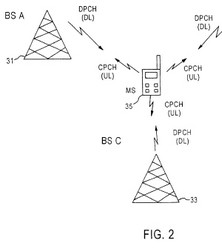
Golden Bridge’s patent covers a CDMA mobile communication scheme that gradually ramps-up the communication power signal in order to avoid interference with other mobile phones. On summary Judgment, the E.D.Texas court held that Golden Bridge’s patent CDMA mobile communication scheme asserted claims were anticipated by the prior art.
Anticipation is a question of fact normally decided by a jury. However, it may be amenable to summary judgment “if the record reveals no genuine dispute of material fact.”
Waiver of Novelty Argument: On appeal, Golden Bridge argued that the prior art does not disclose a claimed synchronization element. That factual contention, however, was only first presented on appeal. Finding that Golden Bridge had ample opportunity to raise the contention at the district court level, the CAFC found that any appeal on the synchronization issue had been waived.
“There is no reason why Golden Bridge could not have raised the issue of whether the synchronization limitation was disclosed in the Häkkinen [prior art] reference during the summary judgment proceedings either before the magistrate judge or before the district court judge. . . Golden Bridge cannot simply choose to make its arguments in iterative fashion, raising a new one on appeal after losing on its other at the district court. This is an appellate court and as such we abide by the general rule that new arguments will not be decided in the first instance on appeal.
New Counsel: Golden Bridge argued that it should be given another opportunity to raise the issue because it had hired new counsel on appeal. The appellate panel quickly rejected that argument — holding that “[n]ew appellate counsel does not present an exceptional case or circumstance in which our declining review will result in injustice. To hold otherwise would open the door to every litigant who is unsuccessful at the district court to simply hire new counsel and then argue he should get to raise new issues on appeal.”
Not Fact Finders: Although not directed at any particular colleagues, Judge Moore’s opinion here strongly re-states the the limited role of the Federal Circuit as an appellate panel: “Appellate courts review district court judgments; we do not find facts. Middleton v. Dep’t of Def., 185 F.3d 1374, 1383 (Fed. Cir. 1999) (‘[A]s an appellate court, we may not find facts . . . .’).”
Notes:
- Based on a request by Nokia, the patent is concurrently under reexamination at the USPTO.
Anti-TrafFix: Design Patent Provides Evidence of Non-Functionality in Trade Dress Claim
 In TrafFix Devices v. Mktg. Displays, the Supreme Court held that the existence of an expired utility patent covering a particular product design provides strong evidence that the design is “functional.”* Consequently, a party would be had-pressed to claim non-functional trade dress protection for the previously patented design. In Keystone Mfg. v. Jaccard Corp., the W.D.N.Y. federal court explored how trade dress protection is impacted by an expired design patent.
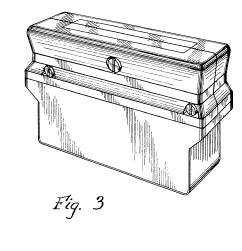
Expired Design Patent: Jaccard’s hand held meat tenderizer is covered by its U.S. Design Patent No. D 276,685. The design patent expired in 1998 – seemingly leaving an open avenue for direct copycat competition. As part of a larger lawsuit, however, Jaccard asserted trade dress rights over its product.
Functionality: Jaccard argues that design patents should be treated as the mirror image of utility patents in a functionality analysis: If a utility patent creates strong proof of functionality, a design patent should provide presumptive evidence of non-functionality.
The district court rejected the suggestion that the design patent creates a presumption of non-functionality. Instead, the court held that the design patent simply serves as another piece of evidence to be used by the jury in determining non-functionality. This conclusion comports with McCarthy on Trademarks:
“A design patent, rather than detracting from a claim of non-functional trade dress or trademark, may support such a claim . . . [W]hile a design patent is some evidence of non-functionality, alone it is not sufficient without other evidence.”
Curiously absent from this decision is any analysis of the populist notion that expiration of a patent transfers to the public a right to copy and use the patented elements.
- * Although there are various definitions of functionality, in trade dress law the term generally refers to whether the element is essential for the product’s use or affects the cost/quality of the product. Only non-functional designs are protectable as trade dress.
- Keystone Mfg. v. Jaccard Corp., 2007 U.S. Dist. LEXIS 13094 (W.D.N.Y. Feb 26, 2007).
- There are several cases in conflict with Keystone Mfg on this point. Fuji Kogyo Co., Ltd. v. Pac. Bay Int’l, Inc., 461 F.3d 675 (6th Cir. 2006) (noting that a design patent serves as presumptive evidence of non-functionality).
Federal Circuit Jurisdiction Extends to Non-Patent Portion of Consolidated Case
Cytologix Corp. v. Ventana Medical Systems (1st Cir. 2008).
CytoLogic filed two separate lawsuits against Ventana — alleging (1) patent infringement and (2) antitrust violations. Both cases were managed by the same judge who held two trials. In a post trial order, the court stated that the cases had been informally consolidated and ordered that they be consolidated “nunc pro tunc.” CytoLogix appealed to the First Circuit (and also to the Federal Circuit).
The Court of Appeals for the Federal Circuit has exclusive jurisdiction over all appeals arising under the federal patent laws. Here, the antitrust action did not arise under the patent laws. However, the First Circuit held that upon consolidation, jurisdiction for the case as a whole was at least partially based on the patent laws — thus providing the Federal Circuit with exclusive jurisdiction over the appeal.
Appeal dismissed.
- Note: The parties have subsequently settled.
- Cite: 513 F.3d 271.
A Theory of Dependent Claims
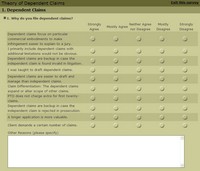
I am working on a post involving dependent claims and would like some thoughts from practitioners on why you file. The one-minute survey is anonymous.
Click on the survey — Preliminary results will be posted on Thursday, May 22.
Patently-O Bits and Bytes No. 35: Politics
- Senator Clinton on Patent Reform: Rough Quote ~ “I oppose anything in the bill that would hurt manufacturers.” [LINK]
- More Politics: Kevin Noonan Says “Bush Administration Continues Attempt to Destroy U.S. Patent System.”
- Chinese Generics: Via Pharmalot.
- Chinese Patents: More than 700,000 patent applications last year. Peter Zura says “Protection of design patents continues to be an untapped resource for foreign filers – the U.S. and other foreign entities make up about 5% of the 270,000 Chinese design patent applications.” (NOTE: The 700,000 includes 270,000 design patent applications and 180,000 utility model applications). Read the SIPO (State IP Office of PRC) Stats. (Thanks to Hal Wegner for the tip).
- IPEG: New website for the European patent blog IPEG. http://www.ipeg.eu/blog/.
- NEW Patent Law Jobs:
- Patent Attorney – Law Firm – Springfield, Mass.
- Patent Attorney – Affinergy – Research Triangle North Carolina
- Patent Associate – Law Firm – Seattle, Wash.
- Patent Agent/IP Technical Specialist – Law Firm – Irvine, Calif.
- Patent Attorney – Law Firm – Silicon Valley, Calif.
- Patent Agent – Large Corporation – Dublin, Calif.
- Patent Counsel – Johns Hopkins University – Baltimore, Md.
- Patent Agent/IP Technical Specialist – Law Firm – Irvine, Calif.
- Business Method Patent Attorney/Student – Remote
- Patent Attorney – Law Firm – Austin, Texas
Inequitable Conduct: Failure to Submit Full Experimental Details
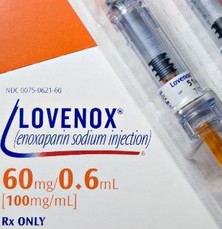 Aventis v. Amphastar Pharmaceuticals and Teva (Fed. Cir. 2008)
Summary: The CAFC affirmed a ruling that the Lovenox patents – owned by Aventis – are unenforceable due to a failure to submit important experimental information during prosecution. In dissent, Judge Rader could not find clear and convincing evidence of intent to deceive the PTO.
Inequitable Conduct: The Aventis patents are directed toward a heparin based drug used to help prevent blood clots. The specification includes a particular set of experimental examples that show an increased half-life of the claimed admixture. During prosecution, the applicant used those examples along with additional data to prove that its drug was inherently different from a prior art drug.
Aventis did not report to the PTO that its experiments showing an increased half-life of the claimed admixture used a different dosage than those testing the prior art drug. In a non-precedential 2006 opinion, the CAFC found the withheld information was material to prosecution — especially because Aventis argued that the benefit of the longer half-life was a potentially lower dosage. [non-prec decision].
By itself, a material omission does not render a patent unenforceable. Rather, a defendant must also show that the patentee acted with intent to deceive the patent office. The district court found intent through circumstantial evidence, and the CAFC affirmed after failing to find any clear error in the way that the district court interpreted the facts.
Dissent: In a strongly worded dissent, Judge Rader argued that inequitable conduct should only be found in “extreme cases of fraud and deception.” In particular, Judge Rader has seen that the intent requirement has lost its import as the court increasingly allows intent to be inferred from loose circumstantial evidence.
“More recently, however, the judicial process has too often emphasized materiality almost to the exclusion of any analysis of the lofty intent requirement for inequitable conduct. Merging intent and materiality at levels far below the Kingsdown rule has revived the inequitable conduct tactic.”
Here, Judge Rader argues that there is also compelling evidence that Aventis did not intend to deceive the patent examiner. For instance, Judge Rader noted that that Aventis actually “submitted all of the underlying data to the patent office with [its] second declaration on June 9, 1994.” Furthermore, focusing on the Aventis scientist who submitted the half-life studies, Judge Rader noted that his stellar reputation should also sway the court:
“I find it difficult to fathom that a scientist of Dr. Uzan’s caliber and reputation would engage in such deception. As the district court points out, Dr. Uzan has had a magnificent fifty year career with Aventis, has published over 350 scientific articles and has received numerous prestigious awards including the Galien Research Prize, France’s highest award for drug discovery. This world-class scientist would hardly risk his reputation and tarnish his brilliant career for a single example in the prosecution of a patent for an invention in which he was not even involved.”.
Result: The direct narrow result of this case is that patent applicants should clearly state experimental differences when comparing a claimed compound or method with the prior art. More broadly, this decision creates yet another reason for applicants to favor short & clean prosecution. It also emphasizes the importance of using a patent attorney or agent that truly understands the science behind each submission.
Federal Circuit: State of the Court
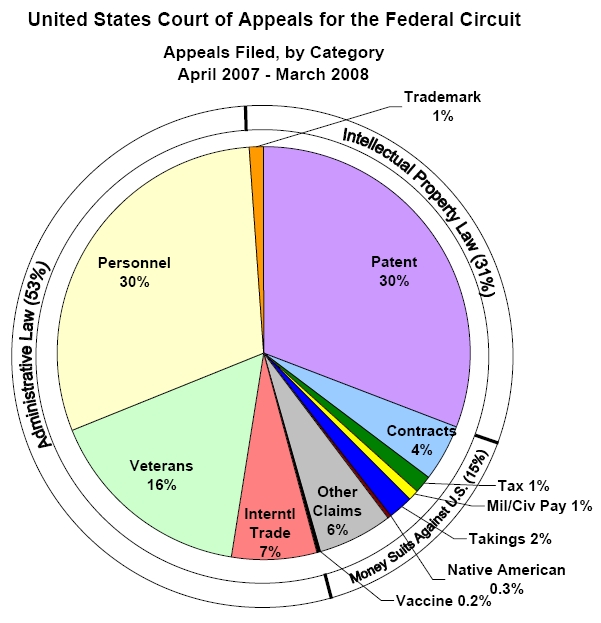
On May 15, 2008, Federal Circuit Chief Judge Michel presented his “State of the Court” address at the well attended Federal Circuit Judicial Conference. As usual with the Chief Judge, his remarks were upbeat but unsatisfied. Several particular issues were emphasized:
- Aging of the CAFC Judges: Within two years, eight of the twelve regular active CAFC judges will be eligible for senior status.
- Settlements: About half of all CAFC appeals settle prior to decision.
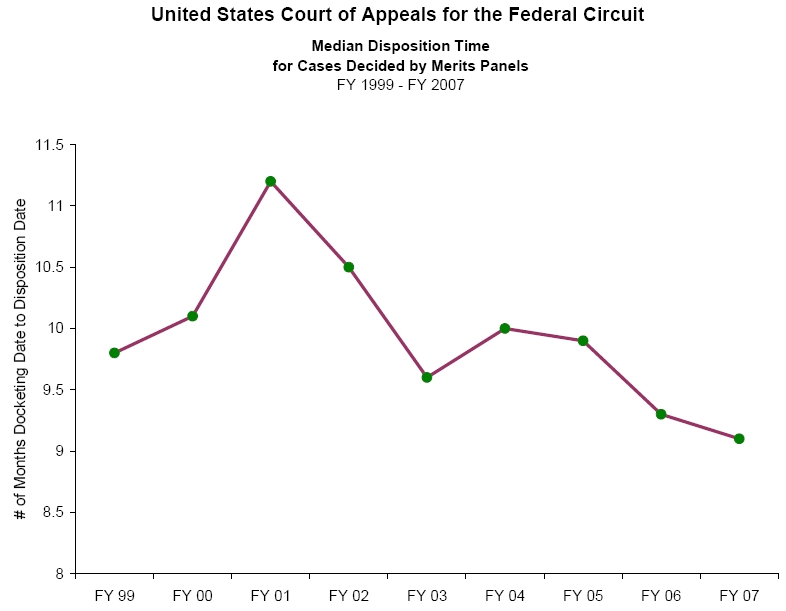
- Speeding Up: “Expedition is a top priority.” Median time from docketing to disposition was nine-months for FY07. The current inventory of cases is now just over six months.
- More Clerks: Judge Michel has requested a fourth law clerk for each judge to keep up with the complexity of the appeals.
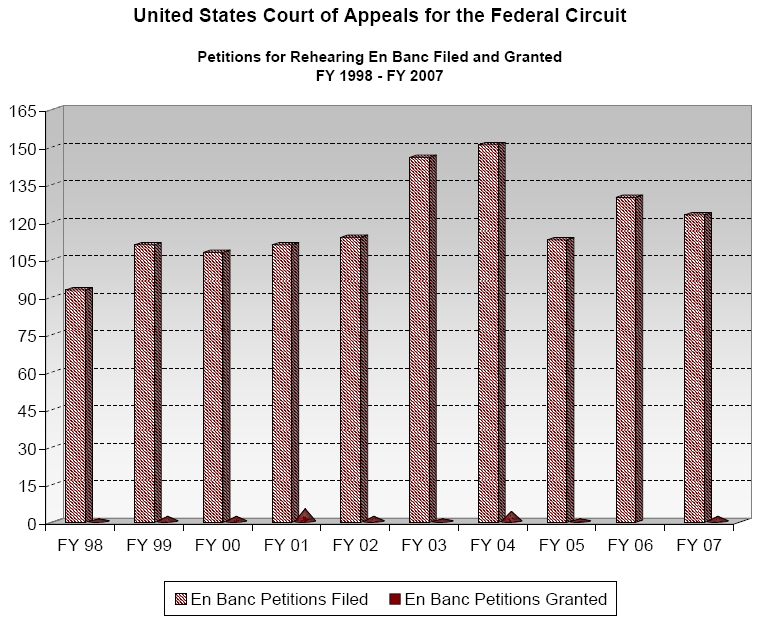
- En Banc and Supreme Court Review: Continue to be exceedingly rare. “Despite news reports of a surge in the last three years in the Supreme Court review of our patent cases, the data shows little change. I believe these data illustrate how well our panels do in nearly all appeals. We can all be proud of the work of the Federal Circuit.”
- Read the remarks. Judge Michel’s charts are reproduced below. (Click to expand).



Phillips Claim Construction: Changed Methodology but Unchanged Results
 Mangosoft v. Oracle (Fed. Cir. 2008)
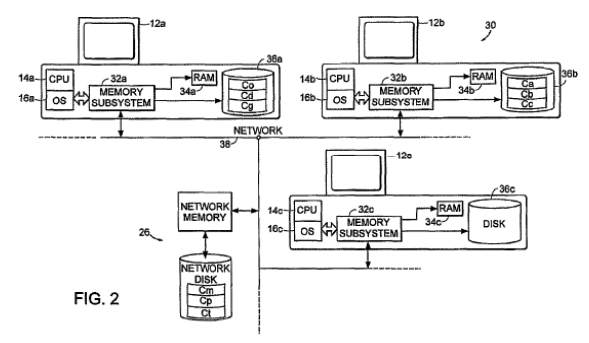
Mangosoft’s patent covers a networked virtual memory system. The virtual memory is formed by pooling storage capacity on the local networked computers (nodes) rather than relying on a primary server. Oracle’s Real Application Clusters do something similar – but use a cluster of memory devices (akin to a RAID).
The appeal focuses on the definition of a “local” storage device. The CAFC agreed with the district court that the “local” limitation requires that the storage device be individually linked to a computer to form a network node.
Here, the district court had relied on a technical dictionary for its definition (in a pre-Phillips opinion). On appeal the CAFC again affirmed that dictionaries are still useful in claim construction. More particular to this case, however, the court found that virtually any system of claim construction would reject the patentee’s proposed broad construction.
“Having found support for the district court’s claim construction in the claim language, the specification, and the prosecution history …, we note that this construction is also consistent with the technical dictionary definition proffered by Oracle.”
Summary judgment of non-infringement is affirmed.
This case could be seen to emphasize the point that for the majority of claim construction decisions, Phillips altered the methodology but not the ultimate result.
Notes:
- Mangosoft had originally sought $500 million in damages from Oracle.
CAFC Gives Patentee Leeway in Claiming Priority and Correcting PTO Mistakes
 E.I. du Pont v. MacDermid Printing (Fed. Cir. 2008).
Rapid Appeal: The first thing that is surprising about this opinion is the quick decision pace. The N.J. district court denied DuPont’s preliminary injunction on August 13, 2007. The CAFC heard oral arguments on April 9, 2008 and then issued its precedential opinion on May 14, 2008. The decision time is well under half of the average in-process time for precedential CAFC opinions. Knowing that, it is not surprising that the opinion was written by Chief Judge Paul Michel and included CIT Judge Pogue sitting by designation. One of Judge Michel’s top priorities as Chief is to speed the appeal process and help avoid serious detriment caused by delay.
Summary: The CAFC vacated a lower court’s denial of preliminary relief — finding that the lower court had improperly refused to recognize DuPont’s patent priority claim to an earlier provisional application.
Claiming Priority: DuPont first filed a provisional application; followed eleven months later by a non-provisional utility application claiming priority using non-standard language. (“This application is a non-provisional of provisional 60/273669 2001-03-06 WHICH IS PENDING.”) The issued patent did not reference the original provisional until after DuPont obtained a certificate of correction. To complicate the matter, DuPont’s litigation counsel originally made “incorrect statements as to the priority date” — apparently forgetting the legal effect of a provisional application.
35 U.S.C. § 119(e)(1) provides four requirements to claim priority to a provisional application:
- The provisional must adequately disclose the claimed invention;
- The non-provisional must be filed within 12–months of the provisional;
- Inventorship must overlap; and
- The non-provisional must include a specific reference to the provisional.
 Overlapping Inventorship: The specification of the provisional and non-provisional were identical. However, the provisional named only one inventor while the non-provisional named five. The defendant here argued that the provisional application should have been amended to properly identify the five inventors. On appeal, the CAFC rejected that argument in two steps: First, the appellate panel held that – as a matter of law – inventorship overlaps when both applications include at least one common inventor. Second, the panel re-affirmed that correction of inventorship for a provisional application is only necessary to establish an overlap of inventorship. See MPEP § 201.03.
Specific Reference to the Original: DuPont used non-standard language in the non-provisional application data sheet (ADS) to claim priority to the provisional. On appeal, the CAFC held that there are no “magic words” required by MPEP § 201.11. Rather, the standard is whether a “reasonable person reading the language … would have concluded that the applicant was claiming priority to an earlier provisional application.” There is no question here that the language used by DuPont conveys the proper message.
Notice of PTO Error: The prosecution history included evidence that the PTO did not originally recognize DuPont’s priority claim. MacDermid argues that once an applicant is on notice of a PTO error — it should be required to ensure that the error is corrected before the application issues. In essence, MacDermid argues that the error in failing to reference the provisional in the originally issued application was DuPont’s error because the company was on notice of the PTO mistakes. On appeal, the CAFC rejected the notion that an applicant’s failure to diligently prosecute converts a PTO error into an applicant error.
“We hold that a lack of diligence during prosecution, at least under the facts of this case, does not convert a PTO error into an applicant error for the purpose of seeking a post-issuance certificate of correction. . . . It is, of course, desirable to have applicants correct the PTO’s mistakes in pending applications as soon as possible so that the correct information is reflected in published applications and issued patents. Nevertheless, nothing in the statute conditions eligibility for a certificate to correct PTO error on the applicant’s diligence in correcting the mistake, and the statute does not set any time limit for seeking such corrections.”
Vacated and Remanded